




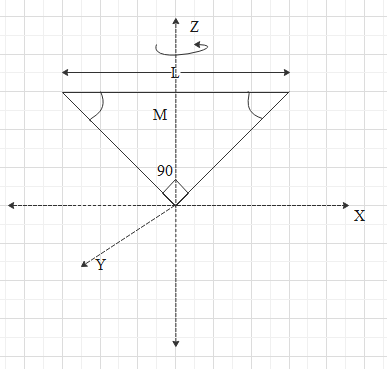
The moment of inertia of the plate about Z-axis is
(A) \[\dfrac{M{{L}^{2}}}{12}\]
(B) \[\dfrac{M{{L}^{2}}}{24}\]
(C) \[\dfrac{M{{L}^{2}}}{6}\]
(D) none of these
Answer
 Verified
590.7k+ views
Hint: The moment of inertia of the plate around the Z-axis is not directly defined but the integration of the very small moment of inertia of small strips around the Z-axis will give the total moment of inertia. The triangle plate is isosceles so the height can be found by length \[L\]and the mass across the small strip can be found by area of the triangle.
Formula used:
Moment of inertia of rod: \[I=\dfrac{M{{L}^{2}}}{12}\]
And parallel axis theorem: \[I'=I+M{{R}^{2}}\]
Complete answer:
Moment of inertia of a given isosceles triangle can be determined by small stripes of the plate parallel to the X-axis shown in the figure below.
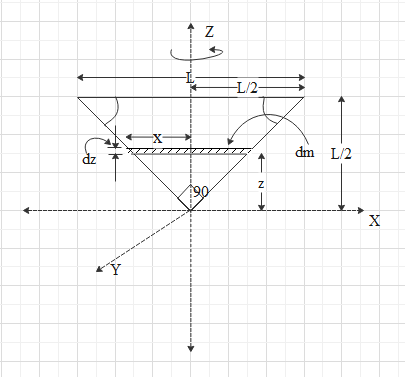
Assume a very small strip at distance \[z\] from the origin. Here the length of the strip will be considered as\[x\], the mass of the strip is \[dm\] and the width of it is \[dz\].
The mass of the strip can be found by area of the triangle,
\[\begin{align}
& \text{mass of triangle }\to \text{ }area\text{ of triangle} \\
& dm\text{ }\to \text{ ?} \\
\end{align}\]
\[dm=\dfrac{4M}{{{L}^{2}}}(2xdz)\]
Now the moment of inertia of rod about its centre is \[I=\dfrac{M{{L}^{2}}}{12}\]
\[\therefore dI=\dfrac{dm{{(2x)}^{2}}}{12}+dm{{z}^{2}}\]
\[\therefore dI=\dfrac{{{(2x)}^{2}}}{12}\dfrac{4M}{{{L}^{2}}}(2xdz)+\dfrac{4M}{{{L}^{2}}}(2xdz){{z}^{2}}\]
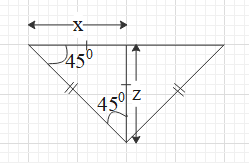
But the triangle is isosceles \[\therefore x=z\] because,
\[\therefore dI=\dfrac{{{(2z)}^{2}}}{12}\dfrac{4M}{{{L}^{2}}}(2zdz)+\dfrac{4M}{{{L}^{2}}}(2zdz){{z}^{2}}\]
\[\therefore dI=\dfrac{32}{3}\dfrac{M}{{{L}^{2}}}({{z}^{3}}dz)\]
Integrating both the side,
\[\therefore \int{dI}=\dfrac{32}{3}\dfrac{M}{{{L}^{2}}}\int\limits_{0}^{{L}/{2}\;}{{{z}^{3}}dz}\]
\[\therefore I=\dfrac{M{{L}^{2}}}{6}\]
So, the correct answer is “Option C”.
Additional Information:
Moment of inertia is the measurement of the rotational inertia of a body. The opposition of the angular speed is a moment of inertia. Here the plate rotating about the Z-axis so the opposition in rotation is called moment of inertia if this triangle plate.
Note:
Direct moment of inertia of the triangle is not defined early but it should be calculated by the small help of calculus. The moment of inertia of the plate is the integral of a small component perpendicular to its rotation either parallel to X-axis or Y-axis. And the mass of that small component depends on the distribution of mass per unit area of the plate homogeneously.
Formula used:
Moment of inertia of rod: \[I=\dfrac{M{{L}^{2}}}{12}\]
And parallel axis theorem: \[I'=I+M{{R}^{2}}\]
Complete answer:
Moment of inertia of a given isosceles triangle can be determined by small stripes of the plate parallel to the X-axis shown in the figure below.
Assume a very small strip at distance \[z\] from the origin. Here the length of the strip will be considered as\[x\], the mass of the strip is \[dm\] and the width of it is \[dz\].
The mass of the strip can be found by area of the triangle,
\[\begin{align}
& \text{mass of triangle }\to \text{ }area\text{ of triangle} \\
& dm\text{ }\to \text{ ?} \\
\end{align}\]
\[dm=\dfrac{4M}{{{L}^{2}}}(2xdz)\]
Now the moment of inertia of rod about its centre is \[I=\dfrac{M{{L}^{2}}}{12}\]
\[\therefore dI=\dfrac{dm{{(2x)}^{2}}}{12}+dm{{z}^{2}}\]
\[\therefore dI=\dfrac{{{(2x)}^{2}}}{12}\dfrac{4M}{{{L}^{2}}}(2xdz)+\dfrac{4M}{{{L}^{2}}}(2xdz){{z}^{2}}\]
But the triangle is isosceles \[\therefore x=z\] because,
\[\therefore dI=\dfrac{{{(2z)}^{2}}}{12}\dfrac{4M}{{{L}^{2}}}(2zdz)+\dfrac{4M}{{{L}^{2}}}(2zdz){{z}^{2}}\]
\[\therefore dI=\dfrac{32}{3}\dfrac{M}{{{L}^{2}}}({{z}^{3}}dz)\]
Integrating both the side,
\[\therefore \int{dI}=\dfrac{32}{3}\dfrac{M}{{{L}^{2}}}\int\limits_{0}^{{L}/{2}\;}{{{z}^{3}}dz}\]
\[\therefore I=\dfrac{M{{L}^{2}}}{6}\]
So, the correct answer is “Option C”.
Additional Information:
Moment of inertia is the measurement of the rotational inertia of a body. The opposition of the angular speed is a moment of inertia. Here the plate rotating about the Z-axis so the opposition in rotation is called moment of inertia if this triangle plate.
Note:
Direct moment of inertia of the triangle is not defined early but it should be calculated by the small help of calculus. The moment of inertia of the plate is the integral of a small component perpendicular to its rotation either parallel to X-axis or Y-axis. And the mass of that small component depends on the distribution of mass per unit area of the plate homogeneously.
Recently Updated Pages
Master Class 11 Computer Science: Engaging Questions & Answers for Success

Master Class 11 Business Studies: Engaging Questions & Answers for Success
Master Class 11 Economics: Engaging Questions & Answers for Success
Master Class 11 English: Engaging Questions & Answers for Success
Master Class 11 Maths: Engaging Questions & Answers for Success
Master Class 11 Biology: Engaging Questions & Answers for Success
Trending doubts
One Metric ton is equal to kg A 10000 B 1000 C 100 class 11 physics CBSE
There are 720 permutations of the digits 1 2 3 4 5 class 11 maths CBSE
Discuss the various forms of bacteria class 11 biology CBSE
Draw a diagram of a plant cell and label at least eight class 11 biology CBSE
State the laws of reflection of light
Explain zero factorial class 11 maths CBSE