




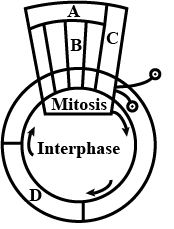
The number of DNA in chromosome at \[G2\] stage of cell cycle is
A. One
B. Two
C. Four
D. Eight
Answer
 Verified
497.7k+ views
Hint: The timing of DNA synthesis divides the cell cycle into four phases, phase, \[G1\] phase, \[G2\] phase and S phase. The interphase is the time between one mitosis process and the next round of mitosis and DNA is synthesized only in a portion of interphase. The duration of cell cycle varies considerably in different kinds of cells. A typical rapidly proliferating human cell has a total cycle time of \[24\] hours.
Complete answer
The rule of thumb for calculation of DNA molecules in a chromosome is as follows:
Number of chromosome is equal to number of functional centromere
Number of DNA molecules is equal to number of chromatids
Option A One: Each chromosome has a single chromatid and each chromatid contains a single DNA molecule. So, the number of DNA present in chromosomes is one. This happens at \[G1\] phase of cell cycle, not \[G2\] phase of cell cycle.
Option A is not correct
Option B Two: \[G2\] stage or second growth stage takes place after the synthesis phase or S phase in which replication of DNA happens. The number of DNA molecules in each chromosome at \[G2\] stage is two as each chromosome has two chromatids.
Hence, Option B is the correct answer.
Option C Four: There is no change in the number of DNA molecules and chromosomes during prophase and metaphase stages of mitosis. In anaphase, chromosome number increases from one to two. However, there is no change in DNA.
So, Option C is not correct
Option D Eight: After cytokinesis, chromosomes and DNA molecules are distributed between cells. So, the number of DNA and chromosomes will be reduced by half.
Option D is not correct
Note:
M phase of the cycle corresponds to mitosis, which is followed by cytokinesis. This is followed by a gap \[1\] or \[G1\] phase, which corresponds to the interval between mitosis and initiation of DNA replication. \[G1\] phase is followed by the S phase or synthesis stage, where DNA synthesis occurs. Then the gap \[2\] or \[G2\] phase occurs, when growth of the cell continues and proteins are synthesized in preparation for the mitosis process.
Complete answer
The rule of thumb for calculation of DNA molecules in a chromosome is as follows:
Number of chromosome is equal to number of functional centromere
Number of DNA molecules is equal to number of chromatids
Option A One: Each chromosome has a single chromatid and each chromatid contains a single DNA molecule. So, the number of DNA present in chromosomes is one. This happens at \[G1\] phase of cell cycle, not \[G2\] phase of cell cycle.
Option A is not correct
Option B Two: \[G2\] stage or second growth stage takes place after the synthesis phase or S phase in which replication of DNA happens. The number of DNA molecules in each chromosome at \[G2\] stage is two as each chromosome has two chromatids.
Hence, Option B is the correct answer.
Option C Four: There is no change in the number of DNA molecules and chromosomes during prophase and metaphase stages of mitosis. In anaphase, chromosome number increases from one to two. However, there is no change in DNA.
So, Option C is not correct
Option D Eight: After cytokinesis, chromosomes and DNA molecules are distributed between cells. So, the number of DNA and chromosomes will be reduced by half.
Option D is not correct
Note:
M phase of the cycle corresponds to mitosis, which is followed by cytokinesis. This is followed by a gap \[1\] or \[G1\] phase, which corresponds to the interval between mitosis and initiation of DNA replication. \[G1\] phase is followed by the S phase or synthesis stage, where DNA synthesis occurs. Then the gap \[2\] or \[G2\] phase occurs, when growth of the cell continues and proteins are synthesized in preparation for the mitosis process.
Recently Updated Pages
Master Class 11 Computer Science: Engaging Questions & Answers for Success

Master Class 11 Business Studies: Engaging Questions & Answers for Success
Master Class 11 Economics: Engaging Questions & Answers for Success
Master Class 11 English: Engaging Questions & Answers for Success
Master Class 11 Maths: Engaging Questions & Answers for Success
Master Class 11 Biology: Engaging Questions & Answers for Success
Trending doubts
One Metric ton is equal to kg A 10000 B 1000 C 100 class 11 physics CBSE
There are 720 permutations of the digits 1 2 3 4 5 class 11 maths CBSE
Discuss the various forms of bacteria class 11 biology CBSE
Draw a diagram of a plant cell and label at least eight class 11 biology CBSE
State the laws of reflection of light
10 examples of friction in our daily life