




The number of matchsticks required to make 10 squares. The squares are placed one beside the other in an order.
A) 31
B) 20
C) 33
D) 32
Answer
 Verified
588k+ views
Hint: Since four matchsticks will be required to make the first square. After that three matchsticks will be required to make the second square. Since one matchstick of the first square will be used as the $4^{th}$ side for the second square. Similarly, three matchsticks are required for the third square, and so on.
Complete step-by-step answer:
The first square will need four matchsticks. Consider the figure, the line represents the matchsticks.

For the second square take anyone matchstick as the one side of the second square. For the other three sides, three matchsticks are required, and so on.
The figure of two square is,
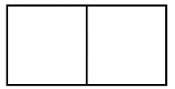
There are 7 lines which mean 7 matchsticks are required for two squares.
For the third square, again three matchsticks are required.
It is forming an Arithmetic Progression
$4,7,10, \ldots $
where, $a = 4$ and $d = 3$.
Now, find the 10th term of the A.P.,
As we know that ${a_n} = {a_1} + \left( {n - 1} \right)d$.
Put ${a_1} = 4,d = 3$ and $n = 10$. Then,
${a_{10}} = 4 + \left( {10 - 1} \right) \times 3$
Subtract 1 from 10 and then multiply the result with 3.
${a_{10}} = 4 + 27$
Now, add the terms to get the final answer,
${a_{10}} = 31$
Hence, the number of matchsticks required to make 10 squares is 31.
Option A is the correct answer.
Note: This question can be done in another way also.
If we remove one matchstick from the end, it will make a pattern of C’s.
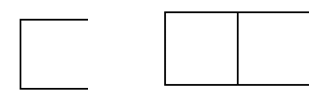
So the number of matchsticks required for n C’s will be,
Number of C’s$ = 3n$
where n is the number of squares.
For square, 1 matchstick is required for the pattern of C’s.$$
Number of matchsticks required$ = 3n + 1$
Now, for 10 squares. Put $n = 10$,
So, the number of matchsticks required$ = 3 \times 10 + 1$
Multiply the terms and add 1 to it.
Number of matchsticks required$ = 31$
Hence, the number of matchsticks required is 31.
Complete step-by-step answer:
The first square will need four matchsticks. Consider the figure, the line represents the matchsticks.
For the second square take anyone matchstick as the one side of the second square. For the other three sides, three matchsticks are required, and so on.
The figure of two square is,
There are 7 lines which mean 7 matchsticks are required for two squares.
For the third square, again three matchsticks are required.
It is forming an Arithmetic Progression
$4,7,10, \ldots $
where, $a = 4$ and $d = 3$.
Now, find the 10th term of the A.P.,
As we know that ${a_n} = {a_1} + \left( {n - 1} \right)d$.
Put ${a_1} = 4,d = 3$ and $n = 10$. Then,
${a_{10}} = 4 + \left( {10 - 1} \right) \times 3$
Subtract 1 from 10 and then multiply the result with 3.
${a_{10}} = 4 + 27$
Now, add the terms to get the final answer,
${a_{10}} = 31$
Hence, the number of matchsticks required to make 10 squares is 31.
Option A is the correct answer.
Note: This question can be done in another way also.
If we remove one matchstick from the end, it will make a pattern of C’s.
So the number of matchsticks required for n C’s will be,
Number of C’s$ = 3n$
where n is the number of squares.
For square, 1 matchstick is required for the pattern of C’s.$$
Number of matchsticks required$ = 3n + 1$
Now, for 10 squares. Put $n = 10$,
So, the number of matchsticks required$ = 3 \times 10 + 1$
Multiply the terms and add 1 to it.
Number of matchsticks required$ = 31$
Hence, the number of matchsticks required is 31.
Recently Updated Pages
Master Class 11 Computer Science: Engaging Questions & Answers for Success

Master Class 11 Business Studies: Engaging Questions & Answers for Success
Master Class 11 Economics: Engaging Questions & Answers for Success
Master Class 11 English: Engaging Questions & Answers for Success
Master Class 11 Maths: Engaging Questions & Answers for Success
Master Class 11 Biology: Engaging Questions & Answers for Success
Trending doubts
One Metric ton is equal to kg A 10000 B 1000 C 100 class 11 physics CBSE
There are 720 permutations of the digits 1 2 3 4 5 class 11 maths CBSE
Discuss the various forms of bacteria class 11 biology CBSE
Draw a diagram of a plant cell and label at least eight class 11 biology CBSE
State the laws of reflection of light
Explain zero factorial class 11 maths CBSE