



The parallel sides of trapezium are 6cm and 8cm. If the distance between them is 4cm, its area is
A.28 sq.cm
B.24 sq.cm
C.82 sq.cm
D.42 sq.cm
Answer
 Verified
569.7k+ views
Hint: In this question, we need to evaluate the area of the trapezium such that the parallel sides of trapezium are 6 cm and 8 cm. For this, we will use the relation between area, length of the parallel sides and length between the parallel sides.
Complete step-by-step answer:
Given the length of the parallel sides of trapezium
\[{L_1} = 6\;cm\] and \[{L_2} = 8\;cm\]
The distance between the parallel sides $D = 4\;cm$
Let us first draw a trapezium from the above given data
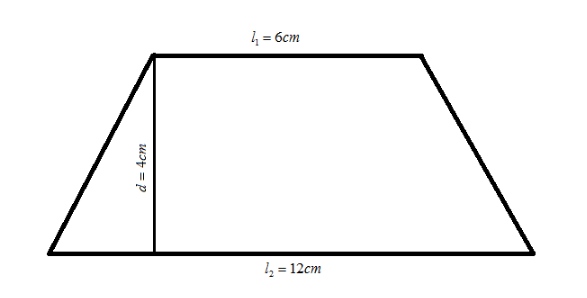
Now we already know the formula for the area of the trapezium which is equal to the product of the sum of parallel sides and distance between them multiplied by half as \[\dfrac{1}{2} \times \left( {{\text{sum of parallel sides}}} \right) \times \left( {{\text{distnace between parallel sides}}} \right)\]
\[
Area = \dfrac{1}{2} \times \left( {6 + 8} \right) \times 4 \\
= \dfrac{1}{2} \times \left( {14} \right) \times 4 \\
= 7 \times 4 \\
= 28\;c{m^2} \;
\]
Hence, the area of trapezoid whose parallel sides are 6cm and 8cm and the distance between them is 4 cm is \[ = 28\;c{m^2}\]
Option A is correct.
So, the correct answer is “Option A”.
Note: When a trapezoid has non parallel sides then the figure is known as irregular trapezoid then to find the area of the trapezoid we divide that geometric figure into a regular triangles or rectangles to find the area of the figure. The area of a trapezium is equal to the product of the sum of the parallel sides and the distance between them multiplied by the half which is given as \[\dfrac{1}{2} \times \left( {{\text{sum of parallel sides}}} \right) \times \left( {{\text{distnace between parallel sides}}} \right)\] .
Complete step-by-step answer:
Given the length of the parallel sides of trapezium
\[{L_1} = 6\;cm\] and \[{L_2} = 8\;cm\]
The distance between the parallel sides $D = 4\;cm$
Let us first draw a trapezium from the above given data
Now we already know the formula for the area of the trapezium which is equal to the product of the sum of parallel sides and distance between them multiplied by half as \[\dfrac{1}{2} \times \left( {{\text{sum of parallel sides}}} \right) \times \left( {{\text{distnace between parallel sides}}} \right)\]
\[
Area = \dfrac{1}{2} \times \left( {6 + 8} \right) \times 4 \\
= \dfrac{1}{2} \times \left( {14} \right) \times 4 \\
= 7 \times 4 \\
= 28\;c{m^2} \;
\]
Hence, the area of trapezoid whose parallel sides are 6cm and 8cm and the distance between them is 4 cm is \[ = 28\;c{m^2}\]
Option A is correct.
So, the correct answer is “Option A”.
Note: When a trapezoid has non parallel sides then the figure is known as irregular trapezoid then to find the area of the trapezoid we divide that geometric figure into a regular triangles or rectangles to find the area of the figure. The area of a trapezium is equal to the product of the sum of the parallel sides and the distance between them multiplied by the half which is given as \[\dfrac{1}{2} \times \left( {{\text{sum of parallel sides}}} \right) \times \left( {{\text{distnace between parallel sides}}} \right)\] .
Recently Updated Pages
Master Class 8 Social Science: Engaging Questions & Answers for Success

Master Class 8 English: Engaging Questions & Answers for Success
Class 8 Question and Answer - Your Ultimate Solutions Guide
Master Class 8 Maths: Engaging Questions & Answers for Success
Master Class 8 Science: Engaging Questions & Answers for Success
Master Class 9 General Knowledge: Engaging Questions & Answers for Success
Trending doubts
What is BLO What is the full form of BLO class 8 social science CBSE
Citizens of India can vote at the age of A 18 years class 8 social science CBSE
Full form of STD, ISD and PCO
Advantages and disadvantages of science
Right to vote is a AFundamental Right BFundamental class 8 social science CBSE
What are the 12 elements of nature class 8 chemistry CBSE