




The pigment that helps the eye to see in dim light is:
A. Iodopsin
B. Rhodopsin
C. Hemocyanin
D. Hematin
Answer
 Verified
591.9k+ views
Hint: Rhodopsin is a pigment present in the rod cells of the retina and helps in the vision in the low light conditions.
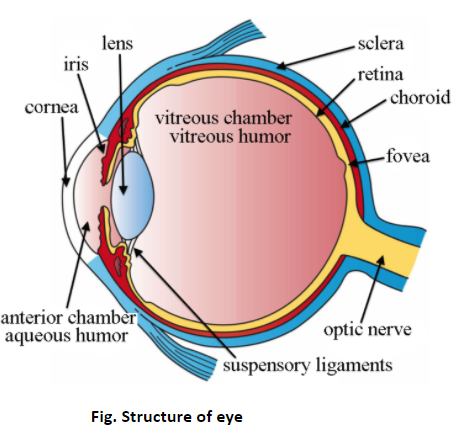
Complete answer: The human eye consists of a) rods and b) cones that help in the vision and perception of the light.
1. Rods and cones are the photoreceptor cells.
2. Rods help in the night vision and works well in the dim light.
3. The number of cones varies from 5 to 7 million while that of rods lies in the range of 110 to 130 million.
4. Rods contain the pigment that is Rhodopsin which helps in the night vision that is dim light.
Exposure to high-intensity light will lead to decomposition of the pigment and thereby, reducing the sensitivity to dim light.
5. Cones contain the pigment that is Iodopsin.
It helps in the daylight vision and works well in the bright light.
It is present in the peripheral zone of the eye. The iodopsinin in the cone cells also helps in distinguishing the color.
6. There are three types of cones-
1. Red
2. Green
3. Blue
It is with the combination of these cone cells that we can visualize the color.
Therefore, the correct option is B. Rhodopsin.
Additional information: Rhodopsin was discovered in 1876 by German physiologist Franz Christian Boll, who found that the normally reddish-purple frog retina turned pale in presence of bright light.
Rhodopsin, also known as visual purple, a pigment-containing sensory protein that converts light into an electrical signal.
Note: The photopigment that is rhodopsin helps in the dim light vision whereas the iodopsin is responsible for bright light vision.
Complete answer: The human eye consists of a) rods and b) cones that help in the vision and perception of the light.
1. Rods and cones are the photoreceptor cells.
2. Rods help in the night vision and works well in the dim light.
3. The number of cones varies from 5 to 7 million while that of rods lies in the range of 110 to 130 million.
4. Rods contain the pigment that is Rhodopsin which helps in the night vision that is dim light.
Exposure to high-intensity light will lead to decomposition of the pigment and thereby, reducing the sensitivity to dim light.
5. Cones contain the pigment that is Iodopsin.
It helps in the daylight vision and works well in the bright light.
It is present in the peripheral zone of the eye. The iodopsinin in the cone cells also helps in distinguishing the color.
6. There are three types of cones-
1. Red
2. Green
3. Blue
It is with the combination of these cone cells that we can visualize the color.
Therefore, the correct option is B. Rhodopsin.
Additional information: Rhodopsin was discovered in 1876 by German physiologist Franz Christian Boll, who found that the normally reddish-purple frog retina turned pale in presence of bright light.
Rhodopsin, also known as visual purple, a pigment-containing sensory protein that converts light into an electrical signal.
Note: The photopigment that is rhodopsin helps in the dim light vision whereas the iodopsin is responsible for bright light vision.
Recently Updated Pages
Master Class 10 Computer Science: Engaging Questions & Answers for Success

Master Class 10 General Knowledge: Engaging Questions & Answers for Success
Master Class 10 English: Engaging Questions & Answers for Success
Master Class 10 Social Science: Engaging Questions & Answers for Success
Master Class 10 Maths: Engaging Questions & Answers for Success
Master Class 10 Science: Engaging Questions & Answers for Success
Trending doubts
What is the median of the first 10 natural numbers class 10 maths CBSE
Which women's tennis player has 24 Grand Slam singles titles?
Who is the Brand Ambassador of Incredible India?
Why is there a time difference of about 5 hours between class 10 social science CBSE
Write a letter to the principal requesting him to grant class 10 english CBSE
A moving boat is observed from the top of a 150 m high class 10 maths CBSE