




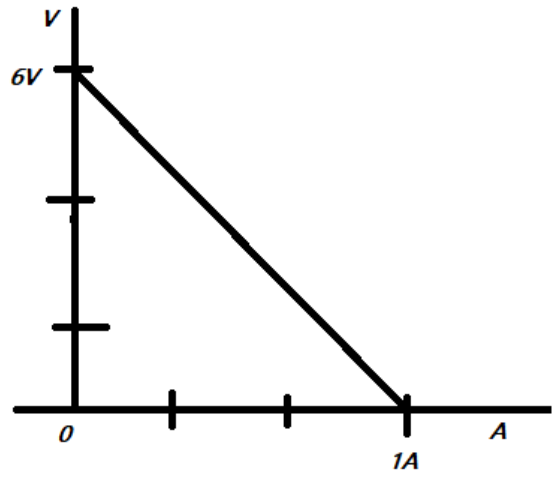
The plot of the variation of potential difference across a combination of three identical cells in series, versus current is shown alongside. What is the emf and internal resistance of each cell?
Answer
 Verified
589.8k+ views
Hint: EMF or the electromotive force is the energy which gets transferred. It is similar to the potential difference and is often used interchangeably. Also, resistance is the property of the material to resist the flow of current through it.
Formula used: $E_{s}=E_{1}+E_{2}+E_{3}$, $R_{s}=R_{1}+R_{2}+R_{3}$and $E=IR$
Complete step-by-step solution:
Given the combination of three identical cells in series. In a series connection, the potential of the combination is the sum of the potentials due to the individual resistances. Or we can say that potentially gets distributed in the series connection of resistances. Similarly, the combination of resistance is the sum of the individual resistances.
Let the emf of the series combination be $E_{s}$ and the individual EMFs be $E_{1}=E_{2}=E_{3}=E$
Then we can say that, $E_{s}=E_{1}+E_{2}+E_{3}=3E$
From the graph, it is clear that, $E_{s}=6V$
Then reducing, we get $6=3E$ or $E=2V$
We know from ohms law that, $E=IR$ where $E$ is the emf, $I$ is the current in the circuit and $R$ is the resistance of combination.
From the graph, we get $I=1A$ for the combination.
Then, we get $R_{s}=\dfrac{E_{s}}{I}=\dfrac{6}{1}=6\Omega$
We know that in series connection, if the resistance of the series combination be $R_{s}$ and the individual resistances be $R_{1}=R_{2}=R_{3}=R$, then we get
$R_{s}=R_{1}+R_{2}+R_{3}=3R$
Then reducing, we get $3R=6$ or $R=2\Omega$
Thus for the given combination, we get,$R=2\Omega$ and $E=2V$.
Note: To read the graph, we must understand a few basics. Like here, the x-axis denotes the current flow. The maximum current flowing through the circuit is $I=1A$. Similarly, the y-axis denotes the potential drop in the circuit. The maximum potential drop possible is given as $E_{s}=6V$. We can then use this to solve the question.
Formula used: $E_{s}=E_{1}+E_{2}+E_{3}$, $R_{s}=R_{1}+R_{2}+R_{3}$and $E=IR$
Complete step-by-step solution:
Given the combination of three identical cells in series. In a series connection, the potential of the combination is the sum of the potentials due to the individual resistances. Or we can say that potentially gets distributed in the series connection of resistances. Similarly, the combination of resistance is the sum of the individual resistances.
Let the emf of the series combination be $E_{s}$ and the individual EMFs be $E_{1}=E_{2}=E_{3}=E$
Then we can say that, $E_{s}=E_{1}+E_{2}+E_{3}=3E$
From the graph, it is clear that, $E_{s}=6V$
Then reducing, we get $6=3E$ or $E=2V$
We know from ohms law that, $E=IR$ where $E$ is the emf, $I$ is the current in the circuit and $R$ is the resistance of combination.
From the graph, we get $I=1A$ for the combination.
Then, we get $R_{s}=\dfrac{E_{s}}{I}=\dfrac{6}{1}=6\Omega$
We know that in series connection, if the resistance of the series combination be $R_{s}$ and the individual resistances be $R_{1}=R_{2}=R_{3}=R$, then we get
$R_{s}=R_{1}+R_{2}+R_{3}=3R$
Then reducing, we get $3R=6$ or $R=2\Omega$
Thus for the given combination, we get,$R=2\Omega$ and $E=2V$.
Note: To read the graph, we must understand a few basics. Like here, the x-axis denotes the current flow. The maximum current flowing through the circuit is $I=1A$. Similarly, the y-axis denotes the potential drop in the circuit. The maximum potential drop possible is given as $E_{s}=6V$. We can then use this to solve the question.
Recently Updated Pages
Master Class 12 Economics: Engaging Questions & Answers for Success

Master Class 12 Physics: Engaging Questions & Answers for Success
Master Class 12 English: Engaging Questions & Answers for Success
Master Class 12 Social Science: Engaging Questions & Answers for Success
Master Class 12 Maths: Engaging Questions & Answers for Success
Master Class 12 Business Studies: Engaging Questions & Answers for Success
Trending doubts
Which are the Top 10 Largest Countries of the World?
What are the major means of transport Explain each class 12 social science CBSE
Draw a labelled sketch of the human eye class 12 physics CBSE
Why cannot DNA pass through cell membranes class 12 biology CBSE
Differentiate between insitu conservation and exsitu class 12 biology CBSE
Draw a neat and well labeled diagram of TS of ovary class 12 biology CBSE