




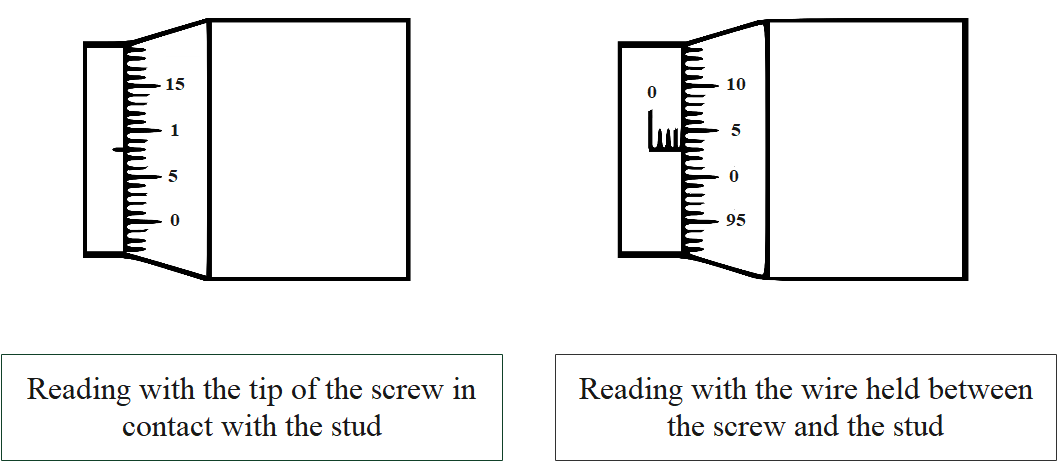
The reading of a screw gauge when an object is placed between the stud and the tip of the screw is as shown above. If the pitch of the screw is 1mm, the diameter of the object is ___.
(A) 2.95 mm
(B) 29.5 mm
(C) 3.11 mm
(D) 31.1 mm
Answer
 Verified
591k+ views
Hint: To answer questions as such, we need to be clear about the basics of screw gauge. It is an instrument which is used for measuring the exact diameters of any thin object such as a thin wire or thin sheet of metal. We also need to be familiar with the least count of a screw gauge which can be defined as the distance that is moved by the tip of the screw when it is turned by one division of the head scale.
Complete step by step answer:
The Least count of screw gauge \[{\text{L.C. = 0.01 mm}}\]
The zero of the circular scale is below the zero of the main scale having a positive zero error when the screw is in contact with the stud.
The positive zero error \[{\text{ = n }} \times {\text{ L.C. = 8 }} \times {\text{ 0.01 = 0.08 mm}}\]
M.S.R or Main Scale Reading = 3mm
Therefore, final reading of screw gauge \[{{\text{d}}_{\text{f}}}{\text{ = M.S.R + }}{{\text{n}}_{\text{1}}}{\text{ }} \times {\text{ L.C. = 3 + 3 }} \times {\text{ 0.01 = 3.03 mm}}\]
Hence the thickness of wire is \[{\text{t = }}{{\text{d}}_{\text{1}}}{\text{ }} - {\text{ error = 3.03 }} - {\text{ 0.08 = 2.95 mm}}\]
So we can say that the correct answer is option A.
Note: The key point that we need to keep in mind is that the zero of the main scale should be in the same position as of the zero in the circular scale for a zero error. Zero of circular scale below the zero in the main scale is considered to be a positive error and vice versa.
We should also remember the principal on which the screw gauge works. The principal is that if we rotate the screw head then in that case we can obtain the linear movement of the main scale. This linear movement that is obtained is used to calculate the diameter of any wire or even the thickness of a metal plate.
Complete step by step answer:
The Least count of screw gauge \[{\text{L.C. = 0.01 mm}}\]
The zero of the circular scale is below the zero of the main scale having a positive zero error when the screw is in contact with the stud.
The positive zero error \[{\text{ = n }} \times {\text{ L.C. = 8 }} \times {\text{ 0.01 = 0.08 mm}}\]
M.S.R or Main Scale Reading = 3mm
Therefore, final reading of screw gauge \[{{\text{d}}_{\text{f}}}{\text{ = M.S.R + }}{{\text{n}}_{\text{1}}}{\text{ }} \times {\text{ L.C. = 3 + 3 }} \times {\text{ 0.01 = 3.03 mm}}\]
Hence the thickness of wire is \[{\text{t = }}{{\text{d}}_{\text{1}}}{\text{ }} - {\text{ error = 3.03 }} - {\text{ 0.08 = 2.95 mm}}\]
So we can say that the correct answer is option A.
Note: The key point that we need to keep in mind is that the zero of the main scale should be in the same position as of the zero in the circular scale for a zero error. Zero of circular scale below the zero in the main scale is considered to be a positive error and vice versa.
We should also remember the principal on which the screw gauge works. The principal is that if we rotate the screw head then in that case we can obtain the linear movement of the main scale. This linear movement that is obtained is used to calculate the diameter of any wire or even the thickness of a metal plate.
Recently Updated Pages
Master Class 11 Computer Science: Engaging Questions & Answers for Success

Master Class 11 Business Studies: Engaging Questions & Answers for Success
Master Class 11 Economics: Engaging Questions & Answers for Success
Master Class 11 English: Engaging Questions & Answers for Success
Master Class 11 Maths: Engaging Questions & Answers for Success
Master Class 11 Biology: Engaging Questions & Answers for Success
Trending doubts
One Metric ton is equal to kg A 10000 B 1000 C 100 class 11 physics CBSE
There are 720 permutations of the digits 1 2 3 4 5 class 11 maths CBSE
Discuss the various forms of bacteria class 11 biology CBSE
Draw a diagram of a plant cell and label at least eight class 11 biology CBSE
State the laws of reflection of light
Explain zero factorial class 11 maths CBSE