




The solution of minerals, water, food and gases that is circulated through xylem and phloem is called:
(a) Sap
(b) Cytoplasm
(c) Sol
(d) Protoplasm
Answer
 Verified
594k+ views
Hint:Plant sap transports the required nutrients all over the parts of
a plant.
Complete answer:Xylem and Phloem are the vascular structures of a plant.
These structures or cells transport their circulatory fluid all over.
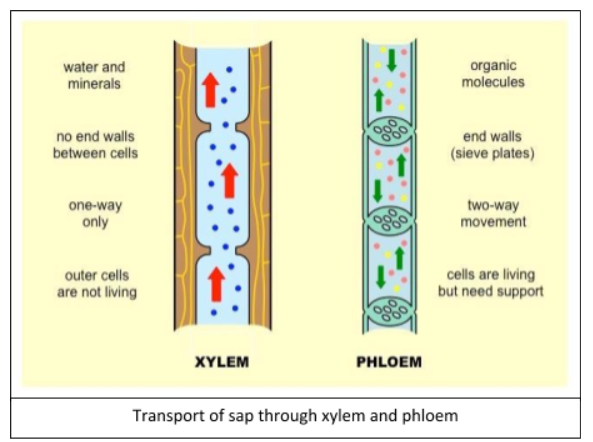
Plant sap, a fluidly material is transported through the xylem tubes and also by phloem cells of a plant. Xylem cells transport water & inorganic nutrients; so the xylem sap consists of minerals and water.
Phloem sap consists of sugar (different carbohydrates), some amino acids and other organic compounds.
Xylem transports the sap from roots towards the leaves. Hence, the movement of sap through xylem follows a vertical path. Xylem helps reach the fluid upwards and against the gravitational pull. Water potential and root cells play an important part here. Phytohormones are also circulated in different parts of the plant body by xylem. Phloem cells transport fluids (sap) filled with biological molecules such as sugar, gases, food etc. The food particles prepared on the leaves are circulated all over via the phloem sap.
Phloem sap transport follows a two-way path; it flows from where carbohydrates or food materials are produced and stored to other places where they are used. More precisely, the cells which are involved in sap-transport are: tracheids or vessel elements of xylem and sieve tube cells of the phloem.
So, the correct option is ‘Sap’.
Note:Plant sap and plant resin/latex are entirely different things.
The constituents and function of resins/latex are also different.
a plant.
Complete answer:Xylem and Phloem are the vascular structures of a plant.
These structures or cells transport their circulatory fluid all over.
Plant sap, a fluidly material is transported through the xylem tubes and also by phloem cells of a plant. Xylem cells transport water & inorganic nutrients; so the xylem sap consists of minerals and water.
Phloem sap consists of sugar (different carbohydrates), some amino acids and other organic compounds.
Xylem transports the sap from roots towards the leaves. Hence, the movement of sap through xylem follows a vertical path. Xylem helps reach the fluid upwards and against the gravitational pull. Water potential and root cells play an important part here. Phytohormones are also circulated in different parts of the plant body by xylem. Phloem cells transport fluids (sap) filled with biological molecules such as sugar, gases, food etc. The food particles prepared on the leaves are circulated all over via the phloem sap.
Phloem sap transport follows a two-way path; it flows from where carbohydrates or food materials are produced and stored to other places where they are used. More precisely, the cells which are involved in sap-transport are: tracheids or vessel elements of xylem and sieve tube cells of the phloem.
So, the correct option is ‘Sap’.
Note:Plant sap and plant resin/latex are entirely different things.
The constituents and function of resins/latex are also different.
Recently Updated Pages
Master Class 10 Computer Science: Engaging Questions & Answers for Success

Master Class 10 General Knowledge: Engaging Questions & Answers for Success
Master Class 10 English: Engaging Questions & Answers for Success
Master Class 10 Social Science: Engaging Questions & Answers for Success
Master Class 10 Maths: Engaging Questions & Answers for Success
Master Class 10 Science: Engaging Questions & Answers for Success
Trending doubts
What is the median of the first 10 natural numbers class 10 maths CBSE
Which women's tennis player has 24 Grand Slam singles titles?
Who is the Brand Ambassador of Incredible India?
Why is there a time difference of about 5 hours between class 10 social science CBSE
Write a letter to the principal requesting him to grant class 10 english CBSE
A moving boat is observed from the top of a 150 m high class 10 maths CBSE