




The stipules are modified into tendrils in
(a) Smilax
(b) Asphodelus
(c) Gloriosa
(d) Asparagus
Answer
 Verified
580.5k+ views
Hint: They are the thorny plants belonging to the family monocotyledons and have a climbing habit having a specialized structure that provides attachment to and support to the plant.
Complete answer:
The stipules are modified into tendrils in the case of Smilax. The tendrils are in the shape of the hook which attached and holds the plant to give support.
- Smilax is the shrubs that grow over the trees due to the presence of climbing roots and tendrils.
- It is a damage- tolerant plant that grows back once cut down or burnt.
- They are used in the farming of honey and the production of the root beers.
- Stipules are the small hair- like outgrowth on the surface of the leaf stalk or petiole.
- In some flowers, the stipules may be incompletely developed or are absent, then that flower is known as exstipulate.
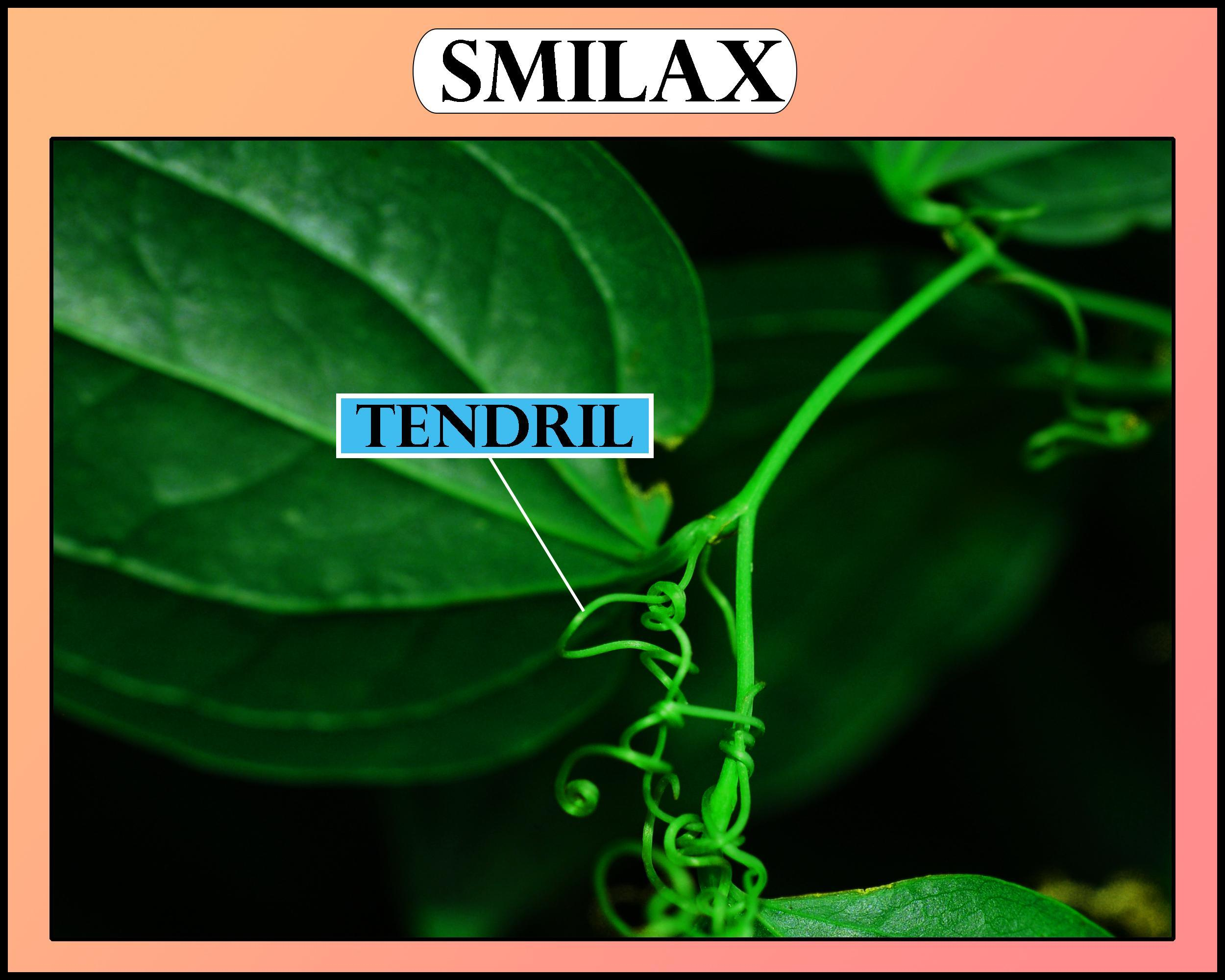
- Stipules are generally found in dicotyledons but sometimes found in monocotyledons plants as one stipule per leaf.
- Stipules are of various types depending upon its structure: scales, spines, hairs, glands, or leaf- like (laminar) structure.
- When the single stipule is present which is surrounding the complete stem is known as an ochrea.
- Stipules help in the protection of plants from animals and bugs from withering off.
- Tendrils are found either on stem, leaves, or even petiole having a thread- like appearance.
- Tendrils give plants the support to climb on other plants and may act as parasites.
- They are sensitive to touch and chemicals and perform photosynthesis.
- The leaves, or stems both may be modified into tendrils according to the habit.
So, the correct answer is ‘Smilax’.
Note: The word stipule was derived from the Latin word stipula, meaning ‘straw’, or ‘stalk’. Linnaeus coined the term petiole. Charles Darwin published his monograph ‘On the Movements and Habits of Climbing Plants’ where he did the earliest and most comprehensive study of tendrils in 1865.
Complete answer:
The stipules are modified into tendrils in the case of Smilax. The tendrils are in the shape of the hook which attached and holds the plant to give support.
- Smilax is the shrubs that grow over the trees due to the presence of climbing roots and tendrils.
- It is a damage- tolerant plant that grows back once cut down or burnt.
- They are used in the farming of honey and the production of the root beers.
- Stipules are the small hair- like outgrowth on the surface of the leaf stalk or petiole.
- In some flowers, the stipules may be incompletely developed or are absent, then that flower is known as exstipulate.
- Stipules are generally found in dicotyledons but sometimes found in monocotyledons plants as one stipule per leaf.
- Stipules are of various types depending upon its structure: scales, spines, hairs, glands, or leaf- like (laminar) structure.
- When the single stipule is present which is surrounding the complete stem is known as an ochrea.
- Stipules help in the protection of plants from animals and bugs from withering off.
- Tendrils are found either on stem, leaves, or even petiole having a thread- like appearance.
- Tendrils give plants the support to climb on other plants and may act as parasites.
- They are sensitive to touch and chemicals and perform photosynthesis.
- The leaves, or stems both may be modified into tendrils according to the habit.
So, the correct answer is ‘Smilax’.
Note: The word stipule was derived from the Latin word stipula, meaning ‘straw’, or ‘stalk’. Linnaeus coined the term petiole. Charles Darwin published his monograph ‘On the Movements and Habits of Climbing Plants’ where he did the earliest and most comprehensive study of tendrils in 1865.
Recently Updated Pages
Master Class 11 Computer Science: Engaging Questions & Answers for Success

Master Class 11 Business Studies: Engaging Questions & Answers for Success
Master Class 11 Economics: Engaging Questions & Answers for Success
Master Class 11 English: Engaging Questions & Answers for Success
Master Class 11 Maths: Engaging Questions & Answers for Success
Master Class 11 Biology: Engaging Questions & Answers for Success
Trending doubts
One Metric ton is equal to kg A 10000 B 1000 C 100 class 11 physics CBSE
There are 720 permutations of the digits 1 2 3 4 5 class 11 maths CBSE
Discuss the various forms of bacteria class 11 biology CBSE
Draw a diagram of a plant cell and label at least eight class 11 biology CBSE
State the laws of reflection of light
Explain zero factorial class 11 maths CBSE