




The upward force exerted by the floating body on the fluid is known as upthrust.
A. True
B. False
Answer
 Verified
606.6k+ views
Hint: Learn Archimedes’ principle and then solve this problem. By Archimedes’ principle “the upward force exerted by the fluid on the floating body is known as upthrust”.
Complete step by step answer:
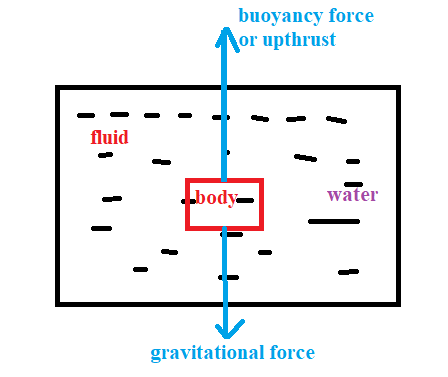
Buoyancy force or upthrust force is an upward force exerted by a fluid that opposes the weight of a partially or fully immersed object. In a column of a fluid, the pressure increases with depth as a result of weight of the overlying fluid. Thus the pressure at the bottom of a column of fluid is greater than at the top of column. Similarly, the pressure at the bottom of an object submerged in a fluid is greater than at the top of the object. The pressure difference results in a net upward force on the object. The magnitude of force is proportional to the pressure difference and is equivalent to the weight of the displaced fluid.
Buoyancy force or upthrust = weight of the displaced fluid
This principle is known as Archimedes’ principle
Note: Students should remember that upward force exerted by the fluid on the floating body is not upward force exerted by the floating body on the fluid. Students always get confused between these two conditions and can write incorrect answers.
Complete step by step answer:
Buoyancy force or upthrust force is an upward force exerted by a fluid that opposes the weight of a partially or fully immersed object. In a column of a fluid, the pressure increases with depth as a result of weight of the overlying fluid. Thus the pressure at the bottom of a column of fluid is greater than at the top of column. Similarly, the pressure at the bottom of an object submerged in a fluid is greater than at the top of the object. The pressure difference results in a net upward force on the object. The magnitude of force is proportional to the pressure difference and is equivalent to the weight of the displaced fluid.
Buoyancy force or upthrust = weight of the displaced fluid
This principle is known as Archimedes’ principle
Note: Students should remember that upward force exerted by the fluid on the floating body is not upward force exerted by the floating body on the fluid. Students always get confused between these two conditions and can write incorrect answers.
Recently Updated Pages
Master Class 10 Computer Science: Engaging Questions & Answers for Success

Master Class 10 General Knowledge: Engaging Questions & Answers for Success
Master Class 10 English: Engaging Questions & Answers for Success
Master Class 10 Social Science: Engaging Questions & Answers for Success
Master Class 10 Maths: Engaging Questions & Answers for Success
Master Class 10 Science: Engaging Questions & Answers for Success
Trending doubts
What is the median of the first 10 natural numbers class 10 maths CBSE
Which women's tennis player has 24 Grand Slam singles titles?
Who is the Brand Ambassador of Incredible India?
Why is there a time difference of about 5 hours between class 10 social science CBSE
Write a letter to the principal requesting him to grant class 10 english CBSE
A moving boat is observed from the top of a 150 m high class 10 maths CBSE