




What should be the value of $M$ so that the block does not slide over the triangular wedge? All surfaces are smooth.
A. $\dfrac{4}{5}(\sqrt 3 - 1)m$
B. $4(\sqrt 3 + 1)m$
C. $\dfrac{5}{2}(\sqrt 3 + 1)m$
D. $5(\sqrt 3 - 1)m$
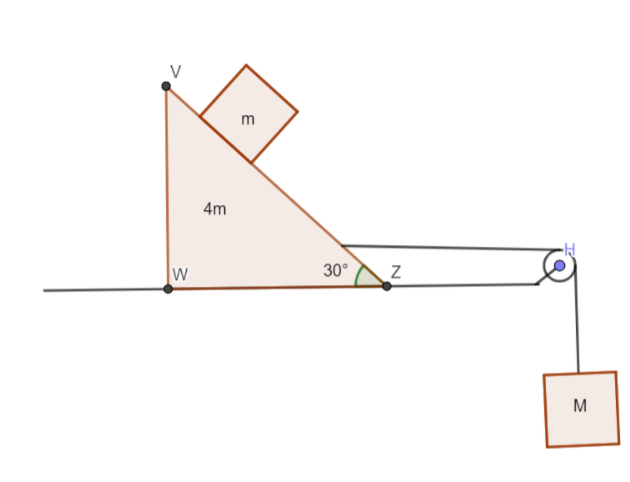
Answer
 Verified
497.7k+ views
Hint: Pseudo force is used whenever there is a relative motion with different accelerations. Tension acting along a string does not change till the time the string encounters a new acceleration or has some object. However, the acceleration in the string remains unchanged.
The acceleration with which the whole wedge mass system moves is given by $a = g\tan \theta $ where a is the acceleration and $\theta $ is the angle between the wedge sides. This angle is also the angle of inclination for the mass m kept on the wedge.
Under the equilibrium condition, the body experiences balanced force in all directions and does not undergo motion. When all surfaces are smooth, it means that the frictional force is absent and its effect should be neglected.
Complete step by step solution:
We will first visualize the forces using a free body diagram of the mass m given in the question.
The free body diagram is given below
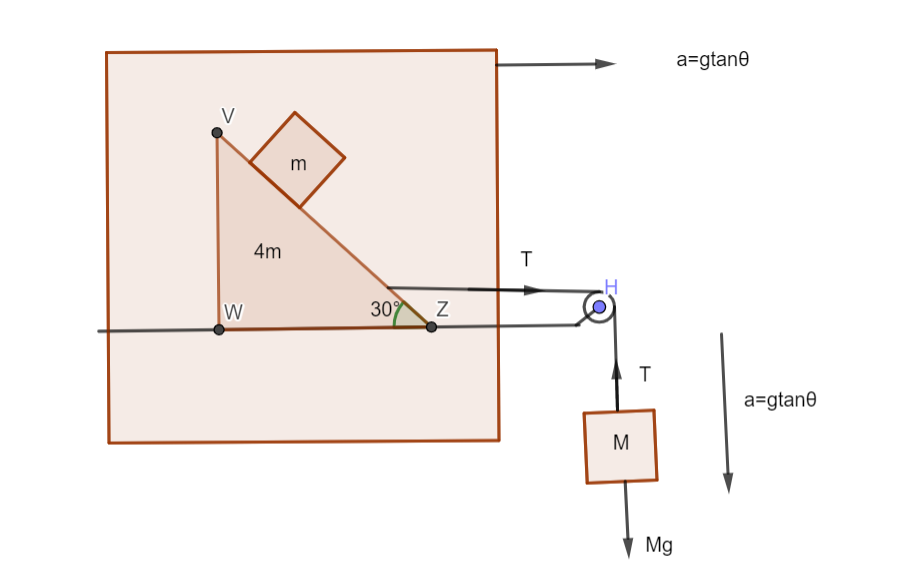
Here $\theta = {30^0}$ as per the given question.
For the vertical equilibrium,
$Mg - T = Ma$,
Substituting $a = g\tan \theta $ we get,
$Mg - T = Mg\tan \theta $ .
This becomes our force equation.
For the horizontal equilibrium,
$T = (4m + m)a$
Again substituting $a = g\tan \theta $ we get,
$T = 5mg\tan \theta $
Substituting this in the force equation we get,
$Mg - 5mg\tan \theta = Mg\tan \theta $
Cancelling out the common terms and substituting $\theta = {30^0}$ ,
$M - 5m\tan {30^0} = M\tan {30^0}$
$ \Rightarrow M - 5m\dfrac{1}{{\sqrt 3 }} = M\dfrac{1}{{\sqrt 3 }}$
Rearranging the terms we get,
$M(1 - \dfrac{1}{{\sqrt 3 }}) = 5m \times \dfrac{1}{{\sqrt 3 }}$
Further solving the equation, we get,
$M = \dfrac{{5m}}{{\sqrt 3 - 1}}$ .
Rationalizing this,
$M = \dfrac{{5m}}{{\sqrt 3 - 1}} \times \dfrac{{\sqrt 3 + 1}}{{\sqrt 3 + 1}}$
$ \Rightarrow M = \dfrac{{5(\sqrt 3 + 1)m}}{2}$
Hence, C is the correct option.
Note:
Here we have used the term acceleration while calculating the forces. But this term in effect means the effective acceleration experienced by the whole system under consideration. And thus, it was the same for the string as well as for the wedge mass system. We must balance the forces in both x and y directions to get every equation we would need to solve. Else we might not get sufficient information from the free body diagram to solve the question.
The acceleration with which the whole wedge mass system moves is given by $a = g\tan \theta $ where a is the acceleration and $\theta $ is the angle between the wedge sides. This angle is also the angle of inclination for the mass m kept on the wedge.
Under the equilibrium condition, the body experiences balanced force in all directions and does not undergo motion. When all surfaces are smooth, it means that the frictional force is absent and its effect should be neglected.
Complete step by step solution:
We will first visualize the forces using a free body diagram of the mass m given in the question.
The free body diagram is given below
Here $\theta = {30^0}$ as per the given question.
For the vertical equilibrium,
$Mg - T = Ma$,
Substituting $a = g\tan \theta $ we get,
$Mg - T = Mg\tan \theta $ .
This becomes our force equation.
For the horizontal equilibrium,
$T = (4m + m)a$
Again substituting $a = g\tan \theta $ we get,
$T = 5mg\tan \theta $
Substituting this in the force equation we get,
$Mg - 5mg\tan \theta = Mg\tan \theta $
Cancelling out the common terms and substituting $\theta = {30^0}$ ,
$M - 5m\tan {30^0} = M\tan {30^0}$
$ \Rightarrow M - 5m\dfrac{1}{{\sqrt 3 }} = M\dfrac{1}{{\sqrt 3 }}$
Rearranging the terms we get,
$M(1 - \dfrac{1}{{\sqrt 3 }}) = 5m \times \dfrac{1}{{\sqrt 3 }}$
Further solving the equation, we get,
$M = \dfrac{{5m}}{{\sqrt 3 - 1}}$ .
Rationalizing this,
$M = \dfrac{{5m}}{{\sqrt 3 - 1}} \times \dfrac{{\sqrt 3 + 1}}{{\sqrt 3 + 1}}$
$ \Rightarrow M = \dfrac{{5(\sqrt 3 + 1)m}}{2}$
Hence, C is the correct option.
Note:
Here we have used the term acceleration while calculating the forces. But this term in effect means the effective acceleration experienced by the whole system under consideration. And thus, it was the same for the string as well as for the wedge mass system. We must balance the forces in both x and y directions to get every equation we would need to solve. Else we might not get sufficient information from the free body diagram to solve the question.
Recently Updated Pages
Master Class 11 Computer Science: Engaging Questions & Answers for Success

Master Class 11 Business Studies: Engaging Questions & Answers for Success
Master Class 11 Economics: Engaging Questions & Answers for Success
Master Class 11 English: Engaging Questions & Answers for Success
Master Class 11 Maths: Engaging Questions & Answers for Success
Master Class 11 Biology: Engaging Questions & Answers for Success
Trending doubts
There are 720 permutations of the digits 1 2 3 4 5 class 11 maths CBSE
Discuss the various forms of bacteria class 11 biology CBSE
Draw a diagram of a plant cell and label at least eight class 11 biology CBSE
Explain zero factorial class 11 maths CBSE
What organs are located on the left side of your body class 11 biology CBSE
Draw a diagram of nephron and explain its structur class 11 biology CBSE