




The $\vec a$ and $\vec b$ are at an angle of $60^\circ $ with each other . Their resultant make an angle of $45^\circ $ with $\vec a$ if $|\vec b|$ = 2 unit then $|\vec a|$ is
A. $\sqrt 3 $
B. $\sqrt 3 - 1$
C. \[\sqrt 3 + 1\]
D. $\sqrt {\dfrac{3}{2}} $
Answer
 Verified
504.3k+ views
Hint: In order to solve the question, we will use the relation between angle which resultant make with $\vec a$, angle between $\vec a$ and $\vec b$ along with the magnitudes of both vector $\vec a$ and $\vec b$. So as to find the magnitude of the vector $\vec a$ as asked in the question .
Formula used:
$\tan \alpha = \dfrac{{b\sin \theta }}{{a + b\cos \theta }}$
Here, $\theta $ is the angle between the vectors and $\alpha $ is the angle that the vector makes with the resultant.
Complete step by step answer:
In the question we are given the angle between two vector $\vec a$ and $\vec b$ along with this we are also given the angle what resultant make with the $\vec a$ question also provide us the magnitude of vector $\vec b$ and we have to find the magnitude of vector $\vec a$.
Angle between $\vec a$ and $\vec b$ = $60^\circ $
Angle between $\vec a$ and the resultant = $45^\circ $
Magnitude of vector $\vec b$ ( $|\vec b|$ ) = 2 unit
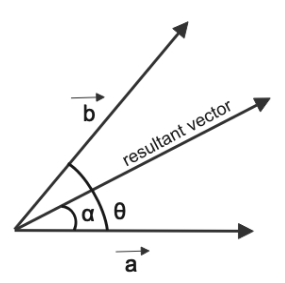
To solve for the magnitude of vector $\vec a$ we only have to use the relation between angle which resultant make with $\vec a$ , angle between $\vec a$ and $\vec b$ along with the magnitudes of both vector $\vec a$ and $\vec b$.
$\tan \alpha = \dfrac{{b\sin \theta }}{{a + b\cos \theta }}$
$\Rightarrow \alpha = 45^\circ $
$\Rightarrow \theta = 60^\circ $
Now we will find the trigonometric values which are required in the formula
$\tan 45^\circ = 1$
$\Rightarrow \sin 60^\circ = \dfrac{{\sqrt 3 }}{2}$
$\Rightarrow \cos 60^\circ = \dfrac{1}{2}$
$\Rightarrow \tan \alpha = \dfrac{{b\sin \theta }}{{a + b\cos \theta }}$
Now we will substitute the trigonometric terms
$\tan 45^\circ = \dfrac{{b\sin 60^\circ }}{{a + b\cos 60^\circ }}$
We will substitute the values of trigonometric terms
$1 = \dfrac{{b\left( {\dfrac{{\sqrt 3 }}{2}} \right)}}{{a + b\left( {\dfrac{1}{2}} \right)}}$
Now we will take the denominator of right hand side to left hand side
$a + b\left( {\dfrac{1}{2}} \right) = b\left( {\dfrac{{\sqrt 3 }}{2}} \right)$
Now substituting the magnitude of vector b
$a + 2\left( {\dfrac{1}{2}} \right) = 2\left( {\dfrac{{\sqrt 3 }}{2}} \right)$
Solving the equation for a and we get
$\therefore a = \sqrt 3 - 1$
Hence, the correct option is B.
Note: Many of the students will make the mistake by not using directly the relationship between angle which resultant make with $\vec a$ , angle between $\vec a$ and $\vec b$ along with the magnitudes of both vector $\vec a$ and $\vec b$ but instead of they will first find the resultant and then they will use trigonometry and diagram to find the result this method have chances of confusion and will make the answer lengthy.
Formula used:
$\tan \alpha = \dfrac{{b\sin \theta }}{{a + b\cos \theta }}$
Here, $\theta $ is the angle between the vectors and $\alpha $ is the angle that the vector makes with the resultant.
Complete step by step answer:
In the question we are given the angle between two vector $\vec a$ and $\vec b$ along with this we are also given the angle what resultant make with the $\vec a$ question also provide us the magnitude of vector $\vec b$ and we have to find the magnitude of vector $\vec a$.
Angle between $\vec a$ and $\vec b$ = $60^\circ $
Angle between $\vec a$ and the resultant = $45^\circ $
Magnitude of vector $\vec b$ ( $|\vec b|$ ) = 2 unit
To solve for the magnitude of vector $\vec a$ we only have to use the relation between angle which resultant make with $\vec a$ , angle between $\vec a$ and $\vec b$ along with the magnitudes of both vector $\vec a$ and $\vec b$.
$\tan \alpha = \dfrac{{b\sin \theta }}{{a + b\cos \theta }}$
$\Rightarrow \alpha = 45^\circ $
$\Rightarrow \theta = 60^\circ $
Now we will find the trigonometric values which are required in the formula
$\tan 45^\circ = 1$
$\Rightarrow \sin 60^\circ = \dfrac{{\sqrt 3 }}{2}$
$\Rightarrow \cos 60^\circ = \dfrac{1}{2}$
$\Rightarrow \tan \alpha = \dfrac{{b\sin \theta }}{{a + b\cos \theta }}$
Now we will substitute the trigonometric terms
$\tan 45^\circ = \dfrac{{b\sin 60^\circ }}{{a + b\cos 60^\circ }}$
We will substitute the values of trigonometric terms
$1 = \dfrac{{b\left( {\dfrac{{\sqrt 3 }}{2}} \right)}}{{a + b\left( {\dfrac{1}{2}} \right)}}$
Now we will take the denominator of right hand side to left hand side
$a + b\left( {\dfrac{1}{2}} \right) = b\left( {\dfrac{{\sqrt 3 }}{2}} \right)$
Now substituting the magnitude of vector b
$a + 2\left( {\dfrac{1}{2}} \right) = 2\left( {\dfrac{{\sqrt 3 }}{2}} \right)$
Solving the equation for a and we get
$\therefore a = \sqrt 3 - 1$
Hence, the correct option is B.
Note: Many of the students will make the mistake by not using directly the relationship between angle which resultant make with $\vec a$ , angle between $\vec a$ and $\vec b$ along with the magnitudes of both vector $\vec a$ and $\vec b$ but instead of they will first find the resultant and then they will use trigonometry and diagram to find the result this method have chances of confusion and will make the answer lengthy.
Recently Updated Pages
Master Class 11 Computer Science: Engaging Questions & Answers for Success

Master Class 11 Business Studies: Engaging Questions & Answers for Success
Master Class 11 Economics: Engaging Questions & Answers for Success
Master Class 11 English: Engaging Questions & Answers for Success
Master Class 11 Maths: Engaging Questions & Answers for Success
Master Class 11 Biology: Engaging Questions & Answers for Success
Trending doubts
One Metric ton is equal to kg A 10000 B 1000 C 100 class 11 physics CBSE
There are 720 permutations of the digits 1 2 3 4 5 class 11 maths CBSE
Discuss the various forms of bacteria class 11 biology CBSE
Draw a diagram of a plant cell and label at least eight class 11 biology CBSE
State the laws of reflection of light
Explain zero factorial class 11 maths CBSE