




Three forces are acting on a body as shown in the figure. To have the resultant force only along the Y-direction, the magnitude of the minimum additional force needed along OX is?

Answer
 Verified
569.1k+ views
Hint: We have been given the forces and the angle they make with the axes. Using this we can find the value of resultant along both the axes. But we want resultant only in Y –direction so the sum of the forces will be zero along X – axis so that the resultant along X direction also becomes zero
Complete step by step answer:
If we want the resultant of all the given forces making respective given forces with the axes to be only in Y – direction then the components of all the forces along X – axis will be zero so that the resultant in X direction becomes zero.
The forces along X and Y axes are given by the product of force with the cos (along X – axis) and sine (along Y – axis) of the angles formed between the force and the axes respectively.
The angles formed along X – axis to find the value of forces along the same can be given as:
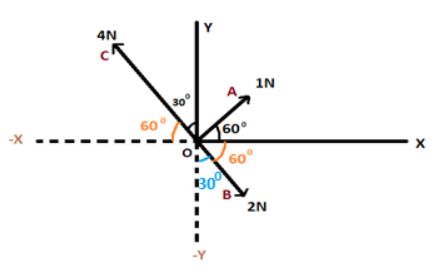
$\angle - YOB = {30^\circ }$ as it is vertically opposite to the given angle of 30°
$\angle XOB = {60^o}$
$\left(
\because \angle XO - Y = {90^\circ } \\
\Rightarrow \angle XOB + \angle - YOB = {90^\circ } \\
\Rightarrow \angle XOB + {30^\circ } = {90^\circ } \\
\Rightarrow \angle XOB = {60^\circ } \\ \right)$
Similarly, $\angle - XOC = {60^o}$
Now, the magnitude of all the forces along X – axis can be given as:
$
{F_A} = 1 \times \cos {60^\circ } \\
{F_B} = 2 \times \cos {60^\circ } \\
{F_C} = 4 \times \cos {60^\circ } \\
$
The value of $\cos {60^\circ }$ is $\dfrac{1}{2}$, so:
$
{F_A} \to 1 \times \dfrac{1}{2} = \dfrac{1}{2}N \\
{F_B} \to 2 \times \dfrac{1}{2} = 1N \\
{F_C} \to 4 \times \dfrac{1}{2} = - 2N \\
$
As the force C is in the negative direction of X – axis, its value is taken as negative.
Let the minimum additional force required along OX (X – axis) be ${F_{req}}$.
Then the sum of all forces equated to zero is given as:
$
\dfrac{1}{2}N + 1N - 2N + {F_{req}} = 0 \\
\dfrac{3}{2}N - 2N + {F_{req}} = 0 \\
\Rightarrow {F_{req}} = 2N - \dfrac{3}{2}N \\
\Rightarrow {F_{req}} = \dfrac{1}{2}N \\
or \\
\Rightarrow {F_{req}} = 0.5N \\
$
Therefore, the minimum additional force needed along OX is $\dfrac{1}{2}N$ or 0.5 N
Note:
Remember that we have to consider sine of angle for Y – axis and cos of angle for X – axis.
The resultant initially would have been along both X and Y directions but it was given in the question that we need resultant along the y – direction only. Thus for neglecting the components of force along the X direction, we equated their sum along with the required force (since it was also along X – axis) to zero.
Complete step by step answer:
If we want the resultant of all the given forces making respective given forces with the axes to be only in Y – direction then the components of all the forces along X – axis will be zero so that the resultant in X direction becomes zero.
The forces along X and Y axes are given by the product of force with the cos (along X – axis) and sine (along Y – axis) of the angles formed between the force and the axes respectively.
The angles formed along X – axis to find the value of forces along the same can be given as:
$\angle - YOB = {30^\circ }$ as it is vertically opposite to the given angle of 30°
$\angle XOB = {60^o}$
$\left(
\because \angle XO - Y = {90^\circ } \\
\Rightarrow \angle XOB + \angle - YOB = {90^\circ } \\
\Rightarrow \angle XOB + {30^\circ } = {90^\circ } \\
\Rightarrow \angle XOB = {60^\circ } \\ \right)$
Similarly, $\angle - XOC = {60^o}$
Now, the magnitude of all the forces along X – axis can be given as:
$
{F_A} = 1 \times \cos {60^\circ } \\
{F_B} = 2 \times \cos {60^\circ } \\
{F_C} = 4 \times \cos {60^\circ } \\
$
The value of $\cos {60^\circ }$ is $\dfrac{1}{2}$, so:
$
{F_A} \to 1 \times \dfrac{1}{2} = \dfrac{1}{2}N \\
{F_B} \to 2 \times \dfrac{1}{2} = 1N \\
{F_C} \to 4 \times \dfrac{1}{2} = - 2N \\
$
As the force C is in the negative direction of X – axis, its value is taken as negative.
Let the minimum additional force required along OX (X – axis) be ${F_{req}}$.
Then the sum of all forces equated to zero is given as:
$
\dfrac{1}{2}N + 1N - 2N + {F_{req}} = 0 \\
\dfrac{3}{2}N - 2N + {F_{req}} = 0 \\
\Rightarrow {F_{req}} = 2N - \dfrac{3}{2}N \\
\Rightarrow {F_{req}} = \dfrac{1}{2}N \\
or \\
\Rightarrow {F_{req}} = 0.5N \\
$
Therefore, the minimum additional force needed along OX is $\dfrac{1}{2}N$ or 0.5 N
Note:
Remember that we have to consider sine of angle for Y – axis and cos of angle for X – axis.
The resultant initially would have been along both X and Y directions but it was given in the question that we need resultant along the y – direction only. Thus for neglecting the components of force along the X direction, we equated their sum along with the required force (since it was also along X – axis) to zero.
Recently Updated Pages
Master Class 11 Computer Science: Engaging Questions & Answers for Success

Master Class 11 Business Studies: Engaging Questions & Answers for Success
Master Class 11 Economics: Engaging Questions & Answers for Success
Master Class 11 English: Engaging Questions & Answers for Success
Master Class 11 Maths: Engaging Questions & Answers for Success
Master Class 11 Biology: Engaging Questions & Answers for Success
Trending doubts
One Metric ton is equal to kg A 10000 B 1000 C 100 class 11 physics CBSE
There are 720 permutations of the digits 1 2 3 4 5 class 11 maths CBSE
Discuss the various forms of bacteria class 11 biology CBSE
Draw a diagram of a plant cell and label at least eight class 11 biology CBSE
State the laws of reflection of light
Explain zero factorial class 11 maths CBSE