




Three particles, each of mass M, are situated at the vertices of an equilateral triangle of side ‘a’. The only forces acting on the particles are their mutual gravitational forces. It is desired that each particle moves in a circle while maintaining their original separation ‘a’. The initial velocity that should be given to each particle and time period of circular motion are respectively.
A. $\sqrt {\dfrac{{2GM}}{a}} ,2\pi \sqrt {\dfrac{{{a^3}}}{{3GM}}} $
B. $\sqrt {\dfrac{{GM}}{a}} ,\dfrac{1}{{2\pi }}\sqrt {\dfrac{{3GM}}{{{a^3}}}} $
C. $\sqrt {\dfrac{{GM}}{a}} ,2\pi \sqrt {\dfrac{{{a^3}}}{{3GM}}} $
D. $\sqrt {\dfrac{{GM}}{{3a}}} ,2\pi \sqrt {\dfrac{{{a^3}}}{{3GM}}} $
Answer
 Verified
598.5k+ views
Hint: Net gravitational force acting on each particle should balance the centripetal force to maintain the original distance of separation during the circular motion
Complete answer:
According to Newton’s law of Gravitation, gravitational force acting between two masses is directly proportional to the product of their masses and inversely proportional to the square of distance between the centres of the two masses. In the given problem, the three masses are same as $M$ and are positioned on the vertex of an equilateral triangle ABC of side $a$ as follows:
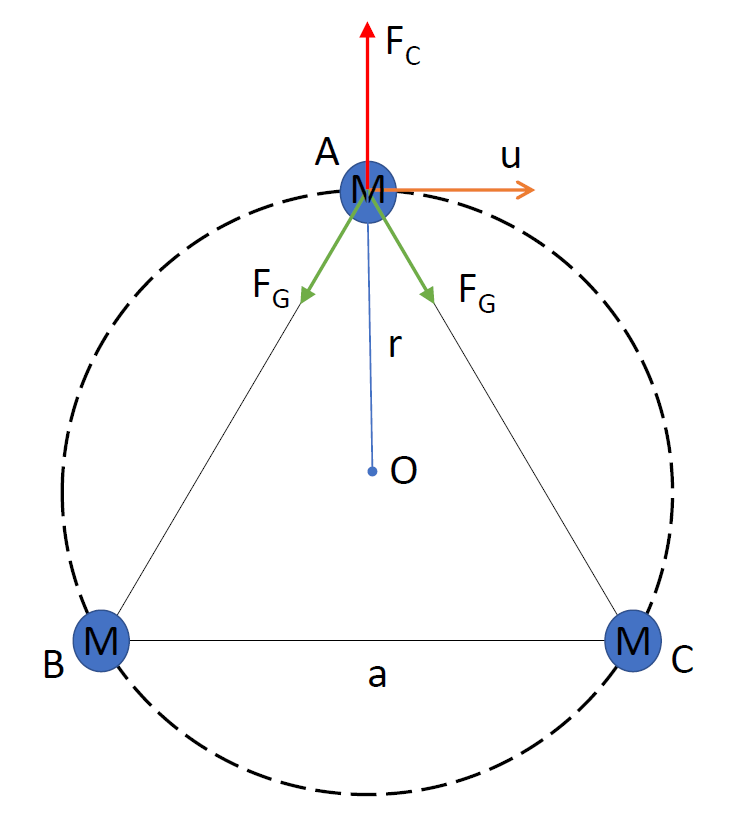
Let O be the centre and $r$ be the radius of the circular motion and $u$ be the velocity of the particles along the circle. Consider the force balance for particles at A.
Outward centripetal force on the particle is given by following expression:
${F_C} = \dfrac{{M{u^2}}}{r}$ (1)
Gravitation force in the direction given in the above diagram based on Newton’s law discussed earlier is given as follows. Consider force on A due to C.
${F_G} = \dfrac{{G{M^2}}}{{{a^2}}}$ (2)
Since the mass at B is also same, the magnitude of the gravitational force is same but directed as shown in above direction, i.e. from A to B. Resultant of two vectors p, q is given by
$R = \sqrt {{p^2} + {q^2} + 2pq\cos \theta } $
Here, both vectors are gravitational forces separated by angle, $\theta = 60$. Since both their magnitudes are the same they will be directed toward the centre in the direction opposite to centripetal force as shown in the diagram. This is also because we have positioned the particles at the vertex of the equilateral triangle. So the resultant gravitational force is given as:
$\begin{gathered}
\Rightarrow R = \sqrt {{{\left( {\dfrac{{G{M^2}}}{{{a^2}}}} \right)}^2} + {{\left( {\dfrac{{G{M^2}}}{{{a^2}}}} \right)}^2} + 2\left( {\dfrac{{G{M^2}}}{{{a^2}}}} \right)\left( {\dfrac{{G{M^2}}}{{{a^2}}}} \right)\cos 60} \\
\Rightarrow R = \sqrt 3 \dfrac{{G{M^2}}}{{{a^2}}} \\
\end{gathered} $ (3)
Now, for maintaining the circular motion and also the distance the centripetal force in (1) should balance the resultant force given in (3). We get the following relation,
$ \Rightarrow R = {F_C}$
$ \Rightarrow \sqrt 3 \dfrac{{G{M^2}}}{{{a^2}}} = \dfrac{{M{u^2}}}{r}$
$ \Rightarrow {u^2} = \dfrac{{\sqrt 3 rGM}}{{{a^2}}}$
Since the circle covers the equilateral triangle, the radius of the circle and the side of the equilateral triangle as follows:
$\begin{gathered}
\Rightarrow \dfrac{{\left( {\dfrac{a}{2}} \right)}}{r} = \cos 30 = \dfrac{{\sqrt 3 }}{2} \\
\Rightarrow a = \sqrt 3 r \\
\end{gathered} $.
The line joining the centre to the vertex becomes the angle bisector at vertex. So we have 30 degrees for the above cosine term.
Substituting this in the last velocity relation,
$ \Rightarrow u = \sqrt {\dfrac{{GM}}{a}} $ (4)
To find the time period of the motion, we need to find the time the particle takes to complete one revolution around the centre. Distance covered in one revolution is equal to the circumference of the circle $ = 2\pi r$ and let $T$ be the time period.
$ \Rightarrow u = \dfrac{{2\pi r}}{T} = \dfrac{{2\pi a}}{{\sqrt 3 T}}$. Using the relation between $a$ and $r$.
$\begin{gathered}
\Rightarrow \sqrt {\dfrac{{GM}}{a}} = \dfrac{{2\pi a}}{{\sqrt 3 T}} \\
\Rightarrow T = 2\pi \sqrt {\dfrac{{{a^3}}}{{3GM}}} \\
\end{gathered} $ (5)
Comparing (4) and (5) with the options, we see that option C is the correct option.
Note: While simplifying the expressions focus on bringing the terms with parameters used in the options. Like the final expressions can be written in terms of $r$ instead of $a$.
Complete answer:
According to Newton’s law of Gravitation, gravitational force acting between two masses is directly proportional to the product of their masses and inversely proportional to the square of distance between the centres of the two masses. In the given problem, the three masses are same as $M$ and are positioned on the vertex of an equilateral triangle ABC of side $a$ as follows:
Let O be the centre and $r$ be the radius of the circular motion and $u$ be the velocity of the particles along the circle. Consider the force balance for particles at A.
Outward centripetal force on the particle is given by following expression:
${F_C} = \dfrac{{M{u^2}}}{r}$ (1)
Gravitation force in the direction given in the above diagram based on Newton’s law discussed earlier is given as follows. Consider force on A due to C.
${F_G} = \dfrac{{G{M^2}}}{{{a^2}}}$ (2)
Since the mass at B is also same, the magnitude of the gravitational force is same but directed as shown in above direction, i.e. from A to B. Resultant of two vectors p, q is given by
$R = \sqrt {{p^2} + {q^2} + 2pq\cos \theta } $
Here, both vectors are gravitational forces separated by angle, $\theta = 60$. Since both their magnitudes are the same they will be directed toward the centre in the direction opposite to centripetal force as shown in the diagram. This is also because we have positioned the particles at the vertex of the equilateral triangle. So the resultant gravitational force is given as:
$\begin{gathered}
\Rightarrow R = \sqrt {{{\left( {\dfrac{{G{M^2}}}{{{a^2}}}} \right)}^2} + {{\left( {\dfrac{{G{M^2}}}{{{a^2}}}} \right)}^2} + 2\left( {\dfrac{{G{M^2}}}{{{a^2}}}} \right)\left( {\dfrac{{G{M^2}}}{{{a^2}}}} \right)\cos 60} \\
\Rightarrow R = \sqrt 3 \dfrac{{G{M^2}}}{{{a^2}}} \\
\end{gathered} $ (3)
Now, for maintaining the circular motion and also the distance the centripetal force in (1) should balance the resultant force given in (3). We get the following relation,
$ \Rightarrow R = {F_C}$
$ \Rightarrow \sqrt 3 \dfrac{{G{M^2}}}{{{a^2}}} = \dfrac{{M{u^2}}}{r}$
$ \Rightarrow {u^2} = \dfrac{{\sqrt 3 rGM}}{{{a^2}}}$
Since the circle covers the equilateral triangle, the radius of the circle and the side of the equilateral triangle as follows:
$\begin{gathered}
\Rightarrow \dfrac{{\left( {\dfrac{a}{2}} \right)}}{r} = \cos 30 = \dfrac{{\sqrt 3 }}{2} \\
\Rightarrow a = \sqrt 3 r \\
\end{gathered} $.
The line joining the centre to the vertex becomes the angle bisector at vertex. So we have 30 degrees for the above cosine term.
Substituting this in the last velocity relation,
$ \Rightarrow u = \sqrt {\dfrac{{GM}}{a}} $ (4)
To find the time period of the motion, we need to find the time the particle takes to complete one revolution around the centre. Distance covered in one revolution is equal to the circumference of the circle $ = 2\pi r$ and let $T$ be the time period.
$ \Rightarrow u = \dfrac{{2\pi r}}{T} = \dfrac{{2\pi a}}{{\sqrt 3 T}}$. Using the relation between $a$ and $r$.
$\begin{gathered}
\Rightarrow \sqrt {\dfrac{{GM}}{a}} = \dfrac{{2\pi a}}{{\sqrt 3 T}} \\
\Rightarrow T = 2\pi \sqrt {\dfrac{{{a^3}}}{{3GM}}} \\
\end{gathered} $ (5)
Comparing (4) and (5) with the options, we see that option C is the correct option.
Note: While simplifying the expressions focus on bringing the terms with parameters used in the options. Like the final expressions can be written in terms of $r$ instead of $a$.
Recently Updated Pages
Master Class 8 Social Science: Engaging Questions & Answers for Success

Master Class 8 English: Engaging Questions & Answers for Success
Class 8 Question and Answer - Your Ultimate Solutions Guide
Master Class 8 Maths: Engaging Questions & Answers for Success
Master Class 8 Science: Engaging Questions & Answers for Success
Master Class 7 English: Engaging Questions & Answers for Success
Trending doubts
Using empirical formula calculate the mode of the following class 1 statistics CBSE
What are the factors of 100 class 7 maths CBSE
Which are the Top 10 Largest Countries of the World?
What is BLO What is the full form of BLO class 8 social science CBSE
The value of 6 more than 7 is A 1 B 1 C 13 D 13 class 7 maths CBSE
One Metric ton is equal to kg A 10000 B 1000 C 100 class 11 physics CBSE