




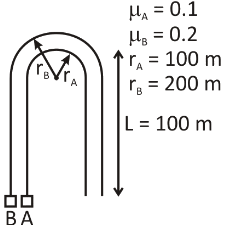
Two car A and B start racing at the same time on a flat race track which consists of two straight sections each of length \[100\pi \]and one circular section as is the Fig. The rule of the race is that each car must travel at a constant speed at all times without ever skidding. Then:
A. Car A completes its journey before car B.
B. Both cars complete the journey at the same time.
C. Velocity of car A is greater than that of car B.
D. Car B completes its journey before car A.
Answer
 Verified
568.5k+ views
Hint: First of all, we will find the centripetal and the centrifugal forces, which acts on the two cars. Both of them will be equal and we will equate. We will find the velocity, distance covered and the time taken by each car. After that we will compare the results.
Formula used:
The formula that gives the centrifugal force is:
\[{F_{{\text{cp}}}} = \mu mg\]
Where,
\[\mu \] indicates coefficient of friction.
\[m\] indicates mass of the body.
\[g\] indicates acceleration due to gravity.
Centripetal force can be written as:
\[{F_{{\text{cg}}}} = \dfrac{{m{v^2}}}{r}\]
Where,
\[m\] indicates mass of the body.
\[r\] indicates the radius of the path.
\[v\] indicates velocity.
Complete step by step answer:
If the condition is taken for the cars not to slide, then the centripetal force should be equal to centrifugal force. Then, mathematically it can be written as:
\[\mu mg = \dfrac{{m{v^2}}}{r}\]
Rearranging the above equation:
$\mu mg = \dfrac{{m{v^2}}}{r} \\
\Rightarrow \mu \times r \times g = {v^2} \\
\Rightarrow v = \sqrt {\mu \times r \times g} \\$
Hence, the expression for velocity is:
\[v = \sqrt {\mu \times r \times g} \] ...... (1)
The curved path is semi-circular.
For the car A, the velocity can be found out by substituting \[\mu = 0.1\], \[r = 100\,{\text{m}}\] and \[g = 10\,{\text{m/}}{{\text{s}}^{\text{2}}}\] in equation (1):
$v = \sqrt {\mu \times r \times g} \\
\Rightarrow v = \sqrt {0.1 \times 100 \times 10} \\
\Rightarrow v = \sqrt {\dfrac{1}{{10}} \times 100 \times 10} \\
\Rightarrow v = \sqrt {100} \\$
\[ \Rightarrow v = 10\,{\text{m/s}}\]
Total distance travelled by the car A is the summation of the distance of two straight sections and curved distance i.e.
Total distance \[\left( S \right)\]:
$S = 2 \times 100\pi + 100\pi \\
\Rightarrow S = 200\pi + 100\pi \\
\Rightarrow S = 300\pi \\$
The time taken is given by the formula:
${t_{\text{A}}} = \dfrac{S}{v} \\
\Rightarrow {t_{\text{A}}} = \dfrac{{300\pi }}{{10}} \\
\Rightarrow {t_{\text{A}}} = 30\pi \,{\text{sec}} \\$
For the car B,
The velocity can be found out by substituting \[\mu = 0.2\], \[r = 200\,{\text{m}}\] and \[g = 10\,{\text{m/}}{{\text{s}}^{\text{2}}}\] in equation (1):
$v = \sqrt {\mu \times r \times g} \\
\Rightarrow v = \sqrt {0.2 \times 200 \times 10} \\
\Rightarrow v = \sqrt {\dfrac{2}{{10}} \times 200 \times 10} \\
\Rightarrow v = \sqrt {400} \\$
\[ \Rightarrow v = 20\,{\text{m/s}}\]
Total distance travelled by the car A is the summation of the distance of two straight sections and curved distance i.e, total distance \[\left( S \right)\]:
$S = 2 \times 100\pi + 200\pi \\
\Rightarrow S = 200\pi + 200\pi \\
\Rightarrow S = 400\pi \\$
The time taken is given by the formula:
${t_{\text{B}}} = \dfrac{S}{v} \\
\Rightarrow {t_{\text{B}}} = \dfrac{{400\pi }}{{20}} \\
\Rightarrow {t_{\text{B}}} = 20\pi \,{\text{sec}} \\$
Since, the time taken by car A is more than car B. So, car B completes its journey before car A.
The correct option is D.
Note: While solving this problem, most of the students seem to have a confusion regarding the total distance covered by each car. The net distance travelled by each car is the summation of the longitudinal distance and the circumference of the semi-circle. Lower the time taken, faster it moves.
Formula used:
The formula that gives the centrifugal force is:
\[{F_{{\text{cp}}}} = \mu mg\]
Where,
\[\mu \] indicates coefficient of friction.
\[m\] indicates mass of the body.
\[g\] indicates acceleration due to gravity.
Centripetal force can be written as:
\[{F_{{\text{cg}}}} = \dfrac{{m{v^2}}}{r}\]
Where,
\[m\] indicates mass of the body.
\[r\] indicates the radius of the path.
\[v\] indicates velocity.
Complete step by step answer:
If the condition is taken for the cars not to slide, then the centripetal force should be equal to centrifugal force. Then, mathematically it can be written as:
\[\mu mg = \dfrac{{m{v^2}}}{r}\]
Rearranging the above equation:
$\mu mg = \dfrac{{m{v^2}}}{r} \\
\Rightarrow \mu \times r \times g = {v^2} \\
\Rightarrow v = \sqrt {\mu \times r \times g} \\$
Hence, the expression for velocity is:
\[v = \sqrt {\mu \times r \times g} \] ...... (1)
The curved path is semi-circular.
For the car A, the velocity can be found out by substituting \[\mu = 0.1\], \[r = 100\,{\text{m}}\] and \[g = 10\,{\text{m/}}{{\text{s}}^{\text{2}}}\] in equation (1):
$v = \sqrt {\mu \times r \times g} \\
\Rightarrow v = \sqrt {0.1 \times 100 \times 10} \\
\Rightarrow v = \sqrt {\dfrac{1}{{10}} \times 100 \times 10} \\
\Rightarrow v = \sqrt {100} \\$
\[ \Rightarrow v = 10\,{\text{m/s}}\]
Total distance travelled by the car A is the summation of the distance of two straight sections and curved distance i.e.
Total distance \[\left( S \right)\]:
$S = 2 \times 100\pi + 100\pi \\
\Rightarrow S = 200\pi + 100\pi \\
\Rightarrow S = 300\pi \\$
The time taken is given by the formula:
${t_{\text{A}}} = \dfrac{S}{v} \\
\Rightarrow {t_{\text{A}}} = \dfrac{{300\pi }}{{10}} \\
\Rightarrow {t_{\text{A}}} = 30\pi \,{\text{sec}} \\$
For the car B,
The velocity can be found out by substituting \[\mu = 0.2\], \[r = 200\,{\text{m}}\] and \[g = 10\,{\text{m/}}{{\text{s}}^{\text{2}}}\] in equation (1):
$v = \sqrt {\mu \times r \times g} \\
\Rightarrow v = \sqrt {0.2 \times 200 \times 10} \\
\Rightarrow v = \sqrt {\dfrac{2}{{10}} \times 200 \times 10} \\
\Rightarrow v = \sqrt {400} \\$
\[ \Rightarrow v = 20\,{\text{m/s}}\]
Total distance travelled by the car A is the summation of the distance of two straight sections and curved distance i.e, total distance \[\left( S \right)\]:
$S = 2 \times 100\pi + 200\pi \\
\Rightarrow S = 200\pi + 200\pi \\
\Rightarrow S = 400\pi \\$
The time taken is given by the formula:
${t_{\text{B}}} = \dfrac{S}{v} \\
\Rightarrow {t_{\text{B}}} = \dfrac{{400\pi }}{{20}} \\
\Rightarrow {t_{\text{B}}} = 20\pi \,{\text{sec}} \\$
Since, the time taken by car A is more than car B. So, car B completes its journey before car A.
The correct option is D.
Note: While solving this problem, most of the students seem to have a confusion regarding the total distance covered by each car. The net distance travelled by each car is the summation of the longitudinal distance and the circumference of the semi-circle. Lower the time taken, faster it moves.
Recently Updated Pages
Master Class 11 Computer Science: Engaging Questions & Answers for Success

Master Class 11 Business Studies: Engaging Questions & Answers for Success
Master Class 11 Economics: Engaging Questions & Answers for Success
Master Class 11 English: Engaging Questions & Answers for Success
Master Class 11 Maths: Engaging Questions & Answers for Success
Master Class 11 Biology: Engaging Questions & Answers for Success
Trending doubts
One Metric ton is equal to kg A 10000 B 1000 C 100 class 11 physics CBSE
There are 720 permutations of the digits 1 2 3 4 5 class 11 maths CBSE
Discuss the various forms of bacteria class 11 biology CBSE
Draw a diagram of a plant cell and label at least eight class 11 biology CBSE
State the laws of reflection of light
Explain zero factorial class 11 maths CBSE