




Two identical spheres with charges 4q and -2q kept some distance apart exert a force F on each other. If they are made to touch each other and replaced at their old position, the force between them will be,
Answer
 Verified
568.5k+ views
Hint: In this question we have been given that two charged spheres are initially kept apart and then made to touch each other before placing them at their original place. Therefore, in order to calculate the force between them after touching, we shall calculate the charge on the spheres after touching. Then we can use Coulomb’s law to calculate the force as it deals with charge on two particles separated by a distance and force.
Formula Used: \[F=\dfrac{k{{q}_{1}}{{q}_{2}}}{{{r}^{2}}}\]
Complete answer:
It is given that the two spheres with charge 4q and – 2q are kept at some distance say r apart as shown in the figure below.
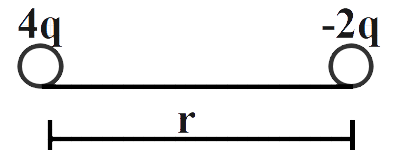
Now, we know that there shall be attraction force between two charges as they are of opposite polarity. We also know that, when the charges are made to touch the total charge will be the sum of both charges and this charge shall be equally distributed on both charge after separation
From coulomb’s law we know,
\[F=\dfrac{k{{q}_{1}}{{q}_{2}}}{{{r}^{2}}}\]
Therefore, the force on both charges before touching can be given by,
\[F=\dfrac{k(4q)(-2q)}{{{r}^{2}}}\]
On solving
We get,
\[F=\dfrac{-8k{{q}^{2}}}{{{r}^{2}}}\] …………….. (1)
Now when the two spheres touch the total charge on both spheres will be
\[Q'=4q+(-2q)\]
Therefore,
\[Q'=2q\]
Therefore, after separation each sphere will have the charge of 1q. Therefore, now the force will be repulsive as the charges are of the same polarity.
Therefore, the force can be given as,
\[F'=\dfrac{k(2q)(2q)}{{{r}^{2}}}\]
Therefore,
\[F'=\dfrac{4k{{q}^{2}}}{{{r}^{2}}}\]………….. (2)
Now, taking the magnitude of equation (1) we get,
\[\left| F \right|=\dfrac{8k{{q}^{2}}}{{{r}^{2}}}\]
Therefore,
\[\dfrac{k{{q}^{2}}}{{{r}^{2}}}=\dfrac{F}{8}\]
Substituting the above value in equation (2)
We get,
\[F'=\dfrac{4F}{8}\]
Therefore,
\[F'=\dfrac{F}{2}\]
Therefore, the force after the separation of the charges will be half the original force.
Note:
Coulomb’s law states that the force acting between the two charged particles is directly proportional to the product of amount of charge on each particle and inversely proportional to the square of distance between the particles. The vector form of Coulomb’s law helps in determining the direction of electric field due to the charges.
Formula Used: \[F=\dfrac{k{{q}_{1}}{{q}_{2}}}{{{r}^{2}}}\]
Complete answer:
It is given that the two spheres with charge 4q and – 2q are kept at some distance say r apart as shown in the figure below.
Now, we know that there shall be attraction force between two charges as they are of opposite polarity. We also know that, when the charges are made to touch the total charge will be the sum of both charges and this charge shall be equally distributed on both charge after separation
From coulomb’s law we know,
\[F=\dfrac{k{{q}_{1}}{{q}_{2}}}{{{r}^{2}}}\]
Therefore, the force on both charges before touching can be given by,
\[F=\dfrac{k(4q)(-2q)}{{{r}^{2}}}\]
On solving
We get,
\[F=\dfrac{-8k{{q}^{2}}}{{{r}^{2}}}\] …………….. (1)
Now when the two spheres touch the total charge on both spheres will be
\[Q'=4q+(-2q)\]
Therefore,
\[Q'=2q\]
Therefore, after separation each sphere will have the charge of 1q. Therefore, now the force will be repulsive as the charges are of the same polarity.
Therefore, the force can be given as,
\[F'=\dfrac{k(2q)(2q)}{{{r}^{2}}}\]
Therefore,
\[F'=\dfrac{4k{{q}^{2}}}{{{r}^{2}}}\]………….. (2)
Now, taking the magnitude of equation (1) we get,
\[\left| F \right|=\dfrac{8k{{q}^{2}}}{{{r}^{2}}}\]
Therefore,
\[\dfrac{k{{q}^{2}}}{{{r}^{2}}}=\dfrac{F}{8}\]
Substituting the above value in equation (2)
We get,
\[F'=\dfrac{4F}{8}\]
Therefore,
\[F'=\dfrac{F}{2}\]
Therefore, the force after the separation of the charges will be half the original force.
Note:
Coulomb’s law states that the force acting between the two charged particles is directly proportional to the product of amount of charge on each particle and inversely proportional to the square of distance between the particles. The vector form of Coulomb’s law helps in determining the direction of electric field due to the charges.
Recently Updated Pages
Master Class 11 Computer Science: Engaging Questions & Answers for Success

Master Class 11 Business Studies: Engaging Questions & Answers for Success
Master Class 11 Economics: Engaging Questions & Answers for Success
Master Class 11 English: Engaging Questions & Answers for Success
Master Class 11 Maths: Engaging Questions & Answers for Success
Master Class 11 Biology: Engaging Questions & Answers for Success
Trending doubts
One Metric ton is equal to kg A 10000 B 1000 C 100 class 11 physics CBSE
There are 720 permutations of the digits 1 2 3 4 5 class 11 maths CBSE
Discuss the various forms of bacteria class 11 biology CBSE
Draw a diagram of a plant cell and label at least eight class 11 biology CBSE
State the laws of reflection of light
Explain zero factorial class 11 maths CBSE