




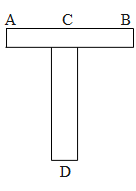
Two identical thin uniform rods of length L each are joined to form T shape as shown in the figure. The distance of the centre of mass from D is
$\begin{align}
& (1)0 \\
& (2)\dfrac{L}{4} \\
& (3)\dfrac{3L}{4} \\
& (4)L \\
\end{align}$
Answer
 Verified
513.3k+ views
Hint : We know that the centre of mass of a body is the point where the whole mass of the body is concentrated. Thus for a system of particles this point is called the point of centre of mass. Thus in order to find the centre of mass of a T shaped rod, then first we have to find the centre of mass of the individual rod. Then find the centre of mass along the vertical rod, we will get the solution.
Complete step-by-step solution:
Given that the length of the rod is L. Hence its centre of mass lies at the half length $\dfrac{L}{2}$.
The centre of mass along the vertical line is,
\[{{y}_{CM}}=\dfrac{{{m}_{1}}{{y}_{1}}+{{m}_{2}}{{y}_{2}}}{{{m}_{1}}+{{m}_{2}}}\]
\[{{y}_{CM}}=\dfrac{0+\dfrac{mL}{2}}{2m}\]
\[{{y}_{CM}}=\dfrac{L}{4}\]
Hence here the centre of mass of the system lies at the lower end of the rod. Thus The distance of the centre of mass from D is $\dfrac{L}{4}$.
Therefore option (2) is correct.
Note: So we calculate the centre of mass of every object by simply knowing their masses and multiplying them by their positions. Besides the pure geometric method we can also find the centre of gravity of any object by the plum line method. For a sphere of uniform density the centre of mass lies at the geometric centre of the sphere.
Complete step-by-step solution:
Given that the length of the rod is L. Hence its centre of mass lies at the half length $\dfrac{L}{2}$.
The centre of mass along the vertical line is,
\[{{y}_{CM}}=\dfrac{{{m}_{1}}{{y}_{1}}+{{m}_{2}}{{y}_{2}}}{{{m}_{1}}+{{m}_{2}}}\]
\[{{y}_{CM}}=\dfrac{0+\dfrac{mL}{2}}{2m}\]
\[{{y}_{CM}}=\dfrac{L}{4}\]
Hence here the centre of mass of the system lies at the lower end of the rod. Thus The distance of the centre of mass from D is $\dfrac{L}{4}$.
Therefore option (2) is correct.
Note: So we calculate the centre of mass of every object by simply knowing their masses and multiplying them by their positions. Besides the pure geometric method we can also find the centre of gravity of any object by the plum line method. For a sphere of uniform density the centre of mass lies at the geometric centre of the sphere.
Recently Updated Pages
Master Class 11 Computer Science: Engaging Questions & Answers for Success

Master Class 11 Business Studies: Engaging Questions & Answers for Success
Master Class 11 Economics: Engaging Questions & Answers for Success
Master Class 11 English: Engaging Questions & Answers for Success
Master Class 11 Maths: Engaging Questions & Answers for Success
Master Class 11 Biology: Engaging Questions & Answers for Success
Trending doubts
One Metric ton is equal to kg A 10000 B 1000 C 100 class 11 physics CBSE
There are 720 permutations of the digits 1 2 3 4 5 class 11 maths CBSE
Discuss the various forms of bacteria class 11 biology CBSE
Draw a diagram of a plant cell and label at least eight class 11 biology CBSE
State the laws of reflection of light
Explain zero factorial class 11 maths CBSE