




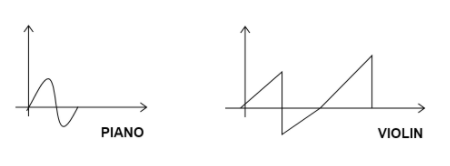
Two musical notes of the same pitch and loudness are played on a violin and a piano. The waveforms as shown in the figure are given below. Explain why the wave patterns are different.
Answer
 Verified
556.5k+ views
Hint: The musical notes are played even on the same pitch and loudness has different waveforms because the type of sound from the two instruments is different. The quality of sound plays an important role in determining the type of waveform.
Complete answer:
Sounds from different instruments even when they are of the same pitch and loudness because of the quality of sound or the tone differs with the type of instrument.
In the case of any sound, there does not exist only one frequency that sounds are not made of only pure notes. Every sound consists of the main note and various other smaller notes.
The smaller notes are known as overtones or harmonics.
Every sound has harmonics in it, the only exception being in the case of a tuning fork.
The main note present in the sound is known as the fundamental and the first overtone is known as the first harmonics, the second overtone is known as the second harmonic, and so on.
Since the sum of these harmonics differs in the case of the piano from that of the violin, the tone or quality of sound in both instruments are also different.
Hence, the waveform of sound produced from the two instruments is different.
Note:
In the case of a tuning fork, there is only fundamental and no harmonics. This is because the sound from the tuning fork is produced due to vibrations and the tuning fork emits pure sine waves at a single frequency. Due to this, the sound emitted by the tuning fork is pure and free from harmonics.
Complete answer:
Sounds from different instruments even when they are of the same pitch and loudness because of the quality of sound or the tone differs with the type of instrument.
In the case of any sound, there does not exist only one frequency that sounds are not made of only pure notes. Every sound consists of the main note and various other smaller notes.
The smaller notes are known as overtones or harmonics.
Every sound has harmonics in it, the only exception being in the case of a tuning fork.
The main note present in the sound is known as the fundamental and the first overtone is known as the first harmonics, the second overtone is known as the second harmonic, and so on.
Since the sum of these harmonics differs in the case of the piano from that of the violin, the tone or quality of sound in both instruments are also different.
Hence, the waveform of sound produced from the two instruments is different.
Note:
In the case of a tuning fork, there is only fundamental and no harmonics. This is because the sound from the tuning fork is produced due to vibrations and the tuning fork emits pure sine waves at a single frequency. Due to this, the sound emitted by the tuning fork is pure and free from harmonics.
Recently Updated Pages
Master Class 11 Computer Science: Engaging Questions & Answers for Success

Master Class 11 Business Studies: Engaging Questions & Answers for Success
Master Class 11 Economics: Engaging Questions & Answers for Success
Master Class 11 English: Engaging Questions & Answers for Success
Master Class 11 Maths: Engaging Questions & Answers for Success
Master Class 11 Biology: Engaging Questions & Answers for Success
Trending doubts
One Metric ton is equal to kg A 10000 B 1000 C 100 class 11 physics CBSE
There are 720 permutations of the digits 1 2 3 4 5 class 11 maths CBSE
Discuss the various forms of bacteria class 11 biology CBSE
Draw a diagram of a plant cell and label at least eight class 11 biology CBSE
State the laws of reflection of light
Explain zero factorial class 11 maths CBSE