




Two towns A and B are connected by a regular bus service with a bus leaving in either direction every T minutes. A man cycling with a speed of 20 km/h in the direction A to B notices that a bus goes post him every 18 minutes in the direction of his motion, and every 6 minutes in the opposite direction. What is the period T of the bus service and with what speed do the buses ply on the road?
Answer
 Verified
602.1k+ views
Hint: In this problem, you have to be very conceptual, otherwise it is very confusing. We will just imagine a timeline and place the incidents there as necessary to solve the problem. BY considering various activities like “in the direction of motion”, “opposite of direction of motion”.
Formula used: $$ d=v \times t $$
Complete step by step solution:
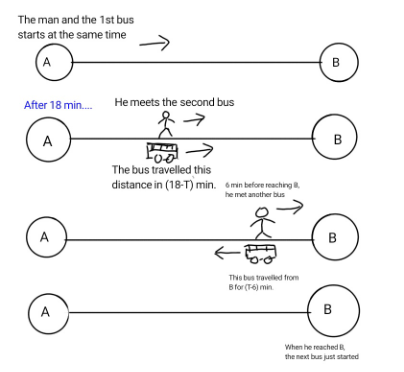
Let us take the velocity of the bus to be v. Also, for our convenience, let the person and a bus start at time $t_1$ o’clock from town A. And let another bus and the person reach town B at time $t_2$ o’clock.
In the direction of motion:
The man meets another bus at time $t_1+18$ min. By the time, he has covered the distance of $d_1=\dfrac{20 km}{60 min}\times 18 min= 6km $. The next bus started at, $t_1+T$ min. So, the next bus has travelled this 6 km in $((t_1+18)-(t_1+T))=18-T$ min. So ….
$(18-T).v=6 …………………1^{st}$ equation
Opposite to the direction of motion:
The man and the bus reach town B at $t_2$ . He met the previous bus at $t_2-6$ min when he was $d_2=\dfrac{20 km}{60 min} \times 6 min=2km $ . And the previous bus started from B at $t_2-T$ . So, the previous bus travelled 2 km in time $((t_2-6)-(t_2-T))=T-6$ min. So …..
$(T-6).v=2 ……………………..2^{nd}$ equation
Solving two equations, we get
T= 9 min and $v=\dfrac{2}{3} km/min=\dfrac{2\times 60}{3} km/h=40 km/h $
This is the required answer.
Additional information:
When two objects move in the same direction, the relative velocity is the difference of their velocities. If they move in opposite directions, relative velocity is the addition of their velocities. However, this concept has not been used here.
Note: Notice that we have made the calculation taking velocity in units of km/min. Later, we have converted the answer into km/h. Try to have a clear idea about the timeline to understand this problem. Students often forget to convert all the units in one single value.
Formula used: $$ d=v \times t $$
Complete step by step solution:
Let us take the velocity of the bus to be v. Also, for our convenience, let the person and a bus start at time $t_1$ o’clock from town A. And let another bus and the person reach town B at time $t_2$ o’clock.
In the direction of motion:
The man meets another bus at time $t_1+18$ min. By the time, he has covered the distance of $d_1=\dfrac{20 km}{60 min}\times 18 min= 6km $. The next bus started at, $t_1+T$ min. So, the next bus has travelled this 6 km in $((t_1+18)-(t_1+T))=18-T$ min. So ….
$(18-T).v=6 …………………1^{st}$ equation
Opposite to the direction of motion:
The man and the bus reach town B at $t_2$ . He met the previous bus at $t_2-6$ min when he was $d_2=\dfrac{20 km}{60 min} \times 6 min=2km $ . And the previous bus started from B at $t_2-T$ . So, the previous bus travelled 2 km in time $((t_2-6)-(t_2-T))=T-6$ min. So …..
$(T-6).v=2 ……………………..2^{nd}$ equation
Solving two equations, we get
T= 9 min and $v=\dfrac{2}{3} km/min=\dfrac{2\times 60}{3} km/h=40 km/h $
This is the required answer.
Additional information:
When two objects move in the same direction, the relative velocity is the difference of their velocities. If they move in opposite directions, relative velocity is the addition of their velocities. However, this concept has not been used here.
Note: Notice that we have made the calculation taking velocity in units of km/min. Later, we have converted the answer into km/h. Try to have a clear idea about the timeline to understand this problem. Students often forget to convert all the units in one single value.
Recently Updated Pages
Master Class 11 Computer Science: Engaging Questions & Answers for Success

Master Class 11 Business Studies: Engaging Questions & Answers for Success
Master Class 11 Economics: Engaging Questions & Answers for Success
Master Class 11 English: Engaging Questions & Answers for Success
Master Class 11 Maths: Engaging Questions & Answers for Success
Master Class 11 Biology: Engaging Questions & Answers for Success
Trending doubts
There are 720 permutations of the digits 1 2 3 4 5 class 11 maths CBSE
Discuss the various forms of bacteria class 11 biology CBSE
Explain zero factorial class 11 maths CBSE
What organs are located on the left side of your body class 11 biology CBSE
Draw a diagram of nephron and explain its structur class 11 biology CBSE
How do I convert ms to kmh Give an example class 11 physics CBSE