




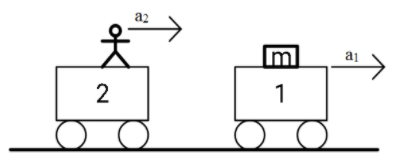
Two trolleys 1 and 2 are moving with accelerations $a_1$ and $a_2$, respectively, in the same direction. A block of mass m on trolley 1 is in equilibrium from the frame of observer stationary with respect to trolley 2. The magnitude of friction force on the block due to the trolley is (assume that no horizontal force other than friction force is acting on the block).
Answer
 Verified
585.3k+ views
Hint: In the frame of the observer the block appears to be stationary because it is also moving with the same acceleration in the forward direction as the observer. Friction resists the forward motion of the block along with the trolley.
Complete answer:
If the block was resting on a stationary surface, and had we applied and external force F, then there would be a resultant motion of the block given by:
$ma = F - f$ ;
where f is the force of friction.
Now, as the block is placed on a moving trolley and it is found to be at rest with another moving observer, we can say that the observer and the block will be moving similarly i.e., with same acceleration.
To understand better, we suppose that trolley 1 moving with $a_1$ block has acceleration $a_2$ with respect to ground such that $a_1 > a_2$ and it also has an acceleration 0 with respect to the observer on trolley 2. This means that the block is unable to move with the velocity of trolley one because it is undergoing a fictional retardation.
The resultant of the block on the trolley can be written as:
$ma_2 = F - f$ ,
as it has a resultant acceleration of $a_2$ w.r.t. ground.
As we are given that no external force acts on the block we can say that F = 0.
So, the magnitude of the friction is
$f = ma_2$.
Therefore, the friction on the block due to the trolley is m$a_2$.
Note:
It is not provided in the question as to which of the two accelerations has higher magnitude. It is for us two imagine a situation suitable for our understanding. We can also experience that when we travel in a bus, we experience a backwards force on us due to the forward acceleration of the bus. This happens due to inertia of our body. An object at rest likes to be in rest after all.
Complete answer:
If the block was resting on a stationary surface, and had we applied and external force F, then there would be a resultant motion of the block given by:
$ma = F - f$ ;
where f is the force of friction.
Now, as the block is placed on a moving trolley and it is found to be at rest with another moving observer, we can say that the observer and the block will be moving similarly i.e., with same acceleration.
To understand better, we suppose that trolley 1 moving with $a_1$ block has acceleration $a_2$ with respect to ground such that $a_1 > a_2$ and it also has an acceleration 0 with respect to the observer on trolley 2. This means that the block is unable to move with the velocity of trolley one because it is undergoing a fictional retardation.
The resultant of the block on the trolley can be written as:
$ma_2 = F - f$ ,
as it has a resultant acceleration of $a_2$ w.r.t. ground.
As we are given that no external force acts on the block we can say that F = 0.
So, the magnitude of the friction is
$f = ma_2$.
Therefore, the friction on the block due to the trolley is m$a_2$.
Note:
It is not provided in the question as to which of the two accelerations has higher magnitude. It is for us two imagine a situation suitable for our understanding. We can also experience that when we travel in a bus, we experience a backwards force on us due to the forward acceleration of the bus. This happens due to inertia of our body. An object at rest likes to be in rest after all.
Recently Updated Pages
Master Class 11 Computer Science: Engaging Questions & Answers for Success

Master Class 11 Business Studies: Engaging Questions & Answers for Success
Master Class 11 Economics: Engaging Questions & Answers for Success
Master Class 11 English: Engaging Questions & Answers for Success
Master Class 11 Maths: Engaging Questions & Answers for Success
Master Class 11 Biology: Engaging Questions & Answers for Success
Trending doubts
One Metric ton is equal to kg A 10000 B 1000 C 100 class 11 physics CBSE
There are 720 permutations of the digits 1 2 3 4 5 class 11 maths CBSE
Discuss the various forms of bacteria class 11 biology CBSE
Draw a diagram of a plant cell and label at least eight class 11 biology CBSE
State the laws of reflection of light
Explain zero factorial class 11 maths CBSE