




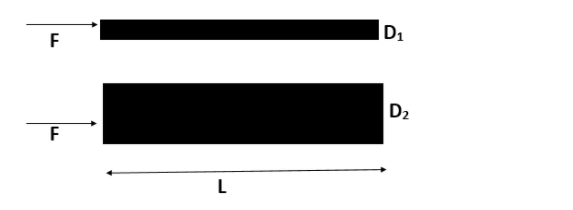
Two wires of the same material and length but diameter in the ratio $1:2$ are stretched by the same force. The elastic potential energy per unit volume for both of the wires when stretched by the equal force will be in the ratio:
\[\begin{align}
& A.16:1 \\
& B.1:1 \\
& C.2:1 \\
& D.4:1 \\
\end{align}\]
Answer
 Verified
591.6k+ views
Hint: Hooke's law is being used here in order to solve this question. Hooke's law is a law which says that the force required to expand or compress a spring or a wire to a certain distance increases linearly with respect to that distance. And elastic energy per unit time is given by the equation,
$E=\dfrac{1}{2}\times stress\times strain$
These all day help you to solve this question.
Complete step by step answer:
First of all let us find out the energy per unit volume.
Elastic energy per unit volume is given by the equation,
$E=\dfrac{1}{2}\times stress\times strain$
According to hooke's law, the strain can be written in the form of,
$strain=\dfrac{stress}{Y}$
Where $Y$be the young’s modulus which is a constant.
Substituting this in the equation of energy per unit volume will give,
$E=\dfrac{{{\left( stress \right)}^{2}}}{2Y}$
Here the stress is given which is expressed in the form of an equation,
$stress=\dfrac{F}{A}$
Substitute this in the equation,
$E=\dfrac{{{\left( F \right)}^{2}}}{2Y{{A}^{2}}}$
Where,
$A=\dfrac{\pi {{D}^{2}}}{4}$
Therefore the equation becomes,
\[E=\dfrac{8{{\left( F \right)}^{2}}}{Y{{\pi }^{2}}{{D}^{4}}}\]
Here as per the question we will get to know that the force acting on the wires as well as the young’s modulus of the wires are the same. Therefore we can derive the relation between energy per unit volume and diameter from this.
\[\therefore \dfrac{{{E}_{1}}}{{{E}_{2}}}={{\left( \dfrac{{{D}_{2}}}{{{D}_{1}}} \right)}^{4}}\]
As we know that the ratio between the diameters is$1:2$.
Substituting this in the equation will give,
\[\therefore \dfrac{{{E}_{1}}}{{{E}_{2}}}={{\left( \dfrac{2}{1} \right)}^{4}}=\dfrac{16}{1}\]
That is the ratio between the energy per unit volume is\[16:1\]. Therefore the correct answer is option A.
Note:
Hooke's law is applicable only when the extension of the spring is sufficiently small. When the extension becomes too high then the spring gets deformed permanently, or even the breaks. This kind of behaviour lies beyond the scope of Hooke's law.
$E=\dfrac{1}{2}\times stress\times strain$
These all day help you to solve this question.
Complete step by step answer:
First of all let us find out the energy per unit volume.
Elastic energy per unit volume is given by the equation,
$E=\dfrac{1}{2}\times stress\times strain$
According to hooke's law, the strain can be written in the form of,
$strain=\dfrac{stress}{Y}$
Where $Y$be the young’s modulus which is a constant.
Substituting this in the equation of energy per unit volume will give,
$E=\dfrac{{{\left( stress \right)}^{2}}}{2Y}$
Here the stress is given which is expressed in the form of an equation,
$stress=\dfrac{F}{A}$
Substitute this in the equation,
$E=\dfrac{{{\left( F \right)}^{2}}}{2Y{{A}^{2}}}$
Where,
$A=\dfrac{\pi {{D}^{2}}}{4}$
Therefore the equation becomes,
\[E=\dfrac{8{{\left( F \right)}^{2}}}{Y{{\pi }^{2}}{{D}^{4}}}\]
Here as per the question we will get to know that the force acting on the wires as well as the young’s modulus of the wires are the same. Therefore we can derive the relation between energy per unit volume and diameter from this.
\[\therefore \dfrac{{{E}_{1}}}{{{E}_{2}}}={{\left( \dfrac{{{D}_{2}}}{{{D}_{1}}} \right)}^{4}}\]
As we know that the ratio between the diameters is$1:2$.
Substituting this in the equation will give,
\[\therefore \dfrac{{{E}_{1}}}{{{E}_{2}}}={{\left( \dfrac{2}{1} \right)}^{4}}=\dfrac{16}{1}\]
That is the ratio between the energy per unit volume is\[16:1\]. Therefore the correct answer is option A.
Note:
Hooke's law is applicable only when the extension of the spring is sufficiently small. When the extension becomes too high then the spring gets deformed permanently, or even the breaks. This kind of behaviour lies beyond the scope of Hooke's law.
Recently Updated Pages
Master Class 11 Computer Science: Engaging Questions & Answers for Success

Master Class 11 Business Studies: Engaging Questions & Answers for Success
Master Class 11 Economics: Engaging Questions & Answers for Success
Master Class 11 English: Engaging Questions & Answers for Success
Master Class 11 Maths: Engaging Questions & Answers for Success
Master Class 11 Biology: Engaging Questions & Answers for Success
Trending doubts
One Metric ton is equal to kg A 10000 B 1000 C 100 class 11 physics CBSE
There are 720 permutations of the digits 1 2 3 4 5 class 11 maths CBSE
Discuss the various forms of bacteria class 11 biology CBSE
Draw a diagram of a plant cell and label at least eight class 11 biology CBSE
State the laws of reflection of light
Explain zero factorial class 11 maths CBSE