




Ultrafiltration takes place in presence of effective filtration pressure.
Reason – In the ultrafiltration process, blood is filtered in Bowman’s capsule, filtered fluid contains protein and blood corpuscles also.
A) Both assertion and reason are correct and the reason is the correct explanation for assertion.
B) Both assertion and reason are correct but the reason is not the correct explanation for assertion.
C) Assertion is correct but Reason is incorrect.
D) Both Assertion and Reason are incorrect
Answer
 Verified
493.8k+ views
Hint: The renal tubule begins with a double-layered cup-shaped structure called Bowman’s capsule. This capsule encloses the glomerulus (first part of nephrons). Glomerulus and Bowman’s capsule together are called renal corpuscles. Blood is purified in the kidney.
Complete answer:
The urine formation’s first step is the filtration of blood, which is carried out by the glomerulus and called glomerular filtration. The kidney filters the blood on average at 1100-1200 mL per minute. The filtration of blood is caused by the glomerular capillary blood pressure with the help of slits present in the membrane of the glomerular. The blood is filtered through the membrane so excellently, that except the proteins almost all the constituents of the plasma pass into the Bowman’s capsule lumen. This process is called ultrafiltration and the filtered fluid is called glomerular filtrate.
In glomerular capillaries, the blood flows under high pressure because the glomerular capillaries are narrower than the afferent renal arteries. It is about 75 mm Hg in man. The amount of filtrate which is formed with the help of kidneys per minute is called Glomerular Filtration Rate (GFR). In a normal healthy individual, the GFR is about 125 mL/minute.
The visceral layer of Bowman’s capsule is made up of special types of cells called podocytes and these podocytes contain the slits that help in filtrete filters. The filtrate is normally reabsorbed in the Proximal Convoluted Tubule that contains glucose, amino acids, vitamins, hormones, ions, water and urea.
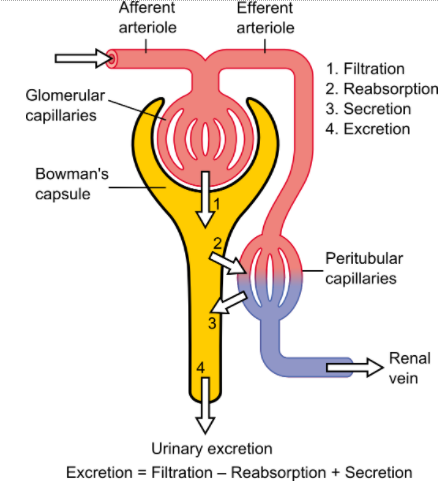
So, the correct answer is option (C) Assertion is correct but the reason is incorrect, because the blood needs high pressure to flow and the filtrate does not contain proteins or cells.
Note: The fluid tend to move in reverse direction due to
- The osmotic pressure of plasma protein in the glomerular capillaries.
- Hydrostatic pressure of the fluid in the urinary tubule.
Complete answer:
The urine formation’s first step is the filtration of blood, which is carried out by the glomerulus and called glomerular filtration. The kidney filters the blood on average at 1100-1200 mL per minute. The filtration of blood is caused by the glomerular capillary blood pressure with the help of slits present in the membrane of the glomerular. The blood is filtered through the membrane so excellently, that except the proteins almost all the constituents of the plasma pass into the Bowman’s capsule lumen. This process is called ultrafiltration and the filtered fluid is called glomerular filtrate.
In glomerular capillaries, the blood flows under high pressure because the glomerular capillaries are narrower than the afferent renal arteries. It is about 75 mm Hg in man. The amount of filtrate which is formed with the help of kidneys per minute is called Glomerular Filtration Rate (GFR). In a normal healthy individual, the GFR is about 125 mL/minute.
The visceral layer of Bowman’s capsule is made up of special types of cells called podocytes and these podocytes contain the slits that help in filtrete filters. The filtrate is normally reabsorbed in the Proximal Convoluted Tubule that contains glucose, amino acids, vitamins, hormones, ions, water and urea.
So, the correct answer is option (C) Assertion is correct but the reason is incorrect, because the blood needs high pressure to flow and the filtrate does not contain proteins or cells.
Note: The fluid tend to move in reverse direction due to
- The osmotic pressure of plasma protein in the glomerular capillaries.
- Hydrostatic pressure of the fluid in the urinary tubule.
Recently Updated Pages
Master Class 11 Computer Science: Engaging Questions & Answers for Success

Master Class 11 Business Studies: Engaging Questions & Answers for Success
Master Class 11 Economics: Engaging Questions & Answers for Success
Master Class 11 English: Engaging Questions & Answers for Success
Master Class 11 Maths: Engaging Questions & Answers for Success
Master Class 11 Biology: Engaging Questions & Answers for Success
Trending doubts
One Metric ton is equal to kg A 10000 B 1000 C 100 class 11 physics CBSE
There are 720 permutations of the digits 1 2 3 4 5 class 11 maths CBSE
Discuss the various forms of bacteria class 11 biology CBSE
Draw a diagram of a plant cell and label at least eight class 11 biology CBSE
State the laws of reflection of light
Explain zero factorial class 11 maths CBSE