




Vector $\overrightarrow A $ which is directed along the x axis, is to be added to vector $\overrightarrow B $, which has a magnitude of $7.0m$. The sum is a third vector that is directed along the y axis, with a magnitude that uses $3.0$ times of $\overrightarrow A $ . What is the magnitude of $\overrightarrow A $ ?
Answer
 Verified
480.3k+ views
Hint: Now in the given question vector $\overrightarrow A $ is parallel to x axis and after adding vector $\overrightarrow B $ to vector $\overrightarrow A $we get a new vector $\overrightarrow C $. Now the vector $\overrightarrow C $ is parallel to the Y axis which means these three vectors are perpendicular to each other and we can find the missing sides (value) by using Pythagoras formula.
Formula used:
Pythagoras Formula:
$h = \sqrt {{p^2} + {b^2}} $
Where is the $b$ base, is the $p$ perpendicular and is the $h$ hypotenuse.
Complete step by step answer:
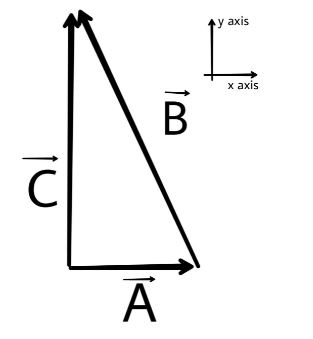
In the given above diagram the vector $\overrightarrow A $ is parallel to x-axis and the vector $\overrightarrow B $ has magnitude of $7.0m$ the new vector form is the vector $\overrightarrow C $. In the given question it is given that vector $\overrightarrow C $ has a magnitude three times that of vector $\overrightarrow A $.
Let vector \[\overrightarrow A \] had the magnitude value of $ = x$
So, the magnitude of vector $\overrightarrow C $ is $ = 3x$
So, we have the base and the perpendicular of a right-angle triangle.The hypotenuse value is:
$h = \sqrt {{{\left( x \right)}^2} + {{\left( {3x} \right)}^2}} $
$\Rightarrow h = \sqrt {{x^2} + 9{x^2}} $
$\Rightarrow h = \sqrt {10{x^2}} $
Hypotenuse is the vector $\overrightarrow B $ which means it has the value of $7.0m$
$7 = \sqrt {10{x^2}} $
$\Rightarrow 49 = 10{x^2}$.......(Squaring on both the sides)
$\Rightarrow {x^2} = \dfrac{{49}}{{10}} = 4.9$
$\therefore x = \sqrt {4.9} = 2.214$
Now the value of $x = 2.214\,m$
So, the vector $\overrightarrow A $ has the value $ = 2.214\,m$.
Note: In this case our vectors are perpendicular to each other so this problem becomes easier, if our vectors were at some angle to each other then we had to use the vector addition formula in order to find the length of the unknown vectors.
$C = \sqrt {{A^2} + {B^2} + 2AB\cos \theta } $
Where $A$and $B$are the two vectors which are being added to each other and $\theta $ is the angle between them. The formula can also be used in order to find out the value of vector $\overrightarrow A $ where the angle between the vectors will be ${90^ \circ }$ and the value $\cos \theta = 0$.
Formula used:
Pythagoras Formula:
$h = \sqrt {{p^2} + {b^2}} $
Where is the $b$ base, is the $p$ perpendicular and is the $h$ hypotenuse.
Complete step by step answer:
In the given above diagram the vector $\overrightarrow A $ is parallel to x-axis and the vector $\overrightarrow B $ has magnitude of $7.0m$ the new vector form is the vector $\overrightarrow C $. In the given question it is given that vector $\overrightarrow C $ has a magnitude three times that of vector $\overrightarrow A $.
Let vector \[\overrightarrow A \] had the magnitude value of $ = x$
So, the magnitude of vector $\overrightarrow C $ is $ = 3x$
So, we have the base and the perpendicular of a right-angle triangle.The hypotenuse value is:
$h = \sqrt {{{\left( x \right)}^2} + {{\left( {3x} \right)}^2}} $
$\Rightarrow h = \sqrt {{x^2} + 9{x^2}} $
$\Rightarrow h = \sqrt {10{x^2}} $
Hypotenuse is the vector $\overrightarrow B $ which means it has the value of $7.0m$
$7 = \sqrt {10{x^2}} $
$\Rightarrow 49 = 10{x^2}$.......(Squaring on both the sides)
$\Rightarrow {x^2} = \dfrac{{49}}{{10}} = 4.9$
$\therefore x = \sqrt {4.9} = 2.214$
Now the value of $x = 2.214\,m$
So, the vector $\overrightarrow A $ has the value $ = 2.214\,m$.
Note: In this case our vectors are perpendicular to each other so this problem becomes easier, if our vectors were at some angle to each other then we had to use the vector addition formula in order to find the length of the unknown vectors.
$C = \sqrt {{A^2} + {B^2} + 2AB\cos \theta } $
Where $A$and $B$are the two vectors which are being added to each other and $\theta $ is the angle between them. The formula can also be used in order to find out the value of vector $\overrightarrow A $ where the angle between the vectors will be ${90^ \circ }$ and the value $\cos \theta = 0$.
Recently Updated Pages
Master Class 11 Computer Science: Engaging Questions & Answers for Success

Master Class 11 Business Studies: Engaging Questions & Answers for Success
Master Class 11 Economics: Engaging Questions & Answers for Success
Master Class 11 English: Engaging Questions & Answers for Success
Master Class 11 Maths: Engaging Questions & Answers for Success
Master Class 11 Biology: Engaging Questions & Answers for Success
Trending doubts
One Metric ton is equal to kg A 10000 B 1000 C 100 class 11 physics CBSE
There are 720 permutations of the digits 1 2 3 4 5 class 11 maths CBSE
Discuss the various forms of bacteria class 11 biology CBSE
Draw a diagram of a plant cell and label at least eight class 11 biology CBSE
State the laws of reflection of light
Explain zero factorial class 11 maths CBSE