




Which is not a characteristic of mitochondria?
A. Mitochondria are the sites of cellular respiration
B. Mitochondria are found in prokaryotic and eukaryotic cells
C. Mitochondria contain DNA and ribosomes
D. Inner space of the mitochondrion contains a fluid matrix
Answer
 Verified
560.7k+ views
Hint: Mitochondria are membrane-bound organelles that are sites of energy production molecules for cells. Mitochondria have been thought to originate as of endosymbiotic relationship with cells. It only occurs in cells having a true nucleus.
Complete answer:
The eukaryotic cells are those which have a true and defined nucleus. These cells consist of membrane-bound organelles and each of them has specific functions to perform. Mitochondria are one of these membrane-bound organelles. The function of mitochondria is to produce energy-giving molecules. The mitochondria are made of double membranes called internal and external mitochondrial membranes. The internal membrane of mitochondria folds to form cristae which increases the surface area of mitochondria. The internal cavity of mitochondria consists of a fluid called the mitochondrial matrix. The matrix contains the mitochondrial DNA and ribosomes.
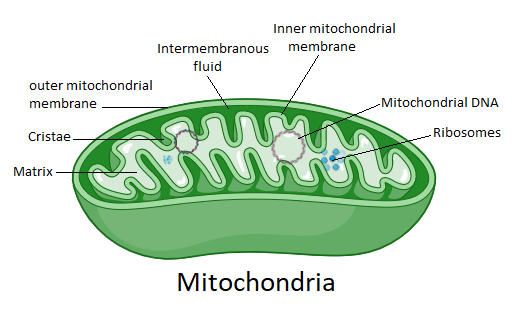
The chemical processes essential for cellular respiration occur in the internal membrane of mitochondria. The electron transport chain is required for completion of the Krebs cycle and production of ATP occurs inside the mitochondria. Thus, mitochondria are the site for cellular respiration, it is found in eukaryotes, it has its own DNA and ribosomes, and the inner space contains fluid matrix. Prokaryotic cells lack membrane-bound organelles like mitochondria.
Hence, we can conclude that the right answer is option B.
Note: It is thought that at the origin of life when the simplest eukaryotic cell formed, it formerly lacked mitochondria. Later the mitochondria became an endosymbiotic organelle of the cell. Both of these get to benefit from each other as mitochondria provide energy to cell and cell provides habitat to mitochondria.
Complete answer:
The eukaryotic cells are those which have a true and defined nucleus. These cells consist of membrane-bound organelles and each of them has specific functions to perform. Mitochondria are one of these membrane-bound organelles. The function of mitochondria is to produce energy-giving molecules. The mitochondria are made of double membranes called internal and external mitochondrial membranes. The internal membrane of mitochondria folds to form cristae which increases the surface area of mitochondria. The internal cavity of mitochondria consists of a fluid called the mitochondrial matrix. The matrix contains the mitochondrial DNA and ribosomes.
The chemical processes essential for cellular respiration occur in the internal membrane of mitochondria. The electron transport chain is required for completion of the Krebs cycle and production of ATP occurs inside the mitochondria. Thus, mitochondria are the site for cellular respiration, it is found in eukaryotes, it has its own DNA and ribosomes, and the inner space contains fluid matrix. Prokaryotic cells lack membrane-bound organelles like mitochondria.
Hence, we can conclude that the right answer is option B.
Note: It is thought that at the origin of life when the simplest eukaryotic cell formed, it formerly lacked mitochondria. Later the mitochondria became an endosymbiotic organelle of the cell. Both of these get to benefit from each other as mitochondria provide energy to cell and cell provides habitat to mitochondria.
Recently Updated Pages
Master Class 11 Computer Science: Engaging Questions & Answers for Success

Master Class 11 Business Studies: Engaging Questions & Answers for Success
Master Class 11 Economics: Engaging Questions & Answers for Success
Master Class 11 English: Engaging Questions & Answers for Success
Master Class 11 Maths: Engaging Questions & Answers for Success
Master Class 11 Biology: Engaging Questions & Answers for Success
Trending doubts
One Metric ton is equal to kg A 10000 B 1000 C 100 class 11 physics CBSE
There are 720 permutations of the digits 1 2 3 4 5 class 11 maths CBSE
Discuss the various forms of bacteria class 11 biology CBSE
Draw a diagram of a plant cell and label at least eight class 11 biology CBSE
State the laws of reflection of light
Explain zero factorial class 11 maths CBSE