



Which lanthanides are exceptions to the Aufbau principle?
Answer
 Verified
490.2k+ views
Hint: We know that lanthanides are the f- block elements. The general electronic configuration of the f-block elements (lanthanides) is given as $ \left[ {{\text{Xe}}} \right]{\text{4}}{{\text{f}}^{1 - 14}}{\text{5}}{{\text{d}}^{0 - 1}}{\text{6}}{{\text{s}}^{\text{2}}} $ . There can be some exceptions in the electronic configuration of some elements in the lanthanide series. Aufbau principle states that maximum two electrons can be filled into orbitals of increasing orbital energy. The orbitals with lowest energy are filled by the electrons before filling the orbitals with higher energy.
Complete answer:
Let us first look at the modern periodic table which is given as follows:
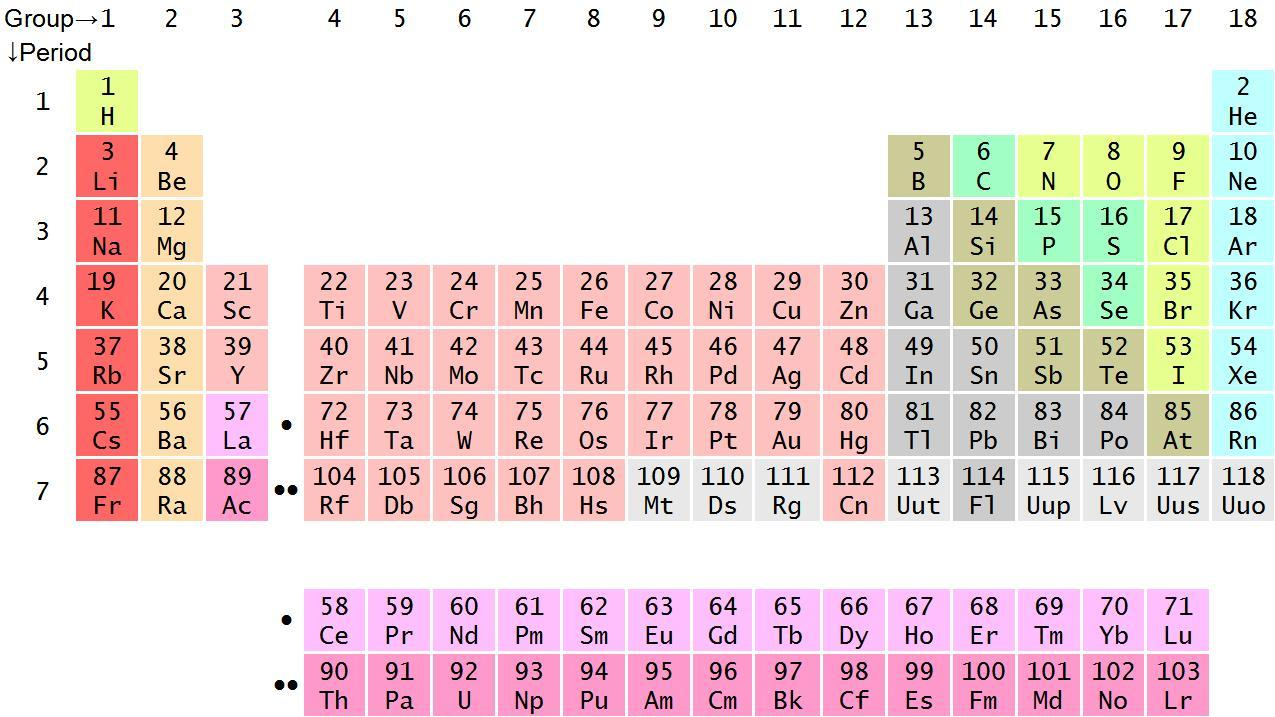
The compounds that are present in the second last row are known to be in lanthanide series.
We can see that the lanthanide series contains fifteen elements which are lanthanum, cerium, praseodymium, neodymium, promethium, samarium, europium, gadolinium, terbium, dysprosium, holmium, erbium, thulium, ytterbium and lutetium. The general electronic configuration of the f-block elements (lanthanides) is given as $ \left[ {{\text{Xe}}} \right]{\text{4}}{{\text{f}}^{1 - 14}}{\text{5}}{{\text{d}}^{0 - 1}}{\text{6}}{{\text{s}}^{\text{2}}} $ . Aufbau principle states that maximum two electrons can be filled into orbitals of increasing orbital energy. The orbitals with lowest energy are filled by the electrons before filling the orbitals with higher energy.
Gadolinium is an element in the lanthanide series which does not follow the Aufbau principle. Its atomic number is $ 64 $ . Its electronic configuration is given as: $ \left[ {{\text{Xe}}} \right]{\text{4}}{{\text{f}}^7}{\text{5}}{{\text{d}}^1}{\text{6}}{{\text{s}}^{\text{2}}} $ .
This electronic configuration of Gadolinium is because in this configuration f orbital is half-filled and s orbital is fully filled which makes the element stable.
Note:
In all lanthanides, isolated $ 5d $ electrons are transferred to the $ 4f $ subshell, except gadolinium, which will destroy the stability and symmetry of the half-filled f subshell. We must remember that the orbitals fill in the order of increasing values of $ n + l $ , where n is the principal quantum number and l is the azimuthal quantum number. If two orbitals have the same value of $ n + l, $ they are filled in ascending order of n.
Complete answer:
Let us first look at the modern periodic table which is given as follows:
The compounds that are present in the second last row are known to be in lanthanide series.
We can see that the lanthanide series contains fifteen elements which are lanthanum, cerium, praseodymium, neodymium, promethium, samarium, europium, gadolinium, terbium, dysprosium, holmium, erbium, thulium, ytterbium and lutetium. The general electronic configuration of the f-block elements (lanthanides) is given as $ \left[ {{\text{Xe}}} \right]{\text{4}}{{\text{f}}^{1 - 14}}{\text{5}}{{\text{d}}^{0 - 1}}{\text{6}}{{\text{s}}^{\text{2}}} $ . Aufbau principle states that maximum two electrons can be filled into orbitals of increasing orbital energy. The orbitals with lowest energy are filled by the electrons before filling the orbitals with higher energy.
Gadolinium is an element in the lanthanide series which does not follow the Aufbau principle. Its atomic number is $ 64 $ . Its electronic configuration is given as: $ \left[ {{\text{Xe}}} \right]{\text{4}}{{\text{f}}^7}{\text{5}}{{\text{d}}^1}{\text{6}}{{\text{s}}^{\text{2}}} $ .
This electronic configuration of Gadolinium is because in this configuration f orbital is half-filled and s orbital is fully filled which makes the element stable.
Note:
In all lanthanides, isolated $ 5d $ electrons are transferred to the $ 4f $ subshell, except gadolinium, which will destroy the stability and symmetry of the half-filled f subshell. We must remember that the orbitals fill in the order of increasing values of $ n + l $ , where n is the principal quantum number and l is the azimuthal quantum number. If two orbitals have the same value of $ n + l, $ they are filled in ascending order of n.
Recently Updated Pages
Master Class 11 Computer Science: Engaging Questions & Answers for Success

Master Class 11 Business Studies: Engaging Questions & Answers for Success
Master Class 11 Economics: Engaging Questions & Answers for Success
Master Class 11 English: Engaging Questions & Answers for Success
Master Class 11 Maths: Engaging Questions & Answers for Success
Master Class 11 Biology: Engaging Questions & Answers for Success
Trending doubts
One Metric ton is equal to kg A 10000 B 1000 C 100 class 11 physics CBSE
There are 720 permutations of the digits 1 2 3 4 5 class 11 maths CBSE
Discuss the various forms of bacteria class 11 biology CBSE
Draw a diagram of a plant cell and label at least eight class 11 biology CBSE
State the laws of reflection of light
Explain zero factorial class 11 maths CBSE