




Which of the elements is a component of cytochrome oxidase?
A. Copper
B. Iron
C. Mercury
D. Cobalt
Answer
 Verified
571.8k+ views
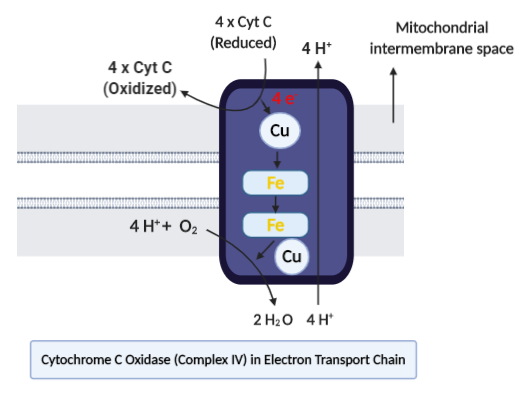
Hint: The enzyme cytochrome oxidase or complex IV is a large protein complex found in bacteria and eukaryotic mitochondria. It is the last enzyme in the cellular transportation chain of the respiratory electron positioned in the membrane. It earns an electron out of each of four molecules of cytochrome c and converts it to one molecule of dioxygen, adding the molecular oxygen to two water molecules.
Complete answer:
Cytochrome C oxidase consists of 13 polypeptide subunits. It includes 3 copper ions that really are essential for its functioning. It also comprises zinc, magnesium, and two heme groups. Copper chaperones are essential for the assembling of the cytochrome c oxidase network, and abnormalities in the genes encoding such chaperones lead to multiple pathologies. The absence of cytochrome oxidase activity is likely to be fatal. Copper is an important micronutrient used by cytochrome c oxidase (Cox) as a metal cofactor. Cox’s key complex includes a copper atom which is needed for its catalytic action. Complications in biogenesis and copper entry into cytochrome c correspond to mitochondrial human diseases. Cox occurs in three conformational states: entirely oxidized, slightly reduced and completely reduced. Each inhibitor does have a strong affinity to some other state. Both heme a3 and CuB nuclear centres are oxidised in the pulsed state; that's the confirmation of the enzyme which has the maximum activity.
Hence, the correct answer is option A.
Note: The above enzyme Cox catalyses the movement of electrons between two substrates, notably ferro cytochrome c and molecular oxygen. Much of the redox energy involved in this mechanism is being used by the enzyme to move protons from aqueous environment to the mitochondrial region of the intermembrane. Thus, cytochrome c oxidase is a redox-linked proton engine that integrates redox energy to proton transportation.
Complete answer:
Cytochrome C oxidase consists of 13 polypeptide subunits. It includes 3 copper ions that really are essential for its functioning. It also comprises zinc, magnesium, and two heme groups. Copper chaperones are essential for the assembling of the cytochrome c oxidase network, and abnormalities in the genes encoding such chaperones lead to multiple pathologies. The absence of cytochrome oxidase activity is likely to be fatal. Copper is an important micronutrient used by cytochrome c oxidase (Cox) as a metal cofactor. Cox’s key complex includes a copper atom which is needed for its catalytic action. Complications in biogenesis and copper entry into cytochrome c correspond to mitochondrial human diseases. Cox occurs in three conformational states: entirely oxidized, slightly reduced and completely reduced. Each inhibitor does have a strong affinity to some other state. Both heme a3 and CuB nuclear centres are oxidised in the pulsed state; that's the confirmation of the enzyme which has the maximum activity.
Hence, the correct answer is option A.
Note: The above enzyme Cox catalyses the movement of electrons between two substrates, notably ferro cytochrome c and molecular oxygen. Much of the redox energy involved in this mechanism is being used by the enzyme to move protons from aqueous environment to the mitochondrial region of the intermembrane. Thus, cytochrome c oxidase is a redox-linked proton engine that integrates redox energy to proton transportation.
Recently Updated Pages
Master Class 11 Computer Science: Engaging Questions & Answers for Success

Master Class 11 Business Studies: Engaging Questions & Answers for Success
Master Class 11 Economics: Engaging Questions & Answers for Success
Master Class 11 English: Engaging Questions & Answers for Success
Master Class 11 Maths: Engaging Questions & Answers for Success
Master Class 11 Biology: Engaging Questions & Answers for Success
Trending doubts
There are 720 permutations of the digits 1 2 3 4 5 class 11 maths CBSE
Discuss the various forms of bacteria class 11 biology CBSE
Draw a diagram of a plant cell and label at least eight class 11 biology CBSE
Explain zero factorial class 11 maths CBSE
What organs are located on the left side of your body class 11 biology CBSE
Draw a diagram of nephron and explain its structur class 11 biology CBSE