




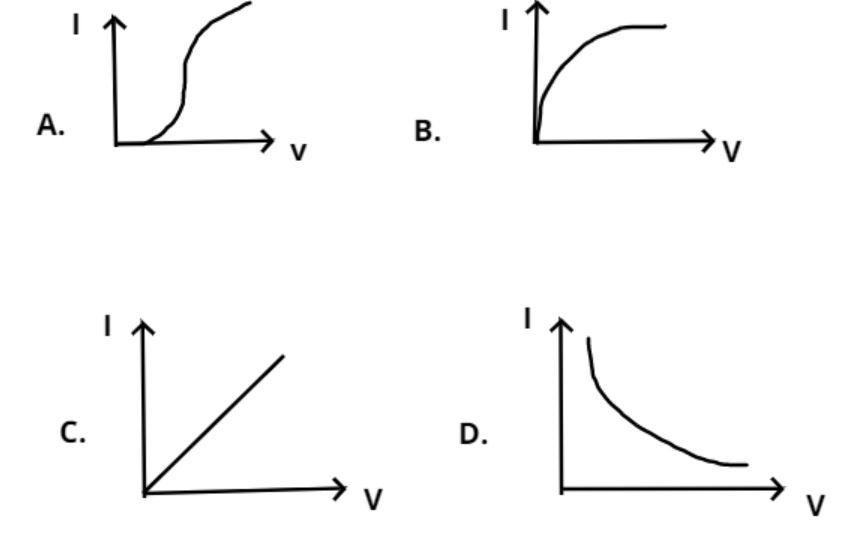
Which of the following graph represents the ohmic conductor?
Answer
 Verified
609.6k+ views
Hint: For a particular conductor the value of its resistance is always constant so as we vary the voltage only current is changing its value according to voltage not the resistance of the ohmic conductor and use Ohm’s law in this question so use these concepts to reach the solution of the question.is the required answer.
Complete Step-by-Step solution:
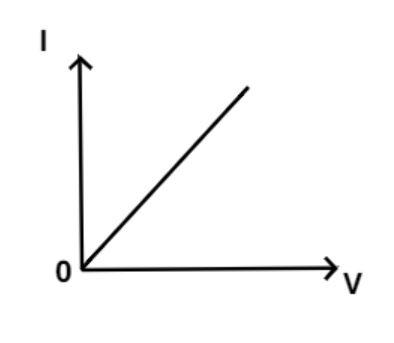
As we know that according to Ohm’s law current (I) through the conductor between two points is directly proportional to the voltage (V).
$ \Rightarrow I \propto V$
Now the proportionality constant is (1/R) which is nothing but the conductance of the material (as R is the resistance of the material).
$ \Rightarrow I = \dfrac{1}{R}V$
So as we vary the voltage, current is also changed according to voltage directly (as the resistance of the conductor remains the same) as shown in the above figure.
So in an ohmic conductor voltage is directly proportional to current.
So this is the required answer.
Hence option (C) is the correct answer.
Note – Whenever we face such types of questions always recall the statement of Ohm’s law which is stated above so as we vary the voltage, current also varies according to the voltage directly so the graph between V and I should be linear.
Complete Step-by-Step solution:
As we know that according to Ohm’s law current (I) through the conductor between two points is directly proportional to the voltage (V).
$ \Rightarrow I \propto V$
Now the proportionality constant is (1/R) which is nothing but the conductance of the material (as R is the resistance of the material).
$ \Rightarrow I = \dfrac{1}{R}V$
So as we vary the voltage, current is also changed according to voltage directly (as the resistance of the conductor remains the same) as shown in the above figure.
So in an ohmic conductor voltage is directly proportional to current.
So this is the required answer.
Hence option (C) is the correct answer.
Note – Whenever we face such types of questions always recall the statement of Ohm’s law which is stated above so as we vary the voltage, current also varies according to the voltage directly so the graph between V and I should be linear.
Recently Updated Pages
Master Class 10 Computer Science: Engaging Questions & Answers for Success

Master Class 10 General Knowledge: Engaging Questions & Answers for Success
Master Class 10 English: Engaging Questions & Answers for Success
Master Class 10 Social Science: Engaging Questions & Answers for Success
Master Class 10 Maths: Engaging Questions & Answers for Success
Master Class 10 Science: Engaging Questions & Answers for Success
Trending doubts
What is the median of the first 10 natural numbers class 10 maths CBSE
Which women's tennis player has 24 Grand Slam singles titles?
Who is the Brand Ambassador of Incredible India?
Why is there a time difference of about 5 hours between class 10 social science CBSE
Write a letter to the principal requesting him to grant class 10 english CBSE
A moving boat is observed from the top of a 150 m high class 10 maths CBSE