




Which of the following groups of animals is found exclusively in marine habitats?
A.Fishes
B.Echinoderms
C.Protozoa
D.Porifera
Answer
 Verified
573.3k+ views
Hint:The largest habitat of all is the marine habitat. The seas, oceans, and bays have occupied about \[70\% \] of the earth’s surface. The depth varies from the intertidal zone to depth as great as 35,400 feet or 6.7 miles. The average depth is about 12,500 feet. In tropical seas, the usual temperature is about \[32^\circ C\] . and that in the arctic region is about \[2.2^\circ C\]. In a given area this temperature rarely varies more than \[5^\circ C\] . during the year.
Complete answer: Fishes- The ocean is tremendously diverse and species-rich. There are about 34000 species of fishes and they are found in freshwaters and mostly in marine waters. Fishes are cold-blooded except for a few species.
Echinoderms- echinoderms usually live in 1 of 2 places. Very shallow water or the ocean floor. Starfish and Sea Urchins can be more commonly found in shallow waters. Whereas ophiuroids or holothurians may be found swarming the deep. Many echinoderms live in shallow waters, a place scientists call the intertidal zone. Many sea stars are found in this zone. No matter how deep the water is.
Protozoa- Protozoa are an abundant, ubiquitous component of the marine fauna. Tintinnids and colorless flagellates may be present in large numbers in the plankton. Ciliates, colorless flagellates, and Sarcodina often abound in benthic environments but because of their small size and fragility, their numbers are often ignored by marine ecologists.
Porifera- Almost every species of Porifera lives in a marine climate, although some are learning to adapt to freshwater. Sponges are found in almost every ocean in the biosphere. Because there are so many species living in many different biomes their preference for habitat differs greatly, for example living in depths ranging from 8,500 feet
Hence the correct answer is option B, Echinoderms.
Below is the picture of a starfish which is an Echinoderm.
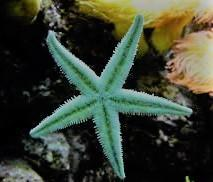
Note: Echinoderms are exclusively marine animals. They inhabit all the seas and in all latitudes. They are usually absent in colder areas, excepting Crinoids which are not uncommon in arctic and Antarctic regions. Echinoderms are found from the intertidal zone to the depth of about 6,000 m.
Complete answer: Fishes- The ocean is tremendously diverse and species-rich. There are about 34000 species of fishes and they are found in freshwaters and mostly in marine waters. Fishes are cold-blooded except for a few species.
Echinoderms- echinoderms usually live in 1 of 2 places. Very shallow water or the ocean floor. Starfish and Sea Urchins can be more commonly found in shallow waters. Whereas ophiuroids or holothurians may be found swarming the deep. Many echinoderms live in shallow waters, a place scientists call the intertidal zone. Many sea stars are found in this zone. No matter how deep the water is.
Protozoa- Protozoa are an abundant, ubiquitous component of the marine fauna. Tintinnids and colorless flagellates may be present in large numbers in the plankton. Ciliates, colorless flagellates, and Sarcodina often abound in benthic environments but because of their small size and fragility, their numbers are often ignored by marine ecologists.
Porifera- Almost every species of Porifera lives in a marine climate, although some are learning to adapt to freshwater. Sponges are found in almost every ocean in the biosphere. Because there are so many species living in many different biomes their preference for habitat differs greatly, for example living in depths ranging from 8,500 feet
Hence the correct answer is option B, Echinoderms.
Below is the picture of a starfish which is an Echinoderm.
Note: Echinoderms are exclusively marine animals. They inhabit all the seas and in all latitudes. They are usually absent in colder areas, excepting Crinoids which are not uncommon in arctic and Antarctic regions. Echinoderms are found from the intertidal zone to the depth of about 6,000 m.
Recently Updated Pages
Master Class 11 Computer Science: Engaging Questions & Answers for Success

Master Class 11 Business Studies: Engaging Questions & Answers for Success
Master Class 11 Economics: Engaging Questions & Answers for Success
Master Class 11 English: Engaging Questions & Answers for Success
Master Class 11 Maths: Engaging Questions & Answers for Success
Master Class 11 Biology: Engaging Questions & Answers for Success
Trending doubts
One Metric ton is equal to kg A 10000 B 1000 C 100 class 11 physics CBSE
There are 720 permutations of the digits 1 2 3 4 5 class 11 maths CBSE
Discuss the various forms of bacteria class 11 biology CBSE
Draw a diagram of a plant cell and label at least eight class 11 biology CBSE
State the laws of reflection of light
10 examples of friction in our daily life