




Which of the following is a proper sequence?
A) Proportional limit, elastic limit, yielding, failure
B) Elastic limit, proportional limit, yielding, failure
C) Yielding, proportional limit, elastic limit, failure
D) Proportional limit, yielding, elastic limit, failure
Answer
 Verified
576k+ views
Hint:In order to answer this question,we are going to apply the concept of stress and strain and discuss about the relationship between them.We have to check the stress-strain graph according to which proportional limit is followed by elastic limit and yield point.
Complete step by step answer:
For this we have to consider the stress strain curve of a general material.
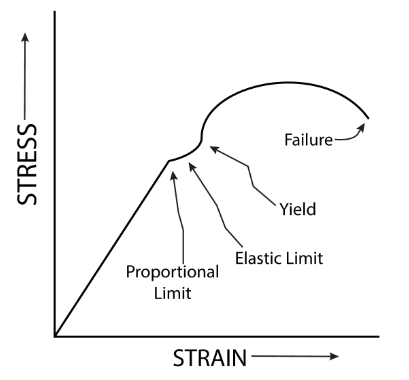
-A stress-strain curve of a material gives the relationship between stress and strain which is obtained by applying load to the material gradually. This curve reveals many of the properties of a material, for example, the Young's modulus, etc.
-The first region is the linear elastic region. In this region, the stress and strain are proportional, that is, obeys the general Hooke's law, and the slope is Young's modulus. In this region, the material only deforms plastically before it reaches the elastic limit. The end of the stage is the starting point of plastic deformation. The stress component of this point is defined as yield strength (or the yield point).
-The second stage is the strain hardening region. This region starts because the stress goes on the far side the yielding purpose, reaching a most at the last word strength point, that is the greatest stress which will be sustained and is termed the ultimate tensile strength.
-The third region is the necking region. On the far side tensile strength, a neck forms wherever the native cross-sectional space becomes considerably smaller than the average.
The necking deformation is non-uniform and can reinforce itself because the stress concentrates additional at little sections. Such feedback results in fast development of necking and leads to failure or fracture.
So, as we can see from the graph the correct answer is option (A).
Note:We have to keep in mind that the stress strain curve can be a little different for a specific material but the general curve gives the basic properties of all materials. So, until it is mentioned in the question that we have to consider a specific material, we would follow the general stress strain curve.
Complete step by step answer:
For this we have to consider the stress strain curve of a general material.
-A stress-strain curve of a material gives the relationship between stress and strain which is obtained by applying load to the material gradually. This curve reveals many of the properties of a material, for example, the Young's modulus, etc.
-The first region is the linear elastic region. In this region, the stress and strain are proportional, that is, obeys the general Hooke's law, and the slope is Young's modulus. In this region, the material only deforms plastically before it reaches the elastic limit. The end of the stage is the starting point of plastic deformation. The stress component of this point is defined as yield strength (or the yield point).
-The second stage is the strain hardening region. This region starts because the stress goes on the far side the yielding purpose, reaching a most at the last word strength point, that is the greatest stress which will be sustained and is termed the ultimate tensile strength.
-The third region is the necking region. On the far side tensile strength, a neck forms wherever the native cross-sectional space becomes considerably smaller than the average.
The necking deformation is non-uniform and can reinforce itself because the stress concentrates additional at little sections. Such feedback results in fast development of necking and leads to failure or fracture.
So, as we can see from the graph the correct answer is option (A).
Note:We have to keep in mind that the stress strain curve can be a little different for a specific material but the general curve gives the basic properties of all materials. So, until it is mentioned in the question that we have to consider a specific material, we would follow the general stress strain curve.
Recently Updated Pages
Master Class 11 Computer Science: Engaging Questions & Answers for Success

Master Class 11 Business Studies: Engaging Questions & Answers for Success
Master Class 11 Economics: Engaging Questions & Answers for Success
Master Class 11 English: Engaging Questions & Answers for Success
Master Class 11 Maths: Engaging Questions & Answers for Success
Master Class 11 Biology: Engaging Questions & Answers for Success
Trending doubts
One Metric ton is equal to kg A 10000 B 1000 C 100 class 11 physics CBSE
There are 720 permutations of the digits 1 2 3 4 5 class 11 maths CBSE
Discuss the various forms of bacteria class 11 biology CBSE
Draw a diagram of a plant cell and label at least eight class 11 biology CBSE
State the laws of reflection of light
Explain zero factorial class 11 maths CBSE