




Which of the following is the shortest phase of meiosis?
(a)Prophase I
(b)Metaphase I
(c)Anaphase I
(d)Prophase II
(e)Metaphase II
Answer
 Verified
591.9k+ views
Hint: The shortest phase is a part of Meiosis I in cell division. It involves the separation of homologous chromosomes, which start moving towards the opposite poles after they are aligned at the equator.
Complete answer:
The shortest phase of mitosis is Anaphase I. In anaphase I, the sister chromatids (identical copies, formed by the DNA replication of a chromosome, with both copies joined by a common centromere) are pulled apart to opposite poles in the cell. The spindles are shortened at this point.
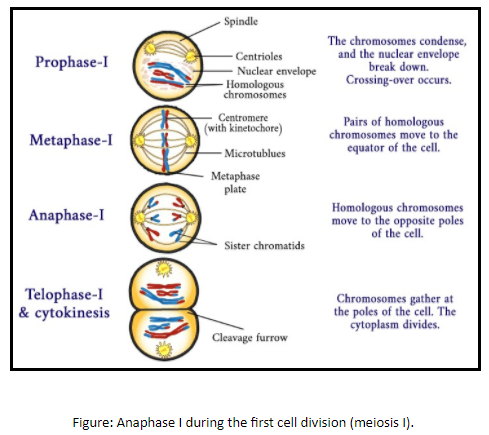
Additional Information: Some information about meiosis:
-During the meiosis, one cell divides twice to form four daughter cells.
-These four daughter cells only have half the number of chromosomes of the parent cell, so they are haploid.
-Meiosis is divided into nine stages. These are meiosis I when the cell divides for the first time and meiosis II when the cell divides for the second time.
-Prophase I is the longest stage of meiosis I.
-During metaphase I, the chromosomes are aligned at the centre of the cell and are ready to be divided.
-In meiosis, two sequential cell divisions occur but the DNA is replicated only once.
-Meiosis produces a new combination of genes due to crossing over of the genes and chance arrangement of bivalents (one pair of chromosomes or sister chromatids) at the equator.
So, the correct answer is, ’Anaphase I.’
Note: During late anaphase, the chromatids reach the opposite poles, which then move farther apart from one another and the cell prepares for the final stage of mitosis known as telophase I. The cell at this point, contains eight chromosomes.
Complete answer:
The shortest phase of mitosis is Anaphase I. In anaphase I, the sister chromatids (identical copies, formed by the DNA replication of a chromosome, with both copies joined by a common centromere) are pulled apart to opposite poles in the cell. The spindles are shortened at this point.
Additional Information: Some information about meiosis:
-During the meiosis, one cell divides twice to form four daughter cells.
-These four daughter cells only have half the number of chromosomes of the parent cell, so they are haploid.
-Meiosis is divided into nine stages. These are meiosis I when the cell divides for the first time and meiosis II when the cell divides for the second time.
-Prophase I is the longest stage of meiosis I.
-During metaphase I, the chromosomes are aligned at the centre of the cell and are ready to be divided.
-In meiosis, two sequential cell divisions occur but the DNA is replicated only once.
-Meiosis produces a new combination of genes due to crossing over of the genes and chance arrangement of bivalents (one pair of chromosomes or sister chromatids) at the equator.
So, the correct answer is, ’Anaphase I.’
Note: During late anaphase, the chromatids reach the opposite poles, which then move farther apart from one another and the cell prepares for the final stage of mitosis known as telophase I. The cell at this point, contains eight chromosomes.
Recently Updated Pages
Master Class 11 Computer Science: Engaging Questions & Answers for Success

Master Class 11 Business Studies: Engaging Questions & Answers for Success
Master Class 11 Economics: Engaging Questions & Answers for Success
Master Class 11 English: Engaging Questions & Answers for Success
Master Class 11 Maths: Engaging Questions & Answers for Success
Master Class 11 Biology: Engaging Questions & Answers for Success
Trending doubts
One Metric ton is equal to kg A 10000 B 1000 C 100 class 11 physics CBSE
There are 720 permutations of the digits 1 2 3 4 5 class 11 maths CBSE
Discuss the various forms of bacteria class 11 biology CBSE
Draw a diagram of a plant cell and label at least eight class 11 biology CBSE
State the laws of reflection of light
Explain zero factorial class 11 maths CBSE