




Which of the following is true regarding the phage lambda, a virus which infects bacteria?
A) In the lytic cycle, the bacteria host replicates viral DNA. passing it on to daughter cells during binary fission.
B) In the lysogenic cycle, The bacterial host replicates viral DNA. passing it to daughter cells during binary fission.
C) In the lytic cycle, viral DNA is integrated into the host genome.
D) In the lysogenic cycle, the host bacterial cell burst. releasing phages.
Answer
 Verified
507.9k+ views
Hint: The Enterobacteria phage is a bacterial virus, also known as a bacteriophage, that infects the bacteria Escherichia coli (E. coli). Esther Lederberg first discovered it in 1950.
Complete answer:
The wild form of this virus has a temperate life cycle that permits it to either lysogenic ally remain within its host's genome or enter a lytic phase in which it kills and lyses the cell to create progeny. Lambda strains with certain mutations are unable to lysogenized cells; instead, they proliferate and enter the lytic cycle after super infecting a cell that has previously been lysogenized.
The virus that infects bacteria is known as the lambda phage. In order to infect bacterial cells, the virus may go through two different cycles. The lytic cycle entails the typical process of viral replication, which includes cell membrane penetration, nucleic acid synthesis, and host cell lysis.
The lysogenic cycle is a type of viral replication in which a bacteriophage's nucleic acid is fused with that of a host. Propagation of the ensuing prophage occurs as a result of this. The viral DNA is passed to the daughter cells as the host cells reproduce.
As a result, option (B) is correct.
A head (also known as a capsid), a tail, and tail fibres make up a phage particle (see image of virus below). The phage's double-strand linear DNA genome is found in the head. The phage particle detects and bonds to its host, E. coli, causing DNA in the phage's head to be expelled into the bacterial cell's cytoplasm through the tail.
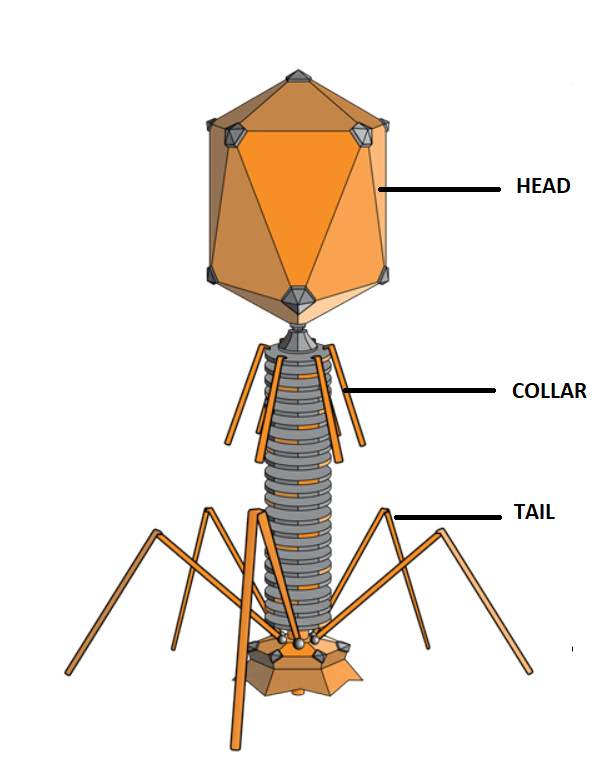
Note: Lambda phage is a non-contractile tailed phage, which means it can't 'push' its DNA through a bacterial cell membrane during an infection. It must instead infiltrate the host cell via an existing channel, having adapted the tip of its tail to engage with a specific pore to allow passage of its DNA into the hosts.
Complete answer:
The wild form of this virus has a temperate life cycle that permits it to either lysogenic ally remain within its host's genome or enter a lytic phase in which it kills and lyses the cell to create progeny. Lambda strains with certain mutations are unable to lysogenized cells; instead, they proliferate and enter the lytic cycle after super infecting a cell that has previously been lysogenized.
The virus that infects bacteria is known as the lambda phage. In order to infect bacterial cells, the virus may go through two different cycles. The lytic cycle entails the typical process of viral replication, which includes cell membrane penetration, nucleic acid synthesis, and host cell lysis.
The lysogenic cycle is a type of viral replication in which a bacteriophage's nucleic acid is fused with that of a host. Propagation of the ensuing prophage occurs as a result of this. The viral DNA is passed to the daughter cells as the host cells reproduce.
As a result, option (B) is correct.
A head (also known as a capsid), a tail, and tail fibres make up a phage particle (see image of virus below). The phage's double-strand linear DNA genome is found in the head. The phage particle detects and bonds to its host, E. coli, causing DNA in the phage's head to be expelled into the bacterial cell's cytoplasm through the tail.
Note: Lambda phage is a non-contractile tailed phage, which means it can't 'push' its DNA through a bacterial cell membrane during an infection. It must instead infiltrate the host cell via an existing channel, having adapted the tip of its tail to engage with a specific pore to allow passage of its DNA into the hosts.
Recently Updated Pages
Master Class 11 Computer Science: Engaging Questions & Answers for Success

Master Class 11 Business Studies: Engaging Questions & Answers for Success
Master Class 11 Economics: Engaging Questions & Answers for Success
Master Class 11 English: Engaging Questions & Answers for Success
Master Class 11 Maths: Engaging Questions & Answers for Success
Master Class 11 Biology: Engaging Questions & Answers for Success
Trending doubts
One Metric ton is equal to kg A 10000 B 1000 C 100 class 11 physics CBSE
There are 720 permutations of the digits 1 2 3 4 5 class 11 maths CBSE
Discuss the various forms of bacteria class 11 biology CBSE
Draw a diagram of a plant cell and label at least eight class 11 biology CBSE
State the laws of reflection of light
10 examples of friction in our daily life