




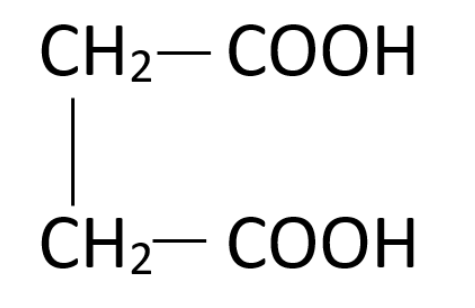
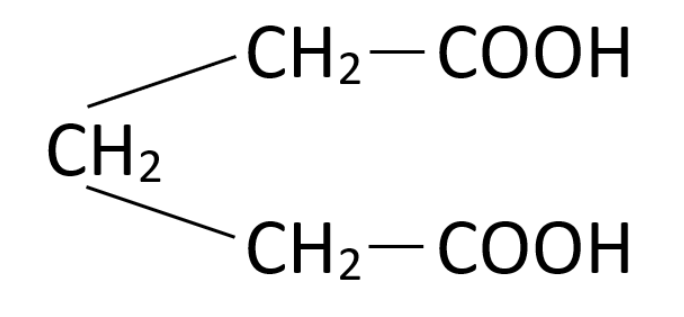
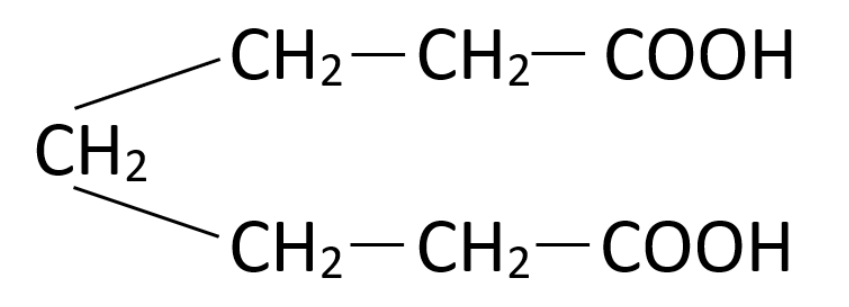
Which of the following will produce cyclic ketone on heating?
(A) $ C{H_2}{\left( {COOH} \right)_2} $
(B)
C)
D)
Answer
 Verified
480.6k+ views
Hint: A cyclic ketone is a ketone in whose molecule the carbon atoms bonded to the carbonyl carbon are connected by one or more carbon chains. These are synthesized when aliphatic dicarboxylic acid undergoes heat treatment.
Complete answer:
When a dicarboxylic aliphatic acid is heated, then five or six-membered cyclic anhydride is formed because they are highly stable. However, compounds like adipic acid (six carbon atoms) & higher acids will give rings of seven or more members which are very unstable. So, on heating, they give cyclic ketones with a loss of $ C{O_2} $ .
As options A, B, and C have a lesser number of carbon atoms than option D, option D has seven carbons so it can form a cyclic ketone.
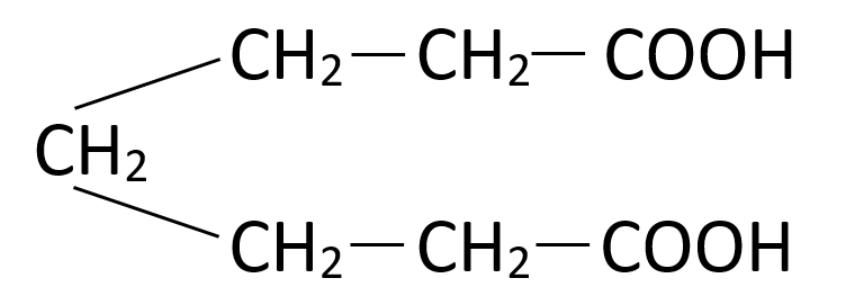
Hence, the correct option is (D).
Note:
The simplest category of cyclic ketone has the formula $ {\left( {C{H_2}} \right)_n}CO $ , where n varies from two in cyclo acetone to the tenth place. There are larger derivatives. Cyclohexanone is a symmetrical cyclic ketone and an important intermediate for the manufacture of nylon.
Complete answer:
When a dicarboxylic aliphatic acid is heated, then five or six-membered cyclic anhydride is formed because they are highly stable. However, compounds like adipic acid (six carbon atoms) & higher acids will give rings of seven or more members which are very unstable. So, on heating, they give cyclic ketones with a loss of $ C{O_2} $ .
As options A, B, and C have a lesser number of carbon atoms than option D, option D has seven carbons so it can form a cyclic ketone.
Hence, the correct option is (D).
Note:
The simplest category of cyclic ketone has the formula $ {\left( {C{H_2}} \right)_n}CO $ , where n varies from two in cyclo acetone to the tenth place. There are larger derivatives. Cyclohexanone is a symmetrical cyclic ketone and an important intermediate for the manufacture of nylon.
Recently Updated Pages
Master Class 12 Economics: Engaging Questions & Answers for Success

Master Class 12 Physics: Engaging Questions & Answers for Success
Master Class 12 English: Engaging Questions & Answers for Success
Master Class 12 Social Science: Engaging Questions & Answers for Success
Master Class 12 Maths: Engaging Questions & Answers for Success
Master Class 12 Business Studies: Engaging Questions & Answers for Success
Trending doubts
Which are the Top 10 Largest Countries of the World?
What are the major means of transport Explain each class 12 social science CBSE
Draw a labelled sketch of the human eye class 12 physics CBSE
Why cannot DNA pass through cell membranes class 12 biology CBSE
Differentiate between insitu conservation and exsitu class 12 biology CBSE
Draw a neat and well labeled diagram of TS of ovary class 12 biology CBSE