




Which one of the following amphibians have fossorial adaptation?
(a)Gymnophiona
(b)Urodela
(c)Anura
(d)All of the above
Answer
 Verified
587.7k+ views
Hint: Fossorial adaptation means animals that are adapted for burying. They are those organisms that live underground in burrows but not permanently. Caecilians are amphibians that resemble snakes or earthworms and have fossorial adaptation.
Complete answer:
A fossorial organism is one adapted for digging and lives underground. The caecilians are amphibians which belong to the Gymnophiona order that resembles earthworms or snakes superficially.
Additional Information: -Caecilians are mostly fossorial, subterranean creatures (although some are aquatic or semi-aquatic and some are aquatic larvae).
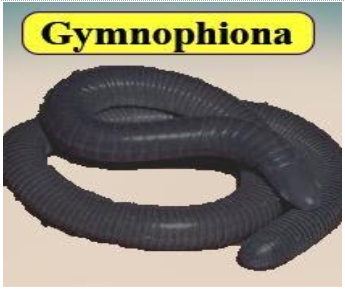
-The body is cylindrical and is dark brown or bluish-black.
-The skin of Gymnophiona is slimy and it bears grooves or ringlike markings; there are very small dermal scales.
-Caecilians are a category of vermiform or serpentine amphibians without limbs.
-They live mostly concealed in the ground and in-stream substrates making them the least common amphibian group.
-Both modern caecilians and their closest fossil relatives are grouped into the broader group Gymnophiona as a clade, Apoda, which also includes more primitive extinct Caecilian amphibians.
-Caecilian diets aren't well known. Mature caecilians tend mainly to feed on insects and other invertebrates found in the respective species' habitat.
-The stomach contents of 14 Boulengerula Tatiana specimens and other largely unrecognizable organic material and remains of plants. The most numerous identifiable remains were found to be termite heads.
-While the undefinable organic material showed that the caecilians consume detritus, the remains may come from earthworms.
-Caecilians in captivity can easily be fed with earthworms, and worms are also common in many Caecilian species' habitat.
-Urodela is an amphibian, a salamander. Anura belongs to the order of the frog. The below image represents a Gymnophiona.
So, the correct answer is ‘Gymnophiona’.
Note: The Caecilian is the only amphibian that reproduces via internal fertilization. All the other amphibians reproduce via external fertilization. 75% of Caecilians are viviparous (These organisms give rise to already developed off-springs).
Complete answer:
A fossorial organism is one adapted for digging and lives underground. The caecilians are amphibians which belong to the Gymnophiona order that resembles earthworms or snakes superficially.
Additional Information: -Caecilians are mostly fossorial, subterranean creatures (although some are aquatic or semi-aquatic and some are aquatic larvae).
-The body is cylindrical and is dark brown or bluish-black.
-The skin of Gymnophiona is slimy and it bears grooves or ringlike markings; there are very small dermal scales.
-Caecilians are a category of vermiform or serpentine amphibians without limbs.
-They live mostly concealed in the ground and in-stream substrates making them the least common amphibian group.
-Both modern caecilians and their closest fossil relatives are grouped into the broader group Gymnophiona as a clade, Apoda, which also includes more primitive extinct Caecilian amphibians.
-Caecilian diets aren't well known. Mature caecilians tend mainly to feed on insects and other invertebrates found in the respective species' habitat.
-The stomach contents of 14 Boulengerula Tatiana specimens and other largely unrecognizable organic material and remains of plants. The most numerous identifiable remains were found to be termite heads.
-While the undefinable organic material showed that the caecilians consume detritus, the remains may come from earthworms.
-Caecilians in captivity can easily be fed with earthworms, and worms are also common in many Caecilian species' habitat.
-Urodela is an amphibian, a salamander. Anura belongs to the order of the frog. The below image represents a Gymnophiona.
So, the correct answer is ‘Gymnophiona’.
Note: The Caecilian is the only amphibian that reproduces via internal fertilization. All the other amphibians reproduce via external fertilization. 75% of Caecilians are viviparous (These organisms give rise to already developed off-springs).
Recently Updated Pages
Master Class 11 Computer Science: Engaging Questions & Answers for Success

Master Class 11 Business Studies: Engaging Questions & Answers for Success
Master Class 11 Economics: Engaging Questions & Answers for Success
Master Class 11 English: Engaging Questions & Answers for Success
Master Class 11 Maths: Engaging Questions & Answers for Success
Master Class 11 Biology: Engaging Questions & Answers for Success
Trending doubts
One Metric ton is equal to kg A 10000 B 1000 C 100 class 11 physics CBSE
There are 720 permutations of the digits 1 2 3 4 5 class 11 maths CBSE
Discuss the various forms of bacteria class 11 biology CBSE
Draw a diagram of a plant cell and label at least eight class 11 biology CBSE
State the laws of reflection of light
10 examples of friction in our daily life