




With the help of a neat and labelled diagram, describe a reflex arc.
Answer
 Verified
586.5k+ views
Hint: Our brain and spinal cord form the central nervous system of our body which is held responsible for the coordination of movements in our body. Our body is always alarmed to the danger and suddenly sometimes reacts to the danger around. This is all done by the central nervous system which has the electrical impulses to carry the information.
Complete answer:
What is a reflex arc?
It is a cycle or pathway which carries the stimulus from the organs to the central nervous system and from the central nervous system to the organs. Various nerve actions make this transmission possible.
It is a neural pathway that will generate a reflex to all the actions by our body. There are two types of reflexes. Autonomic reflex arc and the somatic reflex arc.
Automatic will involve the spinal cord whereas somatic will include the brain mostly.
In this pathway, the sensory neurons will carry the information from the organs receptors to the spinal cord/central nervous system. The response then generated is sent to the effector neurons which will carry the response to the organs from the spinal cord.
This whole transmission forms the reflex arc. The involvement of one sensory and motor neuron makes the monosynaptic pathway. But in the polysynaptic pathway, there are more than one afferent and efferent signals. Mostly the signals are polysynaptic.
Interneuron is the intermediate between the sensory and the motor neuron. Reflex action is the sudden response to a situation so this is done by the reflex arc.
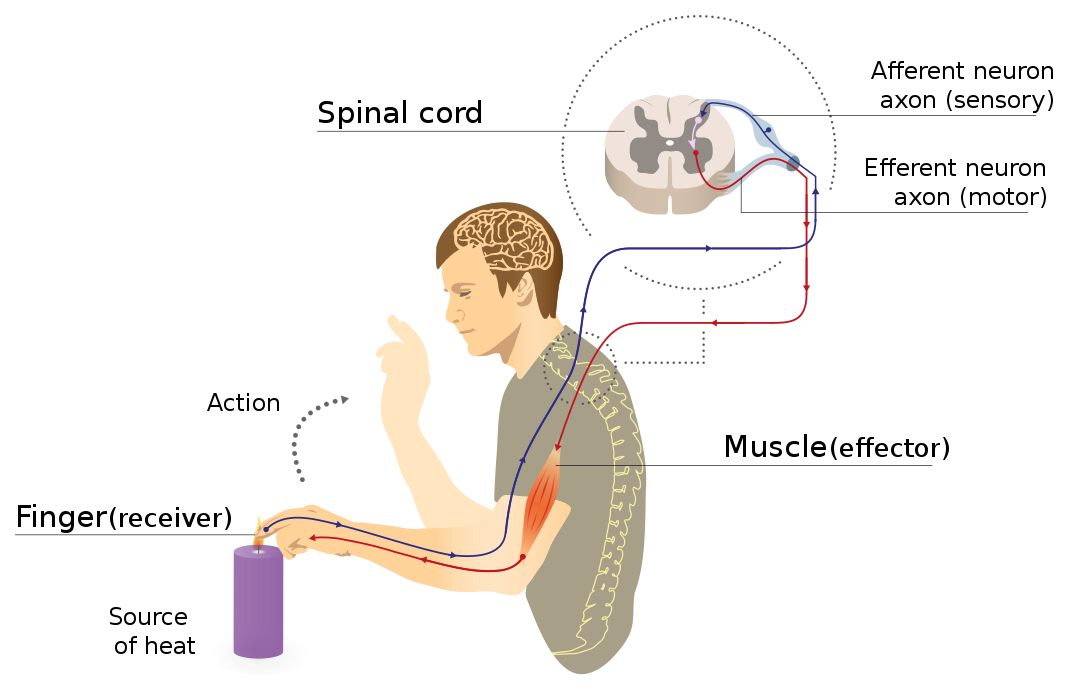
Hence, the correct answer is option (B).
Note: Reflex arc forms the involuntary movements of the body. Like when we touch a hot pan, our hands suddenly move off the pan to protect our body from the harm. So this reflex generates an impulse which tells our body part in the contact of danger to move away. Sensory and motor neurons are electrical impulses.
Complete answer:
What is a reflex arc?
It is a cycle or pathway which carries the stimulus from the organs to the central nervous system and from the central nervous system to the organs. Various nerve actions make this transmission possible.
It is a neural pathway that will generate a reflex to all the actions by our body. There are two types of reflexes. Autonomic reflex arc and the somatic reflex arc.
Automatic will involve the spinal cord whereas somatic will include the brain mostly.
In this pathway, the sensory neurons will carry the information from the organs receptors to the spinal cord/central nervous system. The response then generated is sent to the effector neurons which will carry the response to the organs from the spinal cord.
This whole transmission forms the reflex arc. The involvement of one sensory and motor neuron makes the monosynaptic pathway. But in the polysynaptic pathway, there are more than one afferent and efferent signals. Mostly the signals are polysynaptic.
Interneuron is the intermediate between the sensory and the motor neuron. Reflex action is the sudden response to a situation so this is done by the reflex arc.
Hence, the correct answer is option (B).
Note: Reflex arc forms the involuntary movements of the body. Like when we touch a hot pan, our hands suddenly move off the pan to protect our body from the harm. So this reflex generates an impulse which tells our body part in the contact of danger to move away. Sensory and motor neurons are electrical impulses.
Recently Updated Pages
Master Class 11 Computer Science: Engaging Questions & Answers for Success

Master Class 11 Business Studies: Engaging Questions & Answers for Success
Master Class 11 Economics: Engaging Questions & Answers for Success
Master Class 11 English: Engaging Questions & Answers for Success
Master Class 11 Maths: Engaging Questions & Answers for Success
Master Class 11 Biology: Engaging Questions & Answers for Success
Trending doubts
One Metric ton is equal to kg A 10000 B 1000 C 100 class 11 physics CBSE
There are 720 permutations of the digits 1 2 3 4 5 class 11 maths CBSE
Discuss the various forms of bacteria class 11 biology CBSE
Draw a diagram of a plant cell and label at least eight class 11 biology CBSE
State the laws of reflection of light
Explain zero factorial class 11 maths CBSE