




Write the chemical equation for the following:
A.Gattermann – Koch formulation
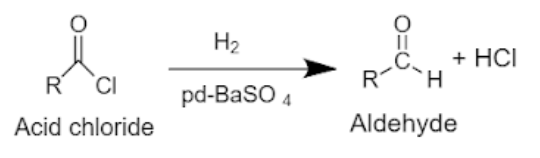
B.Rosenmund reduction
Fischer esterification
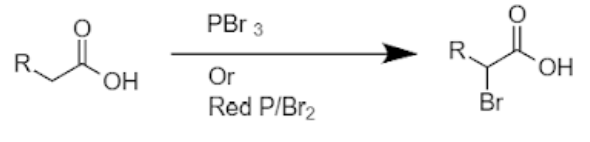
Hell – Volhard – Zelensky reaction
Answer
 Verified
570.9k+ views
Hint: In a chemical equation, the reactants are written on the left, and the products are written on the right. The coefficients next to the symbols of entities indicate the number of moles of a substance produced or used in the chemical reaction.
Complete step by step answer:
- Name reaction is a chemical reaction which is named after the person who developed or discovered it. Hundreds of well-known organic reactions have been named after people.
Gattermann – Koch Reaction: The Gattermann–Koch reaction is named after the German chemists Julius Arnold Koch and Ludwig Gattermann. In a Gattermann–Koch reaction refers to a Friedel–Crafts acylation reaction in which a Friedel–Crafts catalyst, hydrochloric acid, and carbon monoxide are used to produce aromatic aldehydes from various aromatic compounds, including derivatives of naphthalene and benzene. Click here for an in-depth explanation of the reaction details and mechanism of Gattermann – Koch Reaction.

Rosenmund Reduction: The Rosenmund reduction was named after Karl Wilhelm Rosenmund, who in 1918 reported its discovery. A hydrogenation process in which an acyl chloride is selectively reduced to an aldehyde.
Fischer Esterification: Fischer Esterification is an organic reaction which is employed to convert carboxylic acids in the presence of excess alcohol and a strong acid catalyst to give an ester as the final product. Visit Fischer Esterification for more information.

Carboxylic acid ester
Hell-Volhard-Zelinsky Reaction: The Hell-Volhard-Zelinsky reaction is used for the halogenation of carboxylic acids at the alpha carbon. Click here for an in-depth explanation of the reaction details and mechanism of Hell-Volhard-Zelinsky Reaction.
\[\text{ }\!\!\alpha\!\!\text{ -halo acid}\]
Note:
The method of representing a chemical reaction with the help of symbols and formulae of the substances involved in it is known as chemical equation. For example, zinc metal reacts with dilute sulphuric acid to form zinc sulphate and hydrogen gas.
Complete step by step answer:
- Name reaction is a chemical reaction which is named after the person who developed or discovered it. Hundreds of well-known organic reactions have been named after people.
Gattermann – Koch Reaction: The Gattermann–Koch reaction is named after the German chemists Julius Arnold Koch and Ludwig Gattermann. In a Gattermann–Koch reaction refers to a Friedel–Crafts acylation reaction in which a Friedel–Crafts catalyst, hydrochloric acid, and carbon monoxide are used to produce aromatic aldehydes from various aromatic compounds, including derivatives of naphthalene and benzene. Click here for an in-depth explanation of the reaction details and mechanism of Gattermann – Koch Reaction.
Rosenmund Reduction: The Rosenmund reduction was named after Karl Wilhelm Rosenmund, who in 1918 reported its discovery. A hydrogenation process in which an acyl chloride is selectively reduced to an aldehyde.
Fischer Esterification: Fischer Esterification is an organic reaction which is employed to convert carboxylic acids in the presence of excess alcohol and a strong acid catalyst to give an ester as the final product. Visit Fischer Esterification for more information.
Carboxylic acid ester
Hell-Volhard-Zelinsky Reaction: The Hell-Volhard-Zelinsky reaction is used for the halogenation of carboxylic acids at the alpha carbon. Click here for an in-depth explanation of the reaction details and mechanism of Hell-Volhard-Zelinsky Reaction.
\[\text{ }\!\!\alpha\!\!\text{ -halo acid}\]
Note:
The method of representing a chemical reaction with the help of symbols and formulae of the substances involved in it is known as chemical equation. For example, zinc metal reacts with dilute sulphuric acid to form zinc sulphate and hydrogen gas.
Recently Updated Pages
Master Class 11 Computer Science: Engaging Questions & Answers for Success

Master Class 11 Business Studies: Engaging Questions & Answers for Success
Master Class 11 Economics: Engaging Questions & Answers for Success
Master Class 11 English: Engaging Questions & Answers for Success
Master Class 11 Maths: Engaging Questions & Answers for Success
Master Class 11 Biology: Engaging Questions & Answers for Success
Trending doubts
One Metric ton is equal to kg A 10000 B 1000 C 100 class 11 physics CBSE
There are 720 permutations of the digits 1 2 3 4 5 class 11 maths CBSE
Discuss the various forms of bacteria class 11 biology CBSE
Draw a diagram of a plant cell and label at least eight class 11 biology CBSE
State the laws of reflection of light
Explain zero factorial class 11 maths CBSE