




A gas is compressed isothermally to half its initial volume. The same gas is compressed separately through an adiabatic process until its volume is again reduced to half. Then.
(A) Compressing the gas isothermally will require more work to be done
(B) Compressing the gas through adiabatic process will require more work to be done
(C) Compressing the gas isothermally or adiabatically will required the same amount of work
(D) Which of the case(Whether compression through isothermal of through adiabatic process) requires more work will depends upon the atomicity of the gas
Answer
 Verified
232.8k+ views
Hint: It is given that a gas is initially compressed isothermally to half it’s initial volume. Isothermal compression is a type of compression where temperature is kept constant. Later, the same gas is compressed adiabatically, where the temperature of the gas increases due to compression. Use a P-V graph to substantiate your answer.
Complete step by step Solution:
Isothermal compression is a type of gas compression where the temperature of the gas is kept constant during compression. It will have a much lesser slope than adiabatic process since the pressure required to compress the gas will be more if the temperature is kept constant throughout the process. On the other hand, adiabatic process is a compression or expansion process where the system gives out energy to the surrounding as work.
Now, let us assume that the gas undergoes compression from \[V\] to \[\dfrac{V}{2}\]in a given time period. Let us diagrammatically visualize the situation using a P-V plot for the gas.
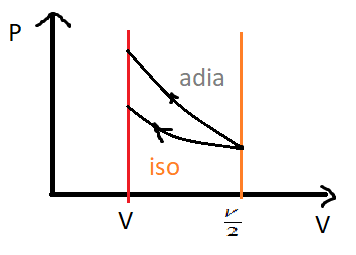
Now, work done by the process can be graphically identified by the area under the graph of the process. Now, when we compare the area under the isothermal process curve and the adiabatic process curve, we can say that the work done for adiabatic process is higher than that of work done by isothermal process.
Since the adiabatic gives out energy to surroundings as work, we can say that work done by adiabatic process is greater than isothermal process.
Hence, Option (b) is the right answer for a given question.
Note: Compression of gas is a process where the volume occupied by gas particles is reduced by forcing the gas molecules together. Naturally, compression of gas increases the temperature of the gas as the volume is reduced.
Complete step by step Solution:
Isothermal compression is a type of gas compression where the temperature of the gas is kept constant during compression. It will have a much lesser slope than adiabatic process since the pressure required to compress the gas will be more if the temperature is kept constant throughout the process. On the other hand, adiabatic process is a compression or expansion process where the system gives out energy to the surrounding as work.
Now, let us assume that the gas undergoes compression from \[V\] to \[\dfrac{V}{2}\]in a given time period. Let us diagrammatically visualize the situation using a P-V plot for the gas.
Now, work done by the process can be graphically identified by the area under the graph of the process. Now, when we compare the area under the isothermal process curve and the adiabatic process curve, we can say that the work done for adiabatic process is higher than that of work done by isothermal process.
Since the adiabatic gives out energy to surroundings as work, we can say that work done by adiabatic process is greater than isothermal process.
Hence, Option (b) is the right answer for a given question.
Note: Compression of gas is a process where the volume occupied by gas particles is reduced by forcing the gas molecules together. Naturally, compression of gas increases the temperature of the gas as the volume is reduced.
Recently Updated Pages
JEE Main 2023 April 6 Shift 1 Question Paper with Answer Key

JEE Main 2023 April 6 Shift 2 Question Paper with Answer Key
JEE Main 2023 (January 31 Evening Shift) Question Paper with Solutions [PDF]
JEE Main 2023 January 30 Shift 2 Question Paper with Answer Key
JEE Main 2023 January 25 Shift 1 Question Paper with Answer Key
JEE Main 2023 January 24 Shift 2 Question Paper with Answer Key
Trending doubts
JEE Main 2026: Session 2 Registration Open, City Intimation Slip, Exam Dates, Syllabus & Eligibility
JEE Main 2026 Application Login: Direct Link, Registration, Form Fill, and Steps
Understanding the Angle of Deviation in a Prism
Hybridisation in Chemistry – Concept, Types & Applications
How to Convert a Galvanometer into an Ammeter or Voltmeter
Understanding Uniform Acceleration in Physics
Other Pages
JEE Advanced Marks vs Ranks 2025: Understanding Category-wise Qualifying Marks and Previous Year Cut-offs
Laws of Motion Class 11 Physics Chapter 4 CBSE Notes - 2025-26
Waves Class 11 Physics Chapter 14 CBSE Notes - 2025-26
Mechanical Properties of Fluids Class 11 Physics Chapter 9 CBSE Notes - 2025-26
Thermodynamics Class 11 Physics Chapter 11 CBSE Notes - 2025-26
Units And Measurements Class 11 Physics Chapter 1 CBSE Notes - 2025-26