




When a particle is moving in vertical circle,
A) Its radial and tangential acceleration both are constant
B) Its radial and tangential acceleration both are varying
C) Its radial acceleration is constant but tangential acceleration is varying
D) Its radial acceleration is varying but tangential acceleration is constant
Answer
 Verified
232.8k+ views
Hint: To this thing we assume a particle which is moving in vertical circular path when any object moving in vertical circular path then it has both type of acceleration radial acceleration as well as tangential acceleration by the radial acceleration object change its direction regularly means it helps to maintain the motion in a circular path Which provided by the centripetal Force and tangential acceleration act along in tangential direction which manage the speed of object in path
Complete step by step solution:
Whenever object move in a vertical circular path then it has both type of acceleration
Let us assume the object of mass Moving in a vertical circular path with the help of a string when it moved in circular path centripetal force acts on it to maintain its circular path
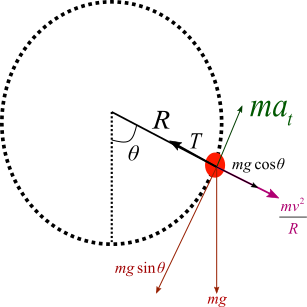
As you can see in the diagram at any instant the object at point B at this moment the force on the object mentioned in the above diagram.
From this diagram we can write following equations
Balancing force in radial direction
$ \Rightarrow mg\cos \theta + \dfrac{{m{v^2}}}{R} = T$
$ \Rightarrow \dfrac{{m{v^2}}}{R} = T - mg\cos \theta $
Here $\dfrac{{{v^2}}}{R}$ Is the centripetal acceleration toward the centre which is also known as radial acceleration ${a_R}$
From above equation Radial acceleration${a_R}$
$\therefore {a_R} = \dfrac{{T - mg\cos \theta }}{m}$ ................... (1)
From this equation we can see that radial acceleration depends upon angle $\theta $ which is varying so radial acceleration varies in vertical circular motion.
For tangential force
$ \Rightarrow m{a_t} = mg\sin \theta $
So tangential acceleration ${a_t}$
$\therefore {a_t} = g\sin \theta $
So we can see from this equation tangential acceleration also depends upon angle $\theta $ so tangential acceleration is also varying in vertical circular motion.
Hence option B is correct.
Note: We know best speed of object moving in vertical circular path gradually decreases when it move from lowest most point to the top most point and the speed of object gradually increases when object move top most point to the lowermost point it means the magnitude off velocity of object continuously change in vertical motion.
Complete step by step solution:
Whenever object move in a vertical circular path then it has both type of acceleration
Let us assume the object of mass Moving in a vertical circular path with the help of a string when it moved in circular path centripetal force acts on it to maintain its circular path
As you can see in the diagram at any instant the object at point B at this moment the force on the object mentioned in the above diagram.
From this diagram we can write following equations
Balancing force in radial direction
$ \Rightarrow mg\cos \theta + \dfrac{{m{v^2}}}{R} = T$
$ \Rightarrow \dfrac{{m{v^2}}}{R} = T - mg\cos \theta $
Here $\dfrac{{{v^2}}}{R}$ Is the centripetal acceleration toward the centre which is also known as radial acceleration ${a_R}$
From above equation Radial acceleration${a_R}$
$\therefore {a_R} = \dfrac{{T - mg\cos \theta }}{m}$ ................... (1)
From this equation we can see that radial acceleration depends upon angle $\theta $ which is varying so radial acceleration varies in vertical circular motion.
For tangential force
$ \Rightarrow m{a_t} = mg\sin \theta $
So tangential acceleration ${a_t}$
$\therefore {a_t} = g\sin \theta $
So we can see from this equation tangential acceleration also depends upon angle $\theta $ so tangential acceleration is also varying in vertical circular motion.
Hence option B is correct.
Note: We know best speed of object moving in vertical circular path gradually decreases when it move from lowest most point to the top most point and the speed of object gradually increases when object move top most point to the lowermost point it means the magnitude off velocity of object continuously change in vertical motion.
Recently Updated Pages
JEE Main 2026 Session 2 Registration Open, Exam Dates, Syllabus & Eligibility

JEE Main 2023 April 6 Shift 1 Question Paper with Answer Key
JEE Main 2023 April 6 Shift 2 Question Paper with Answer Key
JEE Main 2023 (January 31 Evening Shift) Question Paper with Solutions [PDF]
JEE Main 2023 January 30 Shift 2 Question Paper with Answer Key
JEE Main 2023 January 25 Shift 1 Question Paper with Answer Key
Trending doubts
JEE Main Marking Scheme 2026- Paper-Wise Marks Distribution and Negative Marking Details
Understanding Average and RMS Value in Electrical Circuits
Understanding Collisions: Types and Examples for Students
Ideal and Non-Ideal Solutions Explained for Class 12 Chemistry
Understanding Atomic Structure for Beginners
Derive an expression for maximum speed of a car on class 11 physics JEE_Main
Other Pages
JEE Advanced Weightage 2025 Chapter-Wise for Physics, Maths and Chemistry
NCERT Solutions For Class 11 Physics Chapter 9 Mechanical Properties of Fluids (2025-26)
NCERT Solutions For Class 11 Physics Chapter 12 Kinetic Theory (2025-26)
NCERT Solutions For Class 11 Physics Chapter 4 Law of Motion (2025-26)
Class 11 JEE Main Physics Mock Test 2025
Inductive Effect and Its Role in Acidic Strength