




A ray of light moving parallel to the \[x-\]axis gets reflected from a parabolic mirror whose equation is ${{\left( y-2 \right)}^{2}}=4\left( x+1 \right)$. After reflection, the ray must pass through the point
(a). $\left( -2,0 \right)$
(b). $\left( -1,2 \right)$
(c). $\left( 0,2 \right)$
(d). $\left( 2,0 \right)$
Answer
 Verified
232.8k+ views
Hint: The ray of light moving parallel to the \[x-\]axis that gets reflected from a parabolic mirror would pass through the focal point of the parabolic mirror.
Complete step-by-step solution -
It is given in the question that the ray is parallel to the \[x-\]axis. The equation of the parabolic mirror is given as ${{\left( y-2 \right)}^{2}}=4\left( x+1 \right)$.
The plot of the parabolic mirror can be drawn as shown below,
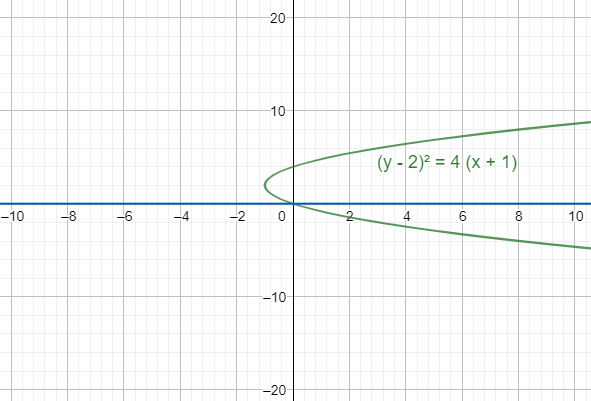
The axis of the parabolic mirror is parallel to the \[x-\]axis and the ray is also parallel to it.
It is known that in a parabolic mirror, the incoming ray of light parallel to the axis is reflected through the focal point.
So, it would mean that, after reflection, the ray of light we have been given in the question would pass through the focal point of the parabolic mirror ${{\left( y-2 \right)}^{2}}=4\left( x+1 \right)$.
We know that the focal point of a parabola of the form ${{y}^{2}}=4ax$ is given as $\left( a,0 \right)$.
No, on comparing the equation ${{\left( y-2 \right)}^{2}}=4\left( x+1 \right)$ with the general equation ${{y}^{2}}=4ax$, we can write the corresponding terms as,
$y=\left( y-2 \right)$, $x=\left( x+1 \right)$ and $a=1$
We know that the coordinates of the focal point for the general equation are $\left( a,0 \right)$. To obtain the focal point of the parabolic mirror, we have to equate both the coordinates as below,
$\left( x+1 \right)=a\Rightarrow \left( x+1 \right)=1\Rightarrow x=0$
$\left( y-2 \right)=0\Rightarrow y=2$
Therefore, the focal point of the parabolic mirror ${{\left( y-2 \right)}^{2}}=4\left( x+1 \right)$ is $\left( 0,2 \right)$.
We have obtained option (c) as the correct answer.
Note: The focal point of a parabola of the form ${{y}^{2}}=4ax$ is given by $\left( a,0 \right)$. There is a chance that you might end up choosing the wrong option by assuming that the focal point for any parabola of the form ${{y}^{2}}=4ax$ would have the y-coordinate as $0$.
Complete step-by-step solution -
It is given in the question that the ray is parallel to the \[x-\]axis. The equation of the parabolic mirror is given as ${{\left( y-2 \right)}^{2}}=4\left( x+1 \right)$.
The plot of the parabolic mirror can be drawn as shown below,
The axis of the parabolic mirror is parallel to the \[x-\]axis and the ray is also parallel to it.
It is known that in a parabolic mirror, the incoming ray of light parallel to the axis is reflected through the focal point.
So, it would mean that, after reflection, the ray of light we have been given in the question would pass through the focal point of the parabolic mirror ${{\left( y-2 \right)}^{2}}=4\left( x+1 \right)$.
We know that the focal point of a parabola of the form ${{y}^{2}}=4ax$ is given as $\left( a,0 \right)$.
No, on comparing the equation ${{\left( y-2 \right)}^{2}}=4\left( x+1 \right)$ with the general equation ${{y}^{2}}=4ax$, we can write the corresponding terms as,
$y=\left( y-2 \right)$, $x=\left( x+1 \right)$ and $a=1$
We know that the coordinates of the focal point for the general equation are $\left( a,0 \right)$. To obtain the focal point of the parabolic mirror, we have to equate both the coordinates as below,
$\left( x+1 \right)=a\Rightarrow \left( x+1 \right)=1\Rightarrow x=0$
$\left( y-2 \right)=0\Rightarrow y=2$
Therefore, the focal point of the parabolic mirror ${{\left( y-2 \right)}^{2}}=4\left( x+1 \right)$ is $\left( 0,2 \right)$.
We have obtained option (c) as the correct answer.
Note: The focal point of a parabola of the form ${{y}^{2}}=4ax$ is given by $\left( a,0 \right)$. There is a chance that you might end up choosing the wrong option by assuming that the focal point for any parabola of the form ${{y}^{2}}=4ax$ would have the y-coordinate as $0$.
Recently Updated Pages
JEE Main 2023 April 6 Shift 1 Question Paper with Answer Key

JEE Main 2023 April 6 Shift 2 Question Paper with Answer Key
JEE Main 2023 (January 31 Evening Shift) Question Paper with Solutions [PDF]
JEE Main 2023 January 30 Shift 2 Question Paper with Answer Key
JEE Main 2023 January 25 Shift 1 Question Paper with Answer Key
JEE Main 2023 January 24 Shift 2 Question Paper with Answer Key
Trending doubts
JEE Main 2026: Session 2 Registration Open, City Intimation Slip, Exam Dates, Syllabus & Eligibility
JEE Main 2026 Application Login: Direct Link, Registration, Form Fill, and Steps
Understanding the Angle of Deviation in a Prism
Hybridisation in Chemistry – Concept, Types & Applications
How to Convert a Galvanometer into an Ammeter or Voltmeter
Understanding the Electric Field of a Uniformly Charged Ring
Other Pages
JEE Advanced Marks vs Ranks 2025: Understanding Category-wise Qualifying Marks and Previous Year Cut-offs
NCERT Solutions For Class 11 Maths Chapter 12 Limits and Derivatives (2025-26)
NCERT Solutions For Class 11 Maths Chapter 10 Conic Sections (2025-26)
JEE Advanced Weightage 2025 Chapter-Wise for Physics, Maths and Chemistry
Derivation of Equation of Trajectory Explained for Students
Understanding Electromagnetic Waves and Their Importance