




A wire frame in the shape of an equilateral triangle is hinged at one vertex so that it can swing freely in a vertical plane, with the plane of the triangle always remaining vertical. The side of the frame is $\dfrac{1}{{\sqrt 3 }}$ m. The time period in seconds of small oscillations of the frame will be (g=10 m${s^{ - 2}}$ )
A) $\dfrac{\pi }{{\sqrt 2 }}$
B) $\dfrac{\pi }{{\sqrt 3 }}$
C) $\dfrac{\pi }{{\sqrt 6 }}$
D) $\dfrac{\pi }{{\sqrt 5 }}$
Answer
 Verified
232.8k+ views
Hint: In order to solve the question, we need to find out the moment of inertia of the triangle side by side and then adding them together. The formula for time period of oscillation is period T=$2\pi \sqrt {\dfrac{I}{{mgL}}} $ where, I is the moment of inertia, m is the mass, g is the gravity (g=10 m${s^{ - 2}}$ ), and L is the distance from center of mass to the point of hinging will help in finding the solution.
Complete step by step answer:
Step 1:
Before we start we need to look into the definition of some quantity which we are going to use in solving the question.
Oscillation refers to any Periodic Motion moving at a distance about the equilibrium position and repeats itself over and over for a period of time. Example The Oscillation up and down of a spring, The Oscillation side by side of a spring. The Oscillation swinging side by side of a pendulum
Moment of inertia: In physics, quantitative measure of the rotational inertia of a bodyi.e., the opposition that the body exhibits to having its speed of rotation about an axis altered by the application of a torque (turning force). The axis may be internal or external and may or may not be fixed.
Parallel Axis Theorem: The moment of inertia of a body about any axis is equal to the sum of the moment of inertia of the body about a parallel axis passing through its centre of mass and the product of its mass and the square of the distance between the two parallel axes.
Step 2:
Coming to the question:
We are given that a wire frame in the shape of an equilateral triangle is hinged at one vertex so that it can swing freely in a vertical plane, with the plane of the triangle always remaining vertical. The side of the frame is $\dfrac{1}{{\sqrt 3 }}$ m
Here we have a diagram for clear understanding.
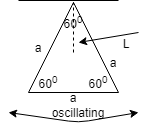
Here a is the side of the triangle and L is the distance from center of mass to the point of hinging which is equal to $\dfrac{a}{{\sqrt 3 }}$
First we will find out the moment of inertia, I
Let the mass of the triangle be m, so each side will have mass $\dfrac{m}{3}$
Now we are using moment of inertia on all the sides. The side at the base will have a moment of inertia of $\dfrac{{{a^2}}}{{12}}$ and also we have to apply parallel axis theorem because of the side and the hinged place.
Then I=$\dfrac{m}{3}$$\left( {\dfrac{{{a^2}}}{3} + \dfrac{{{a^2}}}{3} + \dfrac{{{a^2}}}{{12}} + {{\left( {\dfrac{{\sqrt {3a} }}{2}} \right)}^2}} \right)$
Solving for I, $\dfrac{{2m{a^2}}}{9} + \dfrac{{m{a^2}}}{{36}} + \dfrac{{m{a^2}}}{4}$ which is equal to $\dfrac{1}{2}m{a^2}$ ……… (1)
We are asked for the time period, now using the formula for time period T=$2\pi \sqrt {\dfrac{I}{{mgL}}} $ where, I is the moment of inertia, m is the mass, g is the gravity (g=10 m${s^{ - 2}}$ ), and L is the distance from center of mass to the point of hinging.
Substituting the value in time period we get, T=$2\pi \sqrt {\dfrac{{\dfrac{1}{2}m{a^2}}}{{mg\dfrac{a}{{\sqrt 3 }}}}} $
On further solving the term and cancelling the common term we get, T=$2\pi \sqrt {\dfrac{1}{{2g}}} $
Putting the value of g=10 m${s^{ - 2}}$ we get T = $\dfrac{\pi }{{\sqrt 5 }}$
Therefore the correct option is D.
Note: The combined moment of inertia is obtained using parallel axis theorem in finding the moment of inertia which states that moment of any axis parallel to the original axis is sum of the moment of inertia about the original axis and product of mass times distance between the axes squared.
Complete step by step answer:
Step 1:
Before we start we need to look into the definition of some quantity which we are going to use in solving the question.
Oscillation refers to any Periodic Motion moving at a distance about the equilibrium position and repeats itself over and over for a period of time. Example The Oscillation up and down of a spring, The Oscillation side by side of a spring. The Oscillation swinging side by side of a pendulum
Moment of inertia: In physics, quantitative measure of the rotational inertia of a bodyi.e., the opposition that the body exhibits to having its speed of rotation about an axis altered by the application of a torque (turning force). The axis may be internal or external and may or may not be fixed.
Parallel Axis Theorem: The moment of inertia of a body about any axis is equal to the sum of the moment of inertia of the body about a parallel axis passing through its centre of mass and the product of its mass and the square of the distance between the two parallel axes.
Step 2:
Coming to the question:
We are given that a wire frame in the shape of an equilateral triangle is hinged at one vertex so that it can swing freely in a vertical plane, with the plane of the triangle always remaining vertical. The side of the frame is $\dfrac{1}{{\sqrt 3 }}$ m
Here we have a diagram for clear understanding.
Here a is the side of the triangle and L is the distance from center of mass to the point of hinging which is equal to $\dfrac{a}{{\sqrt 3 }}$
First we will find out the moment of inertia, I
Let the mass of the triangle be m, so each side will have mass $\dfrac{m}{3}$
Now we are using moment of inertia on all the sides. The side at the base will have a moment of inertia of $\dfrac{{{a^2}}}{{12}}$ and also we have to apply parallel axis theorem because of the side and the hinged place.
Then I=$\dfrac{m}{3}$$\left( {\dfrac{{{a^2}}}{3} + \dfrac{{{a^2}}}{3} + \dfrac{{{a^2}}}{{12}} + {{\left( {\dfrac{{\sqrt {3a} }}{2}} \right)}^2}} \right)$
Solving for I, $\dfrac{{2m{a^2}}}{9} + \dfrac{{m{a^2}}}{{36}} + \dfrac{{m{a^2}}}{4}$ which is equal to $\dfrac{1}{2}m{a^2}$ ……… (1)
We are asked for the time period, now using the formula for time period T=$2\pi \sqrt {\dfrac{I}{{mgL}}} $ where, I is the moment of inertia, m is the mass, g is the gravity (g=10 m${s^{ - 2}}$ ), and L is the distance from center of mass to the point of hinging.
Substituting the value in time period we get, T=$2\pi \sqrt {\dfrac{{\dfrac{1}{2}m{a^2}}}{{mg\dfrac{a}{{\sqrt 3 }}}}} $
On further solving the term and cancelling the common term we get, T=$2\pi \sqrt {\dfrac{1}{{2g}}} $
Putting the value of g=10 m${s^{ - 2}}$ we get T = $\dfrac{\pi }{{\sqrt 5 }}$
Therefore the correct option is D.
Note: The combined moment of inertia is obtained using parallel axis theorem in finding the moment of inertia which states that moment of any axis parallel to the original axis is sum of the moment of inertia about the original axis and product of mass times distance between the axes squared.
Recently Updated Pages
Circuit Switching vs Packet Switching: Key Differences Explained

Dimensions of Pressure in Physics: Formula, Derivation & SI Unit
JEE General Topics in Chemistry Important Concepts and Tips
JEE Extractive Metallurgy Important Concepts and Tips for Exam Preparation
JEE Amino Acids and Peptides Important Concepts and Tips for Exam Preparation
JEE Atomic Structure and Chemical Bonding important Concepts and Tips
Trending doubts
JEE Main 2026: Session 2 Registration Open, City Intimation Slip, Exam Dates, Syllabus & Eligibility
JEE Main 2026 Application Login: Direct Link, Registration, Form Fill, and Steps
JEE Main Marking Scheme 2026- Paper-Wise Marks Distribution and Negative Marking Details
Understanding the Angle of Deviation in a Prism
Hybridisation in Chemistry – Concept, Types & Applications
How to Convert a Galvanometer into an Ammeter or Voltmeter
Other Pages
JEE Advanced Marks vs Ranks 2025: Understanding Category-wise Qualifying Marks and Previous Year Cut-offs
Laws of Motion Class 11 Physics Chapter 4 CBSE Notes - 2025-26
Waves Class 11 Physics Chapter 14 CBSE Notes - 2025-26
Mechanical Properties of Fluids Class 11 Physics Chapter 9 CBSE Notes - 2025-26
Thermodynamics Class 11 Physics Chapter 11 CBSE Notes - 2025-26
Units And Measurements Class 11 Physics Chapter 1 CBSE Notes - 2025-26