




Airspeed of an aeroplane is 400km/hr. The wind is blowing at 200km/hr towards the east direction. In what direction should the pilot try to fly the plane to move exactly towards the northeast.
Answer
 Verified
232.8k+ views
Hint: When the plane is moving and the wind is blowing due east in this situation when the plane steers towards northeast then the effect of wind blowing will also affect the angle turned by the aeroplane it will turn more than it was steered to turn. So, if we want to steer at a particular angle then we need to steer at an angle lower than desired because the rest of the turn will be due to the effect of wind.
Complete step by step solution:
Consider the following diagram in this case: the plane is flying and the wind is blowing due east. Now here it is said that the plane needs to be steered exactly northeast. Now as we can see that the exact northeast will be at \[45^\circ \].
So if we need to travel at \[45^\circ \] we will take a steer at an angle more than \[45^\circ \] so the wind will show its effect and the resultant of wind and aeroplane will be at \[45^\circ \].
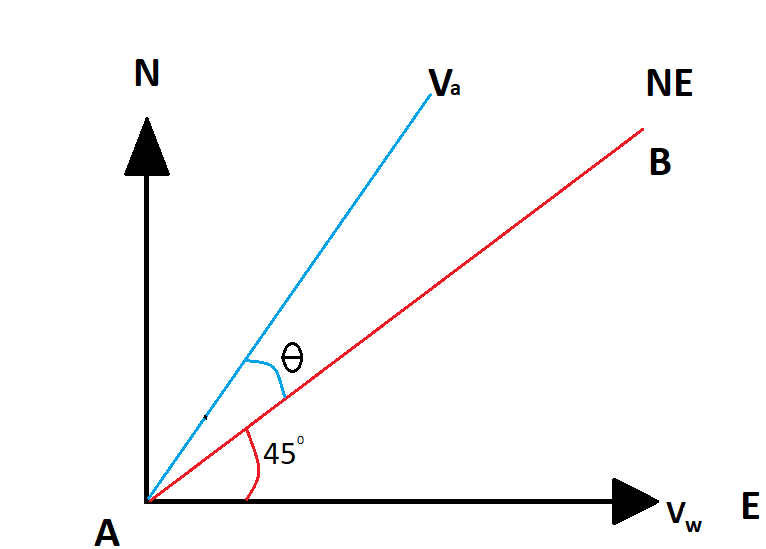
Now in this figure, the red line is the actual path the plane needs to turn and the blue line is the path we will turn to compensate for the effect of wind blowing due east.
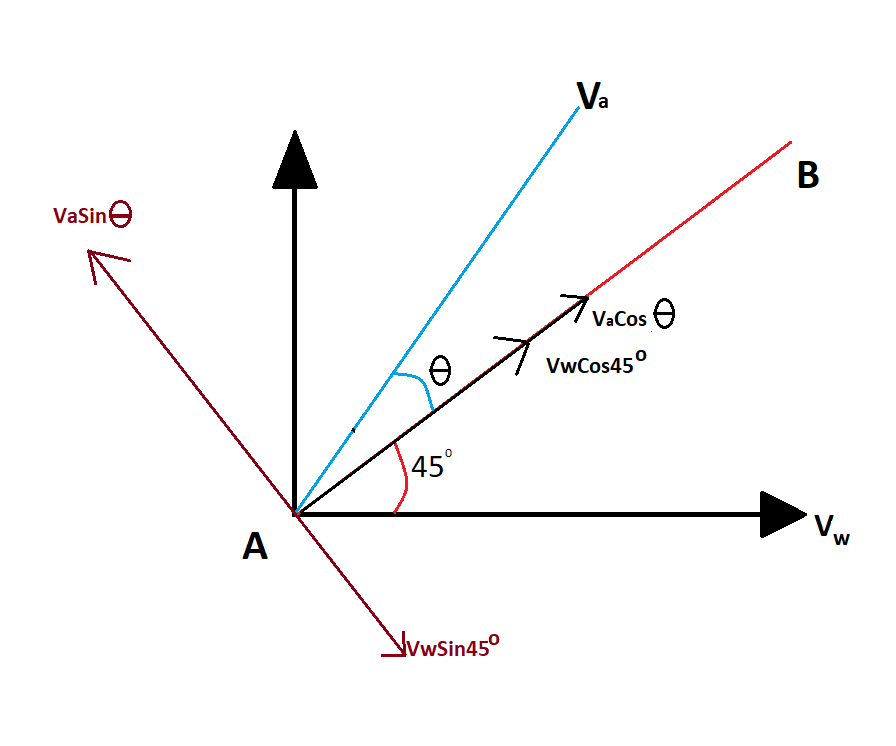
Now resolving the components of ${V_a}$ we get ${V_a}\operatorname{Cos} \theta $ along AB.
And ${V_a}\operatorname{Sin} \theta $ perpendicular to AB
Similarly,
Now we will resolve ${V_w}$ for AB
So, we will get ${V_w}\operatorname{Cos} 45^\circ $ along AB
And ${V_w}\operatorname{Sin} 45^\circ $ perpendicular to that
Now in the figure, we can see that the components ${V_a}\operatorname{Cos} \theta $ and ${V_a}\operatorname{Cos} 45^\circ $ will steer the plane along with AB
And ${V_w}\operatorname{Sin} 45^\circ $, ${V_a}\operatorname{Sin} \theta $ acting in opposite directions will be equal and cancel out each other.
So the net resultant force will be along AB and plane will steer exactly at $45^\circ $
On equating we get ${V_a}\operatorname{Sin} \theta = {V_w}\operatorname{Sin} 45^\circ $
Substituting the values, we get
${V_a}$ is the velocity of the aeroplane $ = 400m{s^{ - 1}}$
${V_w}$ is the velocity of the wind $ = 200m{s^{ - 1}}$
$\Rightarrow 400\operatorname{Sin} \theta = 200\operatorname{Sin} 45^\circ $
$\Rightarrow \operatorname{Sin} \theta = \dfrac{{200}}{{400}}\operatorname{Sin} 45^\circ $
$ \Rightarrow \operatorname{Sin} \theta = \dfrac{1}{2}\operatorname{Sin} 45^\circ $
$ \Rightarrow \theta = 20.70^\circ $
Final answer: The pilot needs to turn an angle of $20.70^\circ $ to move exactly northeast.
Note: The resultant of both the motion will give us the actual motion.
When a plane is flying and it takes a turn and there is wind flowing then the effect of the wind will also be considered in steering the plane.
The effect of wind generally increases or decreases the angle the pilot needs to steer the plan to get into a particular direction.
Complete step by step solution:
Consider the following diagram in this case: the plane is flying and the wind is blowing due east. Now here it is said that the plane needs to be steered exactly northeast. Now as we can see that the exact northeast will be at \[45^\circ \].
So if we need to travel at \[45^\circ \] we will take a steer at an angle more than \[45^\circ \] so the wind will show its effect and the resultant of wind and aeroplane will be at \[45^\circ \].
Now in this figure, the red line is the actual path the plane needs to turn and the blue line is the path we will turn to compensate for the effect of wind blowing due east.
Now resolving the components of ${V_a}$ we get ${V_a}\operatorname{Cos} \theta $ along AB.
And ${V_a}\operatorname{Sin} \theta $ perpendicular to AB
Similarly,
Now we will resolve ${V_w}$ for AB
So, we will get ${V_w}\operatorname{Cos} 45^\circ $ along AB
And ${V_w}\operatorname{Sin} 45^\circ $ perpendicular to that
Now in the figure, we can see that the components ${V_a}\operatorname{Cos} \theta $ and ${V_a}\operatorname{Cos} 45^\circ $ will steer the plane along with AB
And ${V_w}\operatorname{Sin} 45^\circ $, ${V_a}\operatorname{Sin} \theta $ acting in opposite directions will be equal and cancel out each other.
So the net resultant force will be along AB and plane will steer exactly at $45^\circ $
On equating we get ${V_a}\operatorname{Sin} \theta = {V_w}\operatorname{Sin} 45^\circ $
Substituting the values, we get
${V_a}$ is the velocity of the aeroplane $ = 400m{s^{ - 1}}$
${V_w}$ is the velocity of the wind $ = 200m{s^{ - 1}}$
$\Rightarrow 400\operatorname{Sin} \theta = 200\operatorname{Sin} 45^\circ $
$\Rightarrow \operatorname{Sin} \theta = \dfrac{{200}}{{400}}\operatorname{Sin} 45^\circ $
$ \Rightarrow \operatorname{Sin} \theta = \dfrac{1}{2}\operatorname{Sin} 45^\circ $
$ \Rightarrow \theta = 20.70^\circ $
Final answer: The pilot needs to turn an angle of $20.70^\circ $ to move exactly northeast.
Note: The resultant of both the motion will give us the actual motion.
When a plane is flying and it takes a turn and there is wind flowing then the effect of the wind will also be considered in steering the plane.
The effect of wind generally increases or decreases the angle the pilot needs to steer the plan to get into a particular direction.
Recently Updated Pages
JEE Main 2023 April 6 Shift 1 Question Paper with Answer Key

JEE Main 2023 April 6 Shift 2 Question Paper with Answer Key
JEE Main 2023 (January 31 Evening Shift) Question Paper with Solutions [PDF]
JEE Main 2023 January 30 Shift 2 Question Paper with Answer Key
JEE Main 2023 January 25 Shift 1 Question Paper with Answer Key
JEE Main 2023 January 24 Shift 2 Question Paper with Answer Key
Trending doubts
JEE Main 2026: Session 2 Registration Open, City Intimation Slip, Exam Dates, Syllabus & Eligibility
JEE Main 2026 Application Login: Direct Link, Registration, Form Fill, and Steps
Understanding the Angle of Deviation in a Prism
Hybridisation in Chemistry – Concept, Types & Applications
How to Convert a Galvanometer into an Ammeter or Voltmeter
Understanding Uniform Acceleration in Physics
Other Pages
JEE Advanced Marks vs Ranks 2025: Understanding Category-wise Qualifying Marks and Previous Year Cut-offs
Laws of Motion Class 11 Physics Chapter 4 CBSE Notes - 2025-26
Waves Class 11 Physics Chapter 14 CBSE Notes - 2025-26
Mechanical Properties of Fluids Class 11 Physics Chapter 9 CBSE Notes - 2025-26
Thermodynamics Class 11 Physics Chapter 11 CBSE Notes - 2025-26
Units And Measurements Class 11 Physics Chapter 1 CBSE Notes - 2025-26