




Describe the motion as shown by the following velocity time graphs.
A)
B)
Answer
 Verified
233.1k+ views
Hint: The slope of the velocity-time graph gives the acceleration of the body. When the line describing motion of the particle is parallel to the X-axis, the velocity of the particle is considered to be 0. The motion of the body can be defined using acceleration, velocity and the displacement of the body. The slope of any velocity-time graph is the acceleration and the area of the graph is the displacement.
Complete step by step answer:
(A)
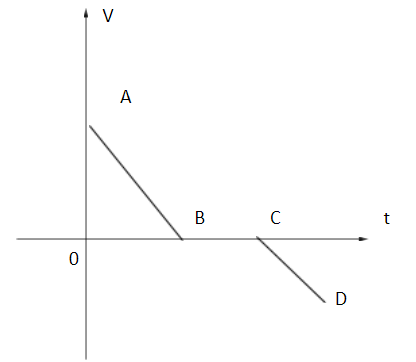
As we can see from the above figure, the point A is in the positive Y axis that means, the velocity of the particle is positive.
We know, Slope of the velocity-time graph gives us the acceleration. In the region AB, we see a slope which is decreasing, therefore, we can say the acceleration is in the negative direction, also termed as deceleration.When the line describing motion of the particle is parallel to the X-axis, the velocity of the particle is considered to be 0. Thus, the region BC is constant zero velocity.
Further, in region CD, we observe a negative slope, that means the body again decelerates at a constant rate.
(B)
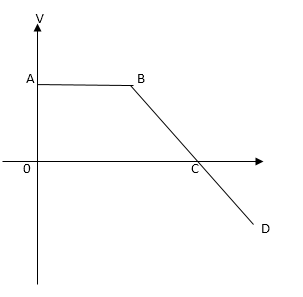
In the above figure, we can observe the following:
Region AB has a constant velocity of some magnitude, as the line of motion is parallel to the x axis.
Region BC, it is seen that the slope of the curve proceeds towards the negative axis, as it has a negative slope. Thus the body decelerates.
In the region CD, the body continues moving further towards the negative axis, due to constant deceleration.
Note: When velocity of a particle is 0, the curve in velocity-time graph coincides with the X axis. Acceleration refers to the increase in speed of a body with respect to time and deceleration refers to decrease in speed of a body with respect to time. Deceleration is also referred to as negative acceleration.
Complete step by step answer:
(A)
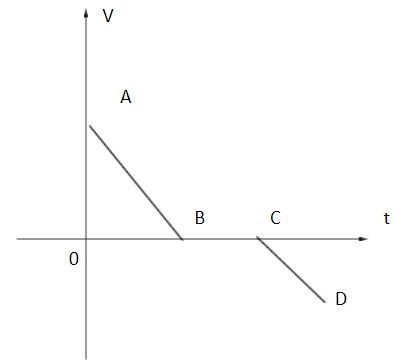
As we can see from the above figure, the point A is in the positive Y axis that means, the velocity of the particle is positive.
We know, Slope of the velocity-time graph gives us the acceleration. In the region AB, we see a slope which is decreasing, therefore, we can say the acceleration is in the negative direction, also termed as deceleration.When the line describing motion of the particle is parallel to the X-axis, the velocity of the particle is considered to be 0. Thus, the region BC is constant zero velocity.
Further, in region CD, we observe a negative slope, that means the body again decelerates at a constant rate.
(B)
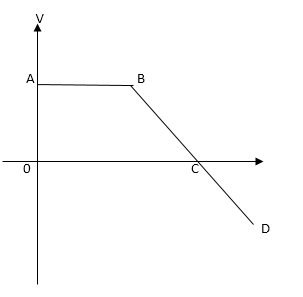
In the above figure, we can observe the following:
Region AB has a constant velocity of some magnitude, as the line of motion is parallel to the x axis.
Region BC, it is seen that the slope of the curve proceeds towards the negative axis, as it has a negative slope. Thus the body decelerates.
In the region CD, the body continues moving further towards the negative axis, due to constant deceleration.
Note: When velocity of a particle is 0, the curve in velocity-time graph coincides with the X axis. Acceleration refers to the increase in speed of a body with respect to time and deceleration refers to decrease in speed of a body with respect to time. Deceleration is also referred to as negative acceleration.
Recently Updated Pages
JEE Main 2023 April 6 Shift 1 Question Paper with Answer Key

JEE Main 2023 April 6 Shift 2 Question Paper with Answer Key
JEE Main 2023 (January 31 Evening Shift) Question Paper with Solutions [PDF]
JEE Main 2023 January 30 Shift 2 Question Paper with Answer Key
JEE Main 2023 January 25 Shift 1 Question Paper with Answer Key
JEE Main 2023 January 24 Shift 2 Question Paper with Answer Key
Trending doubts
JEE Main 2026: Session 2 Registration Open, City Intimation Slip, Exam Dates, Syllabus & Eligibility
JEE Main 2026 Application Login: Direct Link, Registration, Form Fill, and Steps
Understanding the Angle of Deviation in a Prism
Hybridisation in Chemistry – Concept, Types & Applications
How to Convert a Galvanometer into an Ammeter or Voltmeter
Understanding Uniform Acceleration in Physics
Other Pages
JEE Advanced Marks vs Ranks 2025: Understanding Category-wise Qualifying Marks and Previous Year Cut-offs
Laws of Motion Class 11 Physics Chapter 4 CBSE Notes - 2025-26
Waves Class 11 Physics Chapter 14 CBSE Notes - 2025-26
Mechanical Properties of Fluids Class 11 Physics Chapter 9 CBSE Notes - 2025-26
Thermodynamics Class 11 Physics Chapter 11 CBSE Notes - 2025-26
Units And Measurements Class 11 Physics Chapter 1 CBSE Notes - 2025-26