




In the circuit shown the current in the $1\Omega $resistor is:
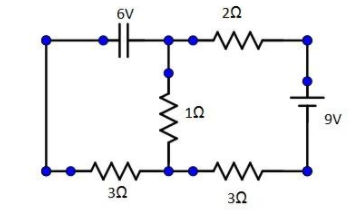
(A) 1.3A, from P to Q
(B) 0A
(C) 0.13A, from Q to P
(D) 0.13A, from P to Q
Answer
 Verified
233.1k+ views
Hint: The question can be solved by grounding one end of the wire and then applying Kirchhoff’s Current Law to the loop formed. Kirchhoff’s Voltage Law can also be used to solve this problem.
Complete Step by Step Solution: Kirchhoff’s Current Law, deals with the conservation of charge entering and leaving a junction. Kirchhoff’s Current Law, often shortened to KCL, states that “The algebraic sum of all currents entering and exiting a node must equal zero.”
This law is used to describe how a charge enters and leaves a wire junction point or node on a wire.
Connect the lower wire of the $1\Omega $ resistor to the ground (Q end) and apply KCL. Consider the grounded circuit as shown below.
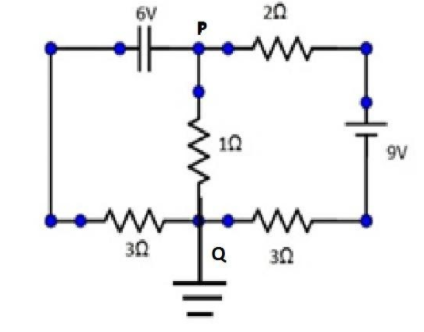
Applying, KCL at the Q point, we can write,
$\dfrac{{V + 6}}{3} + \dfrac{V}{1} = \dfrac{{9 - V}}{5}$
$ \Rightarrow V\left[ {\dfrac{1}{3} + \dfrac{1}{5} + 1} \right] = \dfrac{9}{5} - 2$
Simplifying the equation further,
$ \Rightarrow V\left[ {\dfrac{{5 + 3 + 15}}{{15}}} \right] = \dfrac{{9 - 10}}{5}$
The potential difference between points Q and P is given by,
$ \Rightarrow V = - \dfrac{1}{5} \times \dfrac{{15}}{{23}} = \dfrac{{ - 3}}{{23}} = - 0.13V$
Thus the current in the 1Ω resistor is ${\text{I = }}\dfrac{{\text{V}}}{{\text{R}}}{\text{ = }}\dfrac{{{\text{0}}{\text{.13}}}}{{\text{1}}}{\text{ = 0}}{\text{.13A}}$.
The current flows from Q to P. The correct answer is Option C.
Note: Kirchhoff's voltage law (KVL) states that the sum of all voltages around any closed loop in a circuit must be equal to zero. This is a consequence of charge conservation and also conservation of energy. This means that the sum of all potential differences across the component involved in the circuit gives a zero reading, as expected.
Assuming potential at Q is $V$, we apply KVL loop 1,
$9 - 2i - 1\left( {i - {i_1}} \right) - 3i = 0$.
When we apply KVL to loop 2,
$6 - 3{i_1} + 1\left( {i - {i_1}} \right) = 0$.
Solving the equations for the two loops,
${\text{i = 1}}{\text{.82A}}$ and ${{\text{i}}_{\text{1}}}{\text{ = 1}}{\text{.95A}}$.
Current through the $1\Omega $ resistor is ${\text{0}}{\text{.13A}}$.
Complete Step by Step Solution: Kirchhoff’s Current Law, deals with the conservation of charge entering and leaving a junction. Kirchhoff’s Current Law, often shortened to KCL, states that “The algebraic sum of all currents entering and exiting a node must equal zero.”
This law is used to describe how a charge enters and leaves a wire junction point or node on a wire.
Connect the lower wire of the $1\Omega $ resistor to the ground (Q end) and apply KCL. Consider the grounded circuit as shown below.
Applying, KCL at the Q point, we can write,
$\dfrac{{V + 6}}{3} + \dfrac{V}{1} = \dfrac{{9 - V}}{5}$
$ \Rightarrow V\left[ {\dfrac{1}{3} + \dfrac{1}{5} + 1} \right] = \dfrac{9}{5} - 2$
Simplifying the equation further,
$ \Rightarrow V\left[ {\dfrac{{5 + 3 + 15}}{{15}}} \right] = \dfrac{{9 - 10}}{5}$
The potential difference between points Q and P is given by,
$ \Rightarrow V = - \dfrac{1}{5} \times \dfrac{{15}}{{23}} = \dfrac{{ - 3}}{{23}} = - 0.13V$
Thus the current in the 1Ω resistor is ${\text{I = }}\dfrac{{\text{V}}}{{\text{R}}}{\text{ = }}\dfrac{{{\text{0}}{\text{.13}}}}{{\text{1}}}{\text{ = 0}}{\text{.13A}}$.
The current flows from Q to P. The correct answer is Option C.
Note: Kirchhoff's voltage law (KVL) states that the sum of all voltages around any closed loop in a circuit must be equal to zero. This is a consequence of charge conservation and also conservation of energy. This means that the sum of all potential differences across the component involved in the circuit gives a zero reading, as expected.
Assuming potential at Q is $V$, we apply KVL loop 1,
$9 - 2i - 1\left( {i - {i_1}} \right) - 3i = 0$.
When we apply KVL to loop 2,
$6 - 3{i_1} + 1\left( {i - {i_1}} \right) = 0$.
Solving the equations for the two loops,
${\text{i = 1}}{\text{.82A}}$ and ${{\text{i}}_{\text{1}}}{\text{ = 1}}{\text{.95A}}$.
Current through the $1\Omega $ resistor is ${\text{0}}{\text{.13A}}$.
Recently Updated Pages
JEE Main 2023 April 6 Shift 1 Question Paper with Answer Key

JEE Main 2023 April 6 Shift 2 Question Paper with Answer Key
JEE Main 2023 (January 31 Evening Shift) Question Paper with Solutions [PDF]
JEE Main 2023 January 30 Shift 2 Question Paper with Answer Key
JEE Main 2023 January 25 Shift 1 Question Paper with Answer Key
JEE Main 2023 January 24 Shift 2 Question Paper with Answer Key
Trending doubts
JEE Main 2026: Session 2 Registration Open, City Intimation Slip, Exam Dates, Syllabus & Eligibility
JEE Main 2026 Application Login: Direct Link, Registration, Form Fill, and Steps
Understanding the Angle of Deviation in a Prism
Hybridisation in Chemistry – Concept, Types & Applications
How to Convert a Galvanometer into an Ammeter or Voltmeter
Understanding Uniform Acceleration in Physics
Other Pages
JEE Advanced Marks vs Ranks 2025: Understanding Category-wise Qualifying Marks and Previous Year Cut-offs
Laws of Motion Class 11 Physics Chapter 4 CBSE Notes - 2025-26
Waves Class 11 Physics Chapter 14 CBSE Notes - 2025-26
Mechanical Properties of Fluids Class 11 Physics Chapter 9 CBSE Notes - 2025-26
Thermodynamics Class 11 Physics Chapter 11 CBSE Notes - 2025-26
Units And Measurements Class 11 Physics Chapter 1 CBSE Notes - 2025-26