




Let the refractive index of a denser medium with respect to a rare medium be ${N_{12}}$ and its critical angle${\theta _C}$. At an angle of incidence $A$ when light is travelling from denser medium to rarer medium, a part of the light is reflected and the rest is refracted and the angle between reflected and refracted rays is $90^\circ $. Angle $A$ is given by:
(A) ${\tan ^{ - 1}}(\sin {\theta _C})$
(B) $\dfrac{1}{{{{\tan }^{ - 1}}(\sin {\theta _C})}}$
(C) $\dfrac{1}{{{{\cos }^{ - 1}}(\sin {\theta _C})}}$
(D) ${\cos ^{ - 1}}(\sin {\theta _C})$
Answer
 Verified
233.1k+ views
Hint: To find the angle of incidence we have to learn about the total internal reflection and its condition and about the critical angle we should also have knowledge about the Snell’s law to relate the critical angle with the angle of refraction and incidence.
Complete step by step answer
Angle of incidence is defined as the angle between a ray incident on a surface and the line perpendicular to the surface at the point of incidence.
When a ray of light hits a smooth polished surface, the light ray bounces back, it is called the reflection. The angle at which it bounce back is known as the angle of reflection
When light waves move from one medium to another, there is a change in the direction of waves due to the obstacles, so they bend and continue to pass it is known as refraction. The angle at which it bends is known as angle of refraction.
The relation between the angle of incidence and angle of refraction is given by Snell’s law
Snell's law states that the ratio of the sines of the angles of incidence to angle of refraction is equivalent to the ratio of phase velocities in the two media, or to the reciprocal of the ratio of the refractive indices
$\dfrac{{\sin {\text{ i}}}}{{\sin {\text{ r}}}} = \dfrac{{{v_i}}}{{{v_r}}}{\text{ or }}\dfrac{{{\mu _r}}}{{{\mu _i}}}$
Where,
Sin i is the angle of incidence
Sin r is the angle of refraction
${\mu _i}$ is the refractive index of the incident medium
${\mu _r}$ is the refractive index of the refractive medium
This relationship between the angles of incidence and refraction and the refractive indices of the two media is known as Snell's Law.
The critical angle is the angle of incidence beyond which light rays passing through a denser medium to the surface of a less dense medium are no longer refracted but totally reflected.
The critical angle is given by
$\sin {\theta _c} = \dfrac{{{\mu _r}}}{{{\mu _i}}}$
Here $\sin {\theta _c}$ is the critical angle.
Hence here the total internal reflection takes place.
Given,
The refractive index of a denser medium with respect to a rare medium be ${N_{12}}$
The critical angle is ${\theta _C}$
The angle between refracted and reflected ray is $90^\circ $
The angle of incidence is A
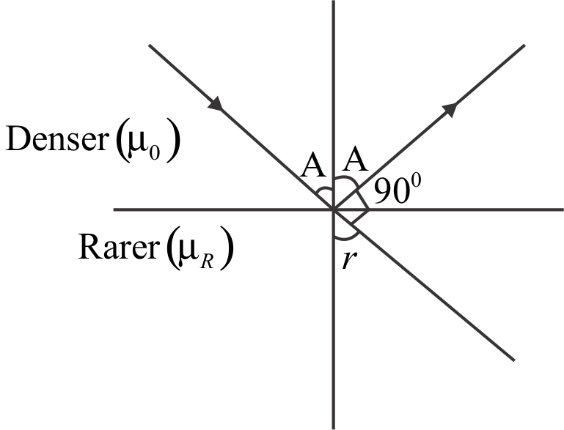
From the diagram
The angle of refraction is $90^\circ - A$
Critical angle is $\sin {\theta _c} = \dfrac{{{\mu _r}}}{{{\mu _i}}}$
We have seen that $\dfrac{{\sin {\text{ i}}}}{{\sin {\text{ r}}}} = \dfrac{{{\mu _r}}}{{{\mu _i}}}$
The critical angle becomes
$ \Rightarrow \sin {\theta _c} = \dfrac{{\sin {\text{ i}}}}{{\sin {\text{ r}}}}$
Substitute the known values
$ \Rightarrow \sin {\theta _c} = \dfrac{{\sin {\text{ A}}}}{{\sin {\text{ (90}}^\circ {\text{ - A)}}}}$
$ \Rightarrow \sin {\theta _c} = \dfrac{{\sin {\text{ A}}}}{{\cos {\text{ A}}}}$
$ \Rightarrow \sin {\theta _c} = \tan A$
$ \Rightarrow A = {\tan ^{ - 1}}\sin {\theta _c}$
Hence the correct answer is option (A) ${\tan ^{ - 1}}\sin {\theta _c}$
Note In the diagram we have noted an angle as A other than the incident angle it is the angle of reflection. The angle of reflection is also A because the angle of reflection is equal to the angle of incidence in total internal reflection.
Complete step by step answer
Angle of incidence is defined as the angle between a ray incident on a surface and the line perpendicular to the surface at the point of incidence.
When a ray of light hits a smooth polished surface, the light ray bounces back, it is called the reflection. The angle at which it bounce back is known as the angle of reflection
When light waves move from one medium to another, there is a change in the direction of waves due to the obstacles, so they bend and continue to pass it is known as refraction. The angle at which it bends is known as angle of refraction.
The relation between the angle of incidence and angle of refraction is given by Snell’s law
Snell's law states that the ratio of the sines of the angles of incidence to angle of refraction is equivalent to the ratio of phase velocities in the two media, or to the reciprocal of the ratio of the refractive indices
$\dfrac{{\sin {\text{ i}}}}{{\sin {\text{ r}}}} = \dfrac{{{v_i}}}{{{v_r}}}{\text{ or }}\dfrac{{{\mu _r}}}{{{\mu _i}}}$
Where,
Sin i is the angle of incidence
Sin r is the angle of refraction
${\mu _i}$ is the refractive index of the incident medium
${\mu _r}$ is the refractive index of the refractive medium
This relationship between the angles of incidence and refraction and the refractive indices of the two media is known as Snell's Law.
The critical angle is the angle of incidence beyond which light rays passing through a denser medium to the surface of a less dense medium are no longer refracted but totally reflected.
The critical angle is given by
$\sin {\theta _c} = \dfrac{{{\mu _r}}}{{{\mu _i}}}$
Here $\sin {\theta _c}$ is the critical angle.
Hence here the total internal reflection takes place.
Given,
The refractive index of a denser medium with respect to a rare medium be ${N_{12}}$
The critical angle is ${\theta _C}$
The angle between refracted and reflected ray is $90^\circ $
The angle of incidence is A
From the diagram
The angle of refraction is $90^\circ - A$
Critical angle is $\sin {\theta _c} = \dfrac{{{\mu _r}}}{{{\mu _i}}}$
We have seen that $\dfrac{{\sin {\text{ i}}}}{{\sin {\text{ r}}}} = \dfrac{{{\mu _r}}}{{{\mu _i}}}$
The critical angle becomes
$ \Rightarrow \sin {\theta _c} = \dfrac{{\sin {\text{ i}}}}{{\sin {\text{ r}}}}$
Substitute the known values
$ \Rightarrow \sin {\theta _c} = \dfrac{{\sin {\text{ A}}}}{{\sin {\text{ (90}}^\circ {\text{ - A)}}}}$
$ \Rightarrow \sin {\theta _c} = \dfrac{{\sin {\text{ A}}}}{{\cos {\text{ A}}}}$
$ \Rightarrow \sin {\theta _c} = \tan A$
$ \Rightarrow A = {\tan ^{ - 1}}\sin {\theta _c}$
Hence the correct answer is option (A) ${\tan ^{ - 1}}\sin {\theta _c}$
Note In the diagram we have noted an angle as A other than the incident angle it is the angle of reflection. The angle of reflection is also A because the angle of reflection is equal to the angle of incidence in total internal reflection.
Recently Updated Pages
JEE Main 2026 Session 2 Registration Open, Exam Dates, Syllabus & Eligibility

JEE Main 2023 April 6 Shift 1 Question Paper with Answer Key
JEE Main 2023 April 6 Shift 2 Question Paper with Answer Key
JEE Main 2023 (January 31 Evening Shift) Question Paper with Solutions [PDF]
JEE Main 2023 January 30 Shift 2 Question Paper with Answer Key
JEE Main 2023 January 25 Shift 1 Question Paper with Answer Key
Trending doubts
JEE Main Marking Scheme 2026- Paper-Wise Marks Distribution and Negative Marking Details
Why does capacitor block DC and allow AC class 12 physics JEE_Main
Understanding Average and RMS Value in Electrical Circuits
Understanding Collisions: Types and Examples for Students
Ideal and Non-Ideal Solutions Explained for Class 12 Chemistry
Understanding Atomic Structure for Beginners
Other Pages
JEE Advanced Weightage 2025 Chapter-Wise for Physics, Maths and Chemistry
CBSE Class 12 Physics Set 2 (55/2/2) 2025 Question Paper & Solutions
Inductive Effect and Its Role in Acidic Strength
Degree of Dissociation: Meaning, Formula, Calculation & Uses
Units and Measurements Mock Test for JEE Main 2025-26 Preparation
Chemistry Question Papers for JEE Main, NEET & Boards (PDFs)