




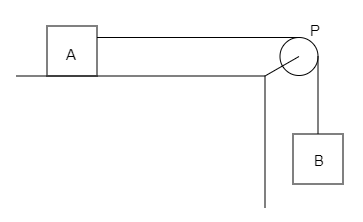
Two blocks $A$ and $B$ are arranged as shown in the figure. The mass of the block $A$ is $10\,kg$. The coefficient of friction between the block $A$ and the horizontal plane is $0.2$. The minimum mass of block $B$ to start motion will be:
(A) $0.2\,kg$
(B) $10\,kg$
(C) $5\,kg$
(D) $2\,kg$
Answer
 Verified
233.1k+ views
Hint The mass of the block $B$ can be determined by the force of the block $B$ is equated with the friction force of the block $A$. The friction force of the block $A$ can be determined by the product of the force of the block $A$ and the coefficient of the friction of the surface of the block $A$.
Useful formula
The friction force of the block $A$ is given by,
$f = {F_A} \times \mu $
Where, $f$ is the frictional force of the block $A$, ${F_A}$ is the force of the block $A$ and $\mu $ is the coefficient of the friction of the block $A$.
Complete step by step solution
Given that,
The mass of the block $A$ is, ${m_A} = 10\,kg$,
The coefficient of the friction is, $\mu = 0.2$.
Now, the force of the block $A$ is given by,
${F_A} = {m_A} \times g$
Where, $g$ is the acceleration due to gravity.
By assuming the acceleration due to gravity is $g = 10\,m{s^{ - 2}}$ and substitute the mass value in the above equation, then
${F_A} = 10 \times 10$
By multiplying the terms in the above equation, then the above equation is written as,
${F_A} = 100\,N$
Now, the friction force of the block $A$ is given by,
${f_A} = {F_A} \times \mu $
By substituting the force of the block $A$ and the coefficient of the friction in the above equation, then the above equation is written as,
\[{f_A} = 100 \times 0.2\]
By multiplying the terms in the above equation, then the above equation is written as,
\[{f_A} = 20\,N\]
Now, the force of the block $B$ is given by,
${F_B} = {m_B} \times g$
By equating the force of the block $B$ and the friction force of the block $A$ , then
\[20 = {m_B} \times g\]
By rearranging the terms in the above equation, then the above equation is written as,
\[{m_B} = \dfrac{{20}}{g}\]
By assuming the acceleration due to gravity is $g = 10\,m{s^{ - 2}}$ and substitute in the above equation, then
\[{m_B} = \dfrac{{20}}{{10}}\]
By dividing the terms in the above equation, then the above equation is written as,
\[{m_B} = 2\,kg\]
Hence, the option (D) is the correct answer.
Note The fore of the object is directly proportional to the mass of the object and the acceleration due to gravity of the object. The frictional force of the object is directly proportional to the force of the object and the coefficient of the friction of the object.
Useful formula
The friction force of the block $A$ is given by,
$f = {F_A} \times \mu $
Where, $f$ is the frictional force of the block $A$, ${F_A}$ is the force of the block $A$ and $\mu $ is the coefficient of the friction of the block $A$.
Complete step by step solution
Given that,
The mass of the block $A$ is, ${m_A} = 10\,kg$,
The coefficient of the friction is, $\mu = 0.2$.
Now, the force of the block $A$ is given by,
${F_A} = {m_A} \times g$
Where, $g$ is the acceleration due to gravity.
By assuming the acceleration due to gravity is $g = 10\,m{s^{ - 2}}$ and substitute the mass value in the above equation, then
${F_A} = 10 \times 10$
By multiplying the terms in the above equation, then the above equation is written as,
${F_A} = 100\,N$
Now, the friction force of the block $A$ is given by,
${f_A} = {F_A} \times \mu $
By substituting the force of the block $A$ and the coefficient of the friction in the above equation, then the above equation is written as,
\[{f_A} = 100 \times 0.2\]
By multiplying the terms in the above equation, then the above equation is written as,
\[{f_A} = 20\,N\]
Now, the force of the block $B$ is given by,
${F_B} = {m_B} \times g$
By equating the force of the block $B$ and the friction force of the block $A$ , then
\[20 = {m_B} \times g\]
By rearranging the terms in the above equation, then the above equation is written as,
\[{m_B} = \dfrac{{20}}{g}\]
By assuming the acceleration due to gravity is $g = 10\,m{s^{ - 2}}$ and substitute in the above equation, then
\[{m_B} = \dfrac{{20}}{{10}}\]
By dividing the terms in the above equation, then the above equation is written as,
\[{m_B} = 2\,kg\]
Hence, the option (D) is the correct answer.
Note The fore of the object is directly proportional to the mass of the object and the acceleration due to gravity of the object. The frictional force of the object is directly proportional to the force of the object and the coefficient of the friction of the object.
Recently Updated Pages
JEE Main 2023 April 6 Shift 1 Question Paper with Answer Key

JEE Main 2023 April 6 Shift 2 Question Paper with Answer Key
JEE Main 2023 (January 31 Evening Shift) Question Paper with Solutions [PDF]
JEE Main 2023 January 30 Shift 2 Question Paper with Answer Key
JEE Main 2023 January 25 Shift 1 Question Paper with Answer Key
JEE Main 2023 January 24 Shift 2 Question Paper with Answer Key
Trending doubts
JEE Main 2026: Session 2 Registration Open, City Intimation Slip, Exam Dates, Syllabus & Eligibility
JEE Main 2026 Application Login: Direct Link, Registration, Form Fill, and Steps
Understanding the Angle of Deviation in a Prism
Hybridisation in Chemistry – Concept, Types & Applications
How to Convert a Galvanometer into an Ammeter or Voltmeter
Understanding Uniform Acceleration in Physics
Other Pages
JEE Advanced Marks vs Ranks 2025: Understanding Category-wise Qualifying Marks and Previous Year Cut-offs
Laws of Motion Class 11 Physics Chapter 4 CBSE Notes - 2025-26
Waves Class 11 Physics Chapter 14 CBSE Notes - 2025-26
Mechanical Properties of Fluids Class 11 Physics Chapter 9 CBSE Notes - 2025-26
Thermodynamics Class 11 Physics Chapter 11 CBSE Notes - 2025-26
Units And Measurements Class 11 Physics Chapter 1 CBSE Notes - 2025-26