




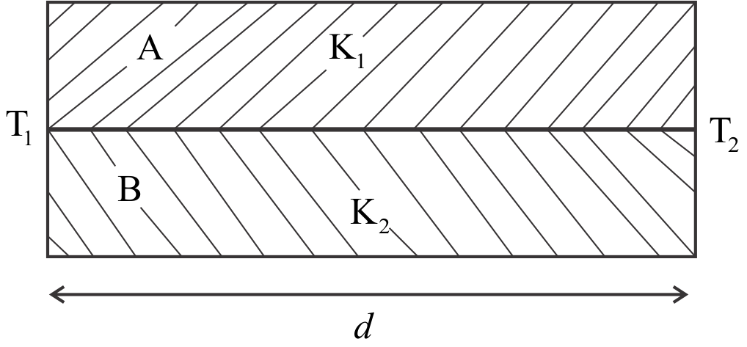
Two rods $A$and $B$of different materials are welded together as shown in the figure. Their thermal conductivities are ${K_1}$ and ${K_2}$. The thermal conductivity of the composite rod will be
$\left( a \right)$ $\dfrac{{{K_1} + {K_2}}}{2}$
$\left( b \right)$ $\dfrac{{3\left( {{K_1} + {K_2}} \right)}}{2}$
$\left( c \right)$ ${K_1} + {K_2}$
$\left( d \right)$$2\left( {{K_1} + {K_2}} \right)$
Answer
 Verified
233.1k+ views
Hint: It is the property of the material that permits material to pass heat through it. If thermal conductivity is additional means material will pass heat through it quickly. Truly in our college stages additionally we tend to come upon through it
Formula
Heat,
$ \Rightarrow H = \dfrac{{KA\Delta T}}{l}$
Where $\Delta T$ is the temperature difference, $l$is the length, and $K$ is the total thermal conductivity or we can say it equivalent thermal conductivity.
Complete step by step solution: In reality, it plays a vital role in conduction heat transfer however in our college stages we tend to address the conductivity mode of warmth transfer without knowing what it's. Generally, conduction heat transfer happens due to free electrons or because of lattice vibrations. In following all conductors of electricity also are smart conductors for heat. Insulators are the substances which can resist the passage of heat through it, these can have lesser thermal conduction values. In our daily practice some times we've to scale back the heat transfer and a few times it ought to be augmented.
In the question it is given that we have two rods of different materials and their thermal conductivities are also given. So we have to calculate the thermal conductivity of the composite rod.
Since both rods have the same temperature difference that means the rod is in parallel combination.
Therefore the total heat will be
$ \Rightarrow H = {H_1} + {H_2}$
So for this, we will use the above heat equation which is total heat will be
$ \Rightarrow H = {H_1} + {H_2}$
And since
$ \Rightarrow H = \dfrac{{KA\Delta T}}{l}$
Therefore, according to the question
The value $H$ will be,
$ \Rightarrow \dfrac{{KA\left( {{T_1} - {T_2}} \right)}}{d}$
Which will be equal to the,
$ \Rightarrow \dfrac{{{K_1}A\left( {{T_1} - {T_2}} \right)}}{d} + \dfrac{{{K_2}A\left( {{T_1} - {T_2}} \right)}}{d}$
Now on solving the above equation, we get
$ \Rightarrow 2K = {K_1} + K{}_2$
$ \Rightarrow K = \dfrac{{{K_1} + K{}_2}}{2}$
Notes: Thermal conductivity, additionally referred to as heat conduction, is the flow of energy from one thing of a better temperature to one thing of a lower temperature. It’s completely different from electrical conduction that deals with electrical currents.
Formula
Heat,
$ \Rightarrow H = \dfrac{{KA\Delta T}}{l}$
Where $\Delta T$ is the temperature difference, $l$is the length, and $K$ is the total thermal conductivity or we can say it equivalent thermal conductivity.
Complete step by step solution: In reality, it plays a vital role in conduction heat transfer however in our college stages we tend to address the conductivity mode of warmth transfer without knowing what it's. Generally, conduction heat transfer happens due to free electrons or because of lattice vibrations. In following all conductors of electricity also are smart conductors for heat. Insulators are the substances which can resist the passage of heat through it, these can have lesser thermal conduction values. In our daily practice some times we've to scale back the heat transfer and a few times it ought to be augmented.
In the question it is given that we have two rods of different materials and their thermal conductivities are also given. So we have to calculate the thermal conductivity of the composite rod.
Since both rods have the same temperature difference that means the rod is in parallel combination.
Therefore the total heat will be
$ \Rightarrow H = {H_1} + {H_2}$
So for this, we will use the above heat equation which is total heat will be
$ \Rightarrow H = {H_1} + {H_2}$
And since
$ \Rightarrow H = \dfrac{{KA\Delta T}}{l}$
Therefore, according to the question
The value $H$ will be,
$ \Rightarrow \dfrac{{KA\left( {{T_1} - {T_2}} \right)}}{d}$
Which will be equal to the,
$ \Rightarrow \dfrac{{{K_1}A\left( {{T_1} - {T_2}} \right)}}{d} + \dfrac{{{K_2}A\left( {{T_1} - {T_2}} \right)}}{d}$
Now on solving the above equation, we get
$ \Rightarrow 2K = {K_1} + K{}_2$
$ \Rightarrow K = \dfrac{{{K_1} + K{}_2}}{2}$
Notes: Thermal conductivity, additionally referred to as heat conduction, is the flow of energy from one thing of a better temperature to one thing of a lower temperature. It’s completely different from electrical conduction that deals with electrical currents.
Recently Updated Pages
JEE Main 2023 April 6 Shift 1 Question Paper with Answer Key

JEE Main 2023 April 6 Shift 2 Question Paper with Answer Key
JEE Main 2023 (January 31 Evening Shift) Question Paper with Solutions [PDF]
JEE Main 2023 January 30 Shift 2 Question Paper with Answer Key
JEE Main 2023 January 25 Shift 1 Question Paper with Answer Key
JEE Main 2023 January 24 Shift 2 Question Paper with Answer Key
Trending doubts
JEE Main 2026: Session 2 Registration Open, City Intimation Slip, Exam Dates, Syllabus & Eligibility
JEE Main 2026 Application Login: Direct Link, Registration, Form Fill, and Steps
Understanding the Angle of Deviation in a Prism
Hybridisation in Chemistry – Concept, Types & Applications
How to Convert a Galvanometer into an Ammeter or Voltmeter
Understanding Uniform Acceleration in Physics
Other Pages
JEE Advanced Marks vs Ranks 2025: Understanding Category-wise Qualifying Marks and Previous Year Cut-offs
Laws of Motion Class 11 Physics Chapter 4 CBSE Notes - 2025-26
Waves Class 11 Physics Chapter 14 CBSE Notes - 2025-26
Mechanical Properties of Fluids Class 11 Physics Chapter 9 CBSE Notes - 2025-26
Thermodynamics Class 11 Physics Chapter 11 CBSE Notes - 2025-26
Units And Measurements Class 11 Physics Chapter 1 CBSE Notes - 2025-26