




(a) An EM wave is travelling in a medium with a velocity $v=v\widehat{i}$. Draw a sketch showing the propagation of the EM wave, indicating the direction of the oscillating electric and magnetic fields.
(b) How are the magnitudes of the electric and magnetic fields related to velocity of the EM wave?
Answer
 Verified
584.7k+ views
Hint: Electromagnetic waves are those waves which have changing electric and magnetic fields while transporting energy and momentum through space. They require no medium and can travel through vacuum.
Complete step-by-step answer:
EM waves are known as the solutions of Maxwell’s equations. Sinusoidal plane waves are one of the types of electromagnetic waves. Not all EM waves are considered to be sinusoidal, but all EM waves can be viewed as linear superposition of sinusoidal plane waves travelling in particular directions.
A plane wave travelling in x-direction will be of the form,
${{E}_{(x,t)}}={{E}_{\max }}\cos (kx-\omega t+\phi )$
${{B}_{(x,t)}}={{B}_{\max }}\cos (kx-\omega t+\phi )$
Where, ‘E’ and ‘B’ are the electric and magnetic fields of the EM waves.
For an EM wave, electric and magnetic fields are always perpendicular to each other and also perpendicular to the direction of propagation. $\overrightarrow{E}\times \overrightarrow{B}$ gives the direction of propagation of the wave.
(a) The given velocity is $v=v\widehat{i}$. With electric field ‘E’ along x-axis and the magnetic field ‘B’ along z-axis, the propagation of EM wave can be illustrated as:
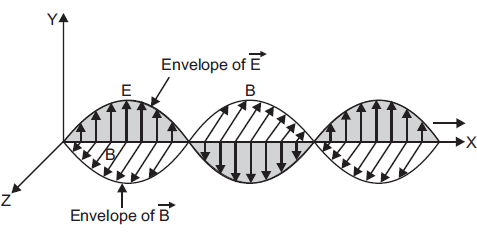
Let $\widehat{i}$ denote the x-direction, $\widehat{j}$ the y-direction $\widehat{k}$ and the z-direction.
The direction of oscillating field can be written as $\widehat{\hat{i}}=\widehat{j}\times \widehat{k}$
(b) As electromagnetic waves are transverse and they propagate at a speed ‘c’. The relation between the electric and magnetic field of an EM wave is given by the ratio of magnitude of electric field to the magnitude of magnetic field.
$c=\dfrac{{{E}_{0}}}{{{B}_{0}}}$
Note: Electromagnetic waves are transverse waves. The speed of any EM wave in free space is equal to the speed of light i.e., $c=3\times {{10}^{8}}m{{s}^{-1}}$. Electromagnetic waves may have any range of wavelength ‘λ’ and frequency ‘f’ as their relation is given as $\lambda f=c$.
Complete step-by-step answer:
EM waves are known as the solutions of Maxwell’s equations. Sinusoidal plane waves are one of the types of electromagnetic waves. Not all EM waves are considered to be sinusoidal, but all EM waves can be viewed as linear superposition of sinusoidal plane waves travelling in particular directions.
A plane wave travelling in x-direction will be of the form,
${{E}_{(x,t)}}={{E}_{\max }}\cos (kx-\omega t+\phi )$
${{B}_{(x,t)}}={{B}_{\max }}\cos (kx-\omega t+\phi )$
Where, ‘E’ and ‘B’ are the electric and magnetic fields of the EM waves.
For an EM wave, electric and magnetic fields are always perpendicular to each other and also perpendicular to the direction of propagation. $\overrightarrow{E}\times \overrightarrow{B}$ gives the direction of propagation of the wave.
(a) The given velocity is $v=v\widehat{i}$. With electric field ‘E’ along x-axis and the magnetic field ‘B’ along z-axis, the propagation of EM wave can be illustrated as:
Let $\widehat{i}$ denote the x-direction, $\widehat{j}$ the y-direction $\widehat{k}$ and the z-direction.
The direction of oscillating field can be written as $\widehat{\hat{i}}=\widehat{j}\times \widehat{k}$
(b) As electromagnetic waves are transverse and they propagate at a speed ‘c’. The relation between the electric and magnetic field of an EM wave is given by the ratio of magnitude of electric field to the magnitude of magnetic field.
$c=\dfrac{{{E}_{0}}}{{{B}_{0}}}$
Note: Electromagnetic waves are transverse waves. The speed of any EM wave in free space is equal to the speed of light i.e., $c=3\times {{10}^{8}}m{{s}^{-1}}$. Electromagnetic waves may have any range of wavelength ‘λ’ and frequency ‘f’ as their relation is given as $\lambda f=c$.
Recently Updated Pages
Master Class 12 Economics: Engaging Questions & Answers for Success

Master Class 12 Physics: Engaging Questions & Answers for Success
Master Class 12 English: Engaging Questions & Answers for Success
Master Class 12 Social Science: Engaging Questions & Answers for Success
Master Class 12 Maths: Engaging Questions & Answers for Success
Master Class 12 Business Studies: Engaging Questions & Answers for Success
Trending doubts
Which are the Top 10 Largest Countries of the World?
What are the major means of transport Explain each class 12 social science CBSE
Draw a labelled sketch of the human eye class 12 physics CBSE
Why cannot DNA pass through cell membranes class 12 biology CBSE
Differentiate between insitu conservation and exsitu class 12 biology CBSE
Draw a neat and well labeled diagram of TS of ovary class 12 biology CBSE