




A ball connected with string is released at an angle $45^{\circ}$ with the vertical as shown in the figure. Then the acceleration of the box at this instant will be [Mass of the box is equal to the mass of the ball].
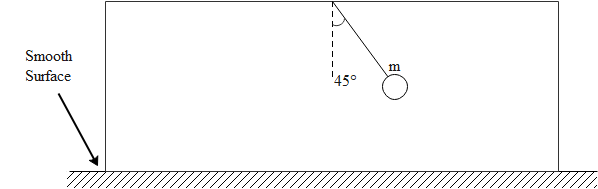
(A) g/4
(B) g/3
(C) g/2
(D) None of these
Answer
 Verified
232.8k+ views
Hint: We know that tension is nothing but the drawing force acting on the body when it is hung from objects like chain, cable, string etc. It is represented by T. The direction of tension is the pull which is given the name tension. Thus, the tension will point away from the mass in the direction of the string or rope. In case of the hanging mass, the string pulls it upwards, so the string or rope exerts an upper force on the mass and the tension will be on the upper side. The tension force is the force that is transmitted through a string, rope, cable or wire when it is pulled tight by forces acting from opposite ends. The tension force is directed along the length of the wire and pulls equally on the objects on the opposite ends of the wire. Based on this concept we have to solve this question.
Complete step by step answer
We know that:
$T\cos \theta =mg$
Here T signifies the tension that is present in the string.
$T=\dfrac{mg}{\cos \theta }$
$T\sin \theta =ma$$T\sin \theta =ma$
Now we have to find the value of a.
So, we can say that:
$a=\dfrac{T\sin \theta }{m}=g\tan \theta$, here the value of $\theta ={{45}^{{}^\circ }}$.
Therefore, we can say that $a=g$.
So now the acceleration of the centre of mass is all zero. So, we can say that:
$\dfrac{ma-(m+m){{a}_{1}}}{m+(m+m)}=0$
So, the value of ${{a}_{1}}=\dfrac{g}{2}$
Hence the correct answer is option C.
Note: We should know that the weight of an object may be thought of as acting at a single point called its centre of mass. Depending on the object's shape, its centre of mass can be inside or outside it. The weight of an object and its mass are directly proportional. The centre of mass of an object is the point at which the object can be balanced. The centre of mass is useful because problems can often be simplified by treating a collection of masses as one mass at their common centre of mass. The weight of the object then acts through this point. In the human form the centre of mass has no fixed point but is dependent on the position of the performer at any given time. Due to the body composition the centre of mass of all athletes varies, as bone, fat, tissue and muscle all contribute to total mass and are in different proportions in each performer.
Complete step by step answer
We know that:
$T\cos \theta =mg$
Here T signifies the tension that is present in the string.
$T=\dfrac{mg}{\cos \theta }$
$T\sin \theta =ma$$T\sin \theta =ma$
Now we have to find the value of a.
So, we can say that:
$a=\dfrac{T\sin \theta }{m}=g\tan \theta$, here the value of $\theta ={{45}^{{}^\circ }}$.
Therefore, we can say that $a=g$.
So now the acceleration of the centre of mass is all zero. So, we can say that:
$\dfrac{ma-(m+m){{a}_{1}}}{m+(m+m)}=0$
So, the value of ${{a}_{1}}=\dfrac{g}{2}$
Hence the correct answer is option C.
Note: We should know that the weight of an object may be thought of as acting at a single point called its centre of mass. Depending on the object's shape, its centre of mass can be inside or outside it. The weight of an object and its mass are directly proportional. The centre of mass of an object is the point at which the object can be balanced. The centre of mass is useful because problems can often be simplified by treating a collection of masses as one mass at their common centre of mass. The weight of the object then acts through this point. In the human form the centre of mass has no fixed point but is dependent on the position of the performer at any given time. Due to the body composition the centre of mass of all athletes varies, as bone, fat, tissue and muscle all contribute to total mass and are in different proportions in each performer.
Recently Updated Pages
JEE Main 2026 Session 2 Registration Open, Exam Dates, Syllabus & Eligibility

JEE Main 2023 April 6 Shift 1 Question Paper with Answer Key
JEE Main 2023 April 6 Shift 2 Question Paper with Answer Key
JEE Main 2023 (January 31 Evening Shift) Question Paper with Solutions [PDF]
JEE Main 2023 January 30 Shift 2 Question Paper with Answer Key
JEE Main 2023 January 25 Shift 1 Question Paper with Answer Key
Trending doubts
JEE Main Marking Scheme 2026- Paper-Wise Marks Distribution and Negative Marking Details
Understanding Average and RMS Value in Electrical Circuits
Understanding Collisions: Types and Examples for Students
Ideal and Non-Ideal Solutions Explained for Class 12 Chemistry
Understanding Atomic Structure for Beginners
Derive an expression for maximum speed of a car on class 11 physics JEE_Main
Other Pages
JEE Advanced Weightage 2025 Chapter-Wise for Physics, Maths and Chemistry
NCERT Solutions For Class 11 Physics Chapter 9 Mechanical Properties of Fluids (2025-26)
NCERT Solutions For Class 11 Physics Chapter 12 Kinetic Theory (2025-26)
NCERT Solutions For Class 11 Physics Chapter 4 Law of Motion (2025-26)
Inductive Effect and Its Role in Acidic Strength
Degree of Dissociation: Meaning, Formula, Calculation & Uses