




A capacitor ${C_1} = 1\,\mu F$ is charged up to a voltage $V = 60\,V$ by connecting it to a battery $B$ through the switch $\left( 1 \right)$. Now ${C_1}$ is disconnected from battery and connected to a circuit consisting of two uncharged capacitors ${C_2} = 3\,\mu F$ and ${C_3} = 6\,\mu F$ through a switch $\left( 2 \right)$ as shown in the figure. The sum of final charges an ${C_2}$ and ${C_3}$ is:
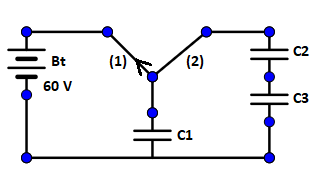
(A) $40\,\mu C$
(B) $36\,\mu C$
(C) $20\,\mu C$
(D) $54\,\mu C$
Answer
 Verified
585.6k+ views
Hint: The sum of the final charges an ${C_2}$ and ${C_3}$ can be determined by using two formulas. The capacitor is series formula and then the potential difference in capacitor formula. By using the given information in these two formulas, the sum of final charges ${C_2}$ and ${C_3}$ can be determined.
Formulae Used:
Capacitor in series,
$\dfrac{1}{C} = \dfrac{1}{{{C_1}}} + \dfrac{1}{{{C_2}}}$
Where, $C$ is the equivalent capacitance, ${C_1}$ capacitance of the first capacitor and ${C_2}$ is the capacitance of the second capacitor.
Potential difference in capacitor,
$V = \dfrac{Q}{C}$
Where, $V$ is the potential difference, $Q$ is the charge and $C$ is the capacitance.
Complete step-by-step solution:
Given that,
A capacitor, ${C_1} = 1\,\mu F$
Voltage $V = 60\,V$
The capacitance is, ${C_2} = 3\,\mu F$ and ${C_3} = 6\,\mu F$
Capacitor in series, and the capacitors ${C_2}$ and ${C_3}$ are in series then,
$\dfrac{1}{C} = \dfrac{1}{{{C_2}}} + \dfrac{1}{{{C_3}}}\,..................\left( 1 \right)$
By rearranging the terms, then the above equation is written as,
$\dfrac{1}{C} = \dfrac{{{C_3} + {C_2}}}{{{C_3} \times {C_2}}}$
By taking reciprocal on both sides of the above equation, then the above equation is written as,
$C = \dfrac{{{C_3} \times {C_2}}}{{{C_3} + {C_2}}}$
By substituting the terms given terms in the above equation, then
$C = \dfrac{{6 \times 3}}{{6 + 3}}$
On further simplification, then
$C = \dfrac{{18}}{9}$
On dividing, then the above equation is written as,
$C = 2\,\mu F$
Now, the potential difference across three capacitors ${C_1}$ and $C$ (Here $C$ is the combined capacitance of ${C_2}$ and ${C_3}$ )
$V = \dfrac{Q}{{{C_1} + C}}$
By substituting the charge and the capacitance in the above equation, then
$V = \dfrac{{60}}{{1 + 2}}$
On further simplification, then
$V = \dfrac{{60}}{3}$
On dividing the terms in the above equation, then
$V = 20\,V$
The sum of the charge of the capacitors ${C_2}$ and ${C_3}$ are,
$Q = C \times V$ (Here $C$ is the combined capacitance of ${C_2}$ and ${C_3}$ )
Now, substituting the combined capacitance of ${C_2}$ and ${C_3}$, and the potential difference $V$ in the above equation, then
$Q = 2 \times 20$
On multiplying, then
$Q = 40\,\mu C$
Thus, the above equation shows the sum of final charges ${C_2}$ and ${C_3}$.
Hence, the option (A) is correct.
Note:- The capacitors ${C_2}$ and ${C_3}$ are in series, so the capacitor in series formula is used. Then, we have to find the total charge across the second capacitor and the third capacitor, so the equivalent capacitance of ${C_2}$ and ${C_3}$ are multiplied with the potential difference.
Formulae Used:
Capacitor in series,
$\dfrac{1}{C} = \dfrac{1}{{{C_1}}} + \dfrac{1}{{{C_2}}}$
Where, $C$ is the equivalent capacitance, ${C_1}$ capacitance of the first capacitor and ${C_2}$ is the capacitance of the second capacitor.
Potential difference in capacitor,
$V = \dfrac{Q}{C}$
Where, $V$ is the potential difference, $Q$ is the charge and $C$ is the capacitance.
Complete step-by-step solution:
Given that,
A capacitor, ${C_1} = 1\,\mu F$
Voltage $V = 60\,V$
The capacitance is, ${C_2} = 3\,\mu F$ and ${C_3} = 6\,\mu F$
Capacitor in series, and the capacitors ${C_2}$ and ${C_3}$ are in series then,
$\dfrac{1}{C} = \dfrac{1}{{{C_2}}} + \dfrac{1}{{{C_3}}}\,..................\left( 1 \right)$
By rearranging the terms, then the above equation is written as,
$\dfrac{1}{C} = \dfrac{{{C_3} + {C_2}}}{{{C_3} \times {C_2}}}$
By taking reciprocal on both sides of the above equation, then the above equation is written as,
$C = \dfrac{{{C_3} \times {C_2}}}{{{C_3} + {C_2}}}$
By substituting the terms given terms in the above equation, then
$C = \dfrac{{6 \times 3}}{{6 + 3}}$
On further simplification, then
$C = \dfrac{{18}}{9}$
On dividing, then the above equation is written as,
$C = 2\,\mu F$
Now, the potential difference across three capacitors ${C_1}$ and $C$ (Here $C$ is the combined capacitance of ${C_2}$ and ${C_3}$ )
$V = \dfrac{Q}{{{C_1} + C}}$
By substituting the charge and the capacitance in the above equation, then
$V = \dfrac{{60}}{{1 + 2}}$
On further simplification, then
$V = \dfrac{{60}}{3}$
On dividing the terms in the above equation, then
$V = 20\,V$
The sum of the charge of the capacitors ${C_2}$ and ${C_3}$ are,
$Q = C \times V$ (Here $C$ is the combined capacitance of ${C_2}$ and ${C_3}$ )
Now, substituting the combined capacitance of ${C_2}$ and ${C_3}$, and the potential difference $V$ in the above equation, then
$Q = 2 \times 20$
On multiplying, then
$Q = 40\,\mu C$
Thus, the above equation shows the sum of final charges ${C_2}$ and ${C_3}$.
Hence, the option (A) is correct.
Note:- The capacitors ${C_2}$ and ${C_3}$ are in series, so the capacitor in series formula is used. Then, we have to find the total charge across the second capacitor and the third capacitor, so the equivalent capacitance of ${C_2}$ and ${C_3}$ are multiplied with the potential difference.
Recently Updated Pages
Master Class 12 Economics: Engaging Questions & Answers for Success

Master Class 12 Physics: Engaging Questions & Answers for Success
Master Class 12 English: Engaging Questions & Answers for Success
Master Class 12 Social Science: Engaging Questions & Answers for Success
Master Class 12 Maths: Engaging Questions & Answers for Success
Master Class 12 Business Studies: Engaging Questions & Answers for Success
Trending doubts
Why cannot DNA pass through cell membranes class 12 biology CBSE
Draw a neat and well labeled diagram of TS of ovary class 12 biology CBSE
In a human foetus the limbs and digits develop after class 12 biology CBSE
AABbCc genotype forms how many types of gametes a 4 class 12 biology CBSE
Differentiate between homogeneous and heterogeneous class 12 chemistry CBSE
The correct structure of ethylenediaminetetraacetic class 12 chemistry CBSE