




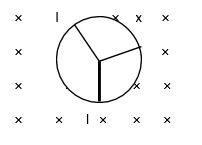
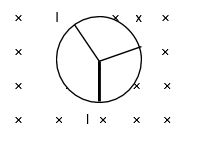
A conducting wheel rim in which there are three conducting rods of each length l is rotating with constant angular velocity ω in a magnetic field B as shown in figure. The induced potential difference between its centre and rim will be:
A. $B\omega {l^2}$
B. $\dfrac{3}{2}B\omega {l^2}$
C. $0$
D. $\dfrac{{B\omega {l^2}}}{2}$
Answer
 Verified
583.2k+ views
Hint: The induced potential difference in a closed loop is equal to the time rate of change of magnetic flux through the loop. The magnetic flux is the product of the magnetic field and area of the loop.
Complete step by step answer:In a magnetic field B, a conducting wheel rim in which there are three conducting rods each of length l is rotating with constant angular velocity ω. As a conductor i.e., conducting wheel is placed in a magnetic field, a certain number of magnetic lines are induced inside the conducting wheel which is passing unit area normal to their direction. This is known as magnetic flux density inside the conducting wheel or magnitude of magnetic induction. The magnetic flux (φ) is numerically equal to the product of magnetic field (B) and area through which the magnetic lines are crossing (A). So, an emf is induced in this wheel due to the change of magnetic flux.
The induced emf (potential difference) in a closed loop i.e., conducting wheel is equal to the rate of change of magnetic flux through the conducting wheel rim i.e.,
$emf = \dfrac{\phi }{t}$ [time is t]
$emf = \dfrac{{BA}}{t}$
$emf = \dfrac{{B \times \pi {l^2}}}{t}$ [$A = \pi {l^2}$ where l is the radius of the wheel]
$emf = \dfrac{{B \times \pi {l^2}}}{{\dfrac{{2\pi }}{\omega }}}$ $\left[ {t = \dfrac{{2\pi }}{\omega }} \right]$
$emf = \dfrac{{B \times \pi {l^2} \times \omega }}{{2\pi }} = \dfrac{{B\omega {l^2}}}{2}$
Hence, the induced potential difference between centre and rim is equal to $\dfrac{{B\omega {l^2}}}{2}$ .
Therefore, option D is correct.
Note:The induced emf or potential difference between the centre of the wheel and rim is the same for each of the conducting rods. Each rods are of length l which indicates that rods are the radius of the wheel.
Complete step by step answer:In a magnetic field B, a conducting wheel rim in which there are three conducting rods each of length l is rotating with constant angular velocity ω. As a conductor i.e., conducting wheel is placed in a magnetic field, a certain number of magnetic lines are induced inside the conducting wheel which is passing unit area normal to their direction. This is known as magnetic flux density inside the conducting wheel or magnitude of magnetic induction. The magnetic flux (φ) is numerically equal to the product of magnetic field (B) and area through which the magnetic lines are crossing (A). So, an emf is induced in this wheel due to the change of magnetic flux.
The induced emf (potential difference) in a closed loop i.e., conducting wheel is equal to the rate of change of magnetic flux through the conducting wheel rim i.e.,
$emf = \dfrac{\phi }{t}$ [time is t]
$emf = \dfrac{{BA}}{t}$
$emf = \dfrac{{B \times \pi {l^2}}}{t}$ [$A = \pi {l^2}$ where l is the radius of the wheel]
$emf = \dfrac{{B \times \pi {l^2}}}{{\dfrac{{2\pi }}{\omega }}}$ $\left[ {t = \dfrac{{2\pi }}{\omega }} \right]$
$emf = \dfrac{{B \times \pi {l^2} \times \omega }}{{2\pi }} = \dfrac{{B\omega {l^2}}}{2}$
Hence, the induced potential difference between centre and rim is equal to $\dfrac{{B\omega {l^2}}}{2}$ .
Therefore, option D is correct.
Note:The induced emf or potential difference between the centre of the wheel and rim is the same for each of the conducting rods. Each rods are of length l which indicates that rods are the radius of the wheel.
Recently Updated Pages
Master Class 12 Economics: Engaging Questions & Answers for Success

Master Class 12 Physics: Engaging Questions & Answers for Success
Master Class 12 English: Engaging Questions & Answers for Success
Master Class 12 Social Science: Engaging Questions & Answers for Success
Master Class 12 Maths: Engaging Questions & Answers for Success
Master Class 12 Business Studies: Engaging Questions & Answers for Success
Trending doubts
Why cannot DNA pass through cell membranes class 12 biology CBSE
Draw a neat and well labeled diagram of TS of ovary class 12 biology CBSE
In a human foetus the limbs and digits develop after class 12 biology CBSE
AABbCc genotype forms how many types of gametes a 4 class 12 biology CBSE
Differentiate between homogeneous and heterogeneous class 12 chemistry CBSE
The correct structure of ethylenediaminetetraacetic class 12 chemistry CBSE