




A light ray is incident on a glass slab. It is partially reflected and partially transmitted. Then the reflected ray is
A. completely polarised and highly intense
B. partially polarised and poorly intense
C. partially polarised and highly intense
D. completely polarised and poorly intense
Answer
 Verified
578.1k+ views
Hint: When a ray of light incident on a glass surface undergoes partial reflection and partial transmission, then a part of its energy is transmitted while the rest of its energy is reflected. The intensity of light is decided by its energy and if the energy gets divided then polarization takes place.
Complete answer:
We are given a light ray which is unpolarized in nature and is incident on a glass slab as shown in the following diagram.
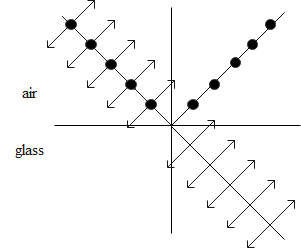
The partial reflection and partial transmission result in the partial polarisation of the light rays where the energy of the light ray gets distributed between the reflected ray and the transmitted ray. The reflected ray gets partially linearly polarized. The direction which the electric field vector vibrates is parallel to the plane of the interface between air and glass.
Polarization results in reduction in the intensity of the light rays since the components of the electric field get removed on polarisation. The intensity is directly related to the magnitude of the electric field vector. Due to this, the intensity of the reflected light is poor compared to the original light ray.
So, the correct answer is “Option B”.
Note:
The electric field vector of unpolarised light vibrates in all directions. The glass slab acts as a polarizer. When the unpolarised light ray is incident on it then the partial reflection and transmission restricts the vibration of these electric field vectors in a certain direction and the reflected and transmitted light rays have electric field vectors vibrating along the linear direction and they become linearly polarized with reduction in intensity.
Complete answer:
We are given a light ray which is unpolarized in nature and is incident on a glass slab as shown in the following diagram.
The partial reflection and partial transmission result in the partial polarisation of the light rays where the energy of the light ray gets distributed between the reflected ray and the transmitted ray. The reflected ray gets partially linearly polarized. The direction which the electric field vector vibrates is parallel to the plane of the interface between air and glass.
Polarization results in reduction in the intensity of the light rays since the components of the electric field get removed on polarisation. The intensity is directly related to the magnitude of the electric field vector. Due to this, the intensity of the reflected light is poor compared to the original light ray.
So, the correct answer is “Option B”.
Note:
The electric field vector of unpolarised light vibrates in all directions. The glass slab acts as a polarizer. When the unpolarised light ray is incident on it then the partial reflection and transmission restricts the vibration of these electric field vectors in a certain direction and the reflected and transmitted light rays have electric field vectors vibrating along the linear direction and they become linearly polarized with reduction in intensity.
Recently Updated Pages
Master Class 12 Economics: Engaging Questions & Answers for Success

Master Class 12 Physics: Engaging Questions & Answers for Success
Master Class 12 English: Engaging Questions & Answers for Success
Master Class 12 Social Science: Engaging Questions & Answers for Success
Master Class 12 Maths: Engaging Questions & Answers for Success
Master Class 12 Business Studies: Engaging Questions & Answers for Success
Trending doubts
Which are the Top 10 Largest Countries of the World?
What are the major means of transport Explain each class 12 social science CBSE
Draw a labelled sketch of the human eye class 12 physics CBSE
Why cannot DNA pass through cell membranes class 12 biology CBSE
Differentiate between insitu conservation and exsitu class 12 biology CBSE
Draw a neat and well labeled diagram of TS of ovary class 12 biology CBSE